Xanthelasma is soft, yellow cholesterol deposits on the eyelids. It rarely goes away by itself, so removal is the way to clear it: laser, surgery, peels or freezing in a clinic, or Xanthel® at home for small to medium plaques. About half of people with xanthelasma have a lipid disorder, so see your doctor about the cause too.
Key Takeaways
- Xanthelasma is cholesterol-filled cells in the eyelid skin, harmless in itself.
- About half of people with it have a lipid disorder, so get a blood test.
- It’s linked with higher heart risk, even when cholesterol is normal.
- It doesn’t usually fade by itself and can slowly grow.
- Clinic removal suits large, deep or lid-edge plaques.
- Xanthel® is made for removing small to medium plaques at home.
On This Page 15 sections
What Is Xanthelasma?
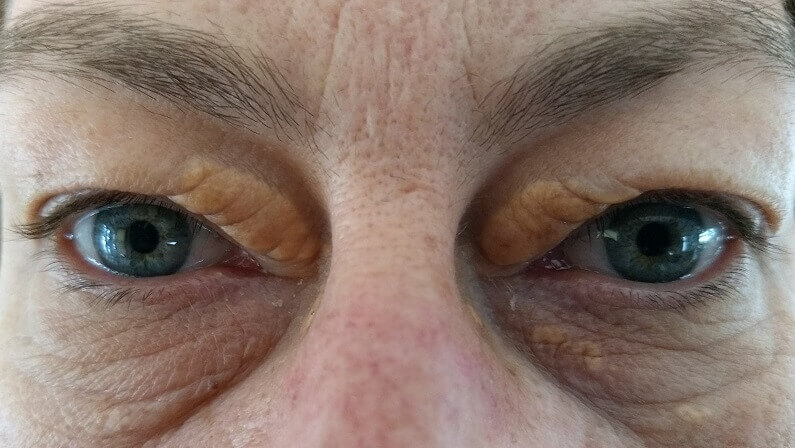
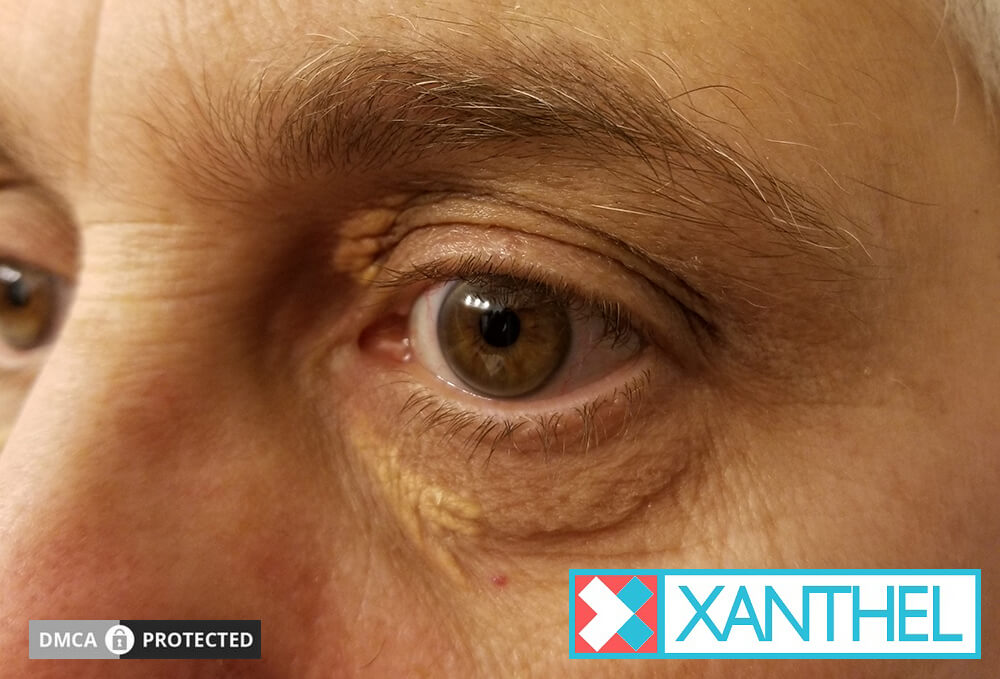
Xanthelasma is soft, yellowish, flat or slightly raised plaques on the eyelids, mostly near the inner corner of the upper lid and often on both sides. They’re made of cholesterol-filled cells in the skin, and they’re harmless in themselves.
Its full medical name is xanthelasma palpebrarum, and it’s the most common type of xanthoma, the family of fatty skin deposits. StatPearls, the clinical reference from the National Library of Medicine, puts it at about 1.1% of women and 0.3% of men, seen from about age 20 to 70 and most often between 35 and 55.[1] The lower lid is involved less often than the upper.[1]
The plaques form when fats leak from small blood vessels in the eyelid skin. Blinking squeezes the tiny vessels there, vessels get leakier with age, and immune cells called macrophages swallow the leaked fat until they become swollen “foam cells” that gather deep in the skin.[1] That’s why the yellow spots on eyelids feel soft and can’t be squeezed out: the fat is inside cells.
Our guides on what xanthelasma is, xanthelasma palpebrarum and what xanthelasma looks like go further, and our complete xanthelasma guide brings it all together.
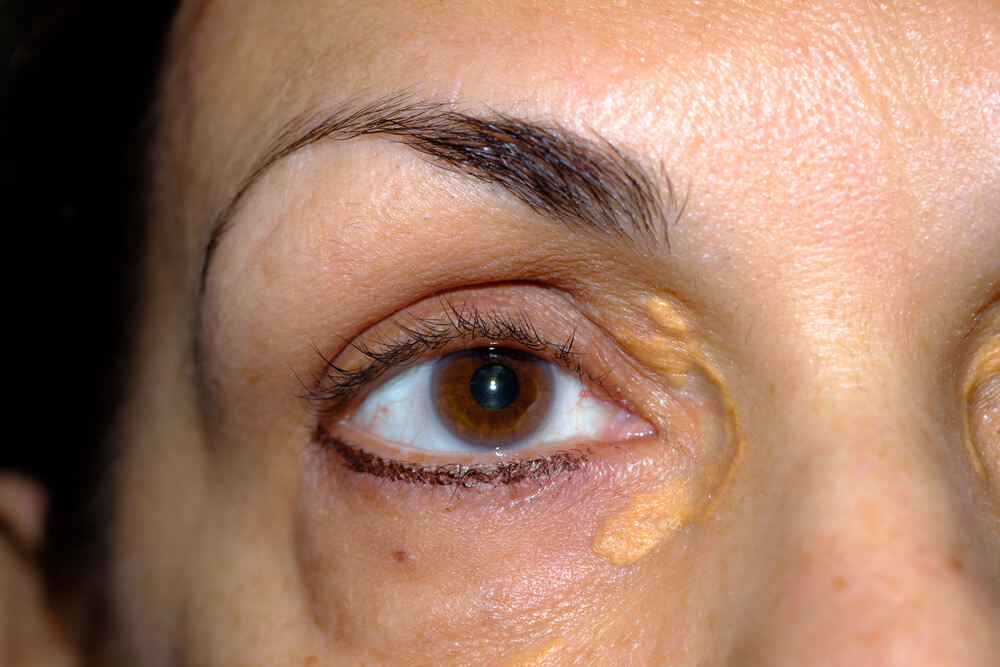
What Causes Xanthelasma?
About half of people with xanthelasma have a primary or secondary lipid disorder, such as raised LDL cholesterol or low HDL. The other half have normal blood fats, and their plaques seem to come from local factors in the eyelid skin.
StatPearls lists the main lipid causes as inherited high cholesterol and triglyceride patterns and low HDL. Secondary causes include diabetes, an underactive thyroid, the liver condition primary biliary cholangitis, kidney problems such as nephrotic syndrome, and taking retinoid or estrogen medicines.[1] In younger people, an inherited lipid disorder should be considered.[1]
That’s why the first step, whatever you decide about the plaques, is a blood test. StatPearls recommends a fasting lipid profile, a liver panel, thyroid tests and a fasting glucose check.[1]
Our causes of xanthelasma guide covers every known cause, and you can read whether xanthelasma is genetic and what foods cause xanthelasma.
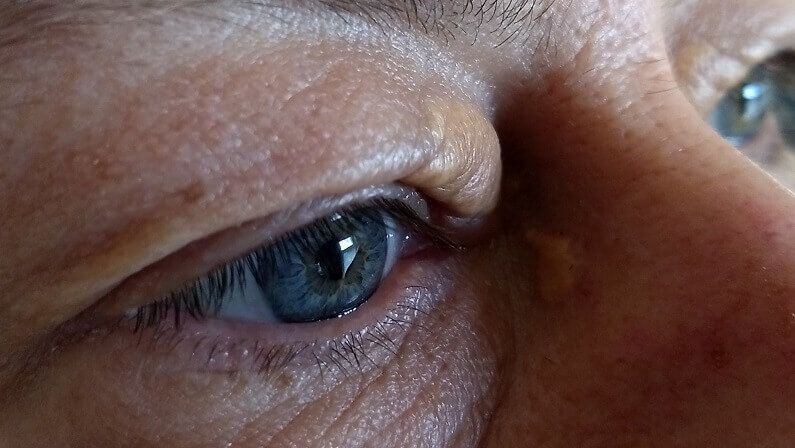
Is Xanthelasma Dangerous?
The plaques themselves are harmless and don’t affect your sight. But xanthelasma is linked with a higher risk of heart disease, so take it as a good reason to get your heart health checked.
In a Copenhagen study that followed almost 13,000 people for decades, those with xanthelasma had a higher risk of heart attack and heart disease, and the link held even after allowing for cholesterol.[2] A 2020 analysis of 15 studies with 854 patients found people with xanthelasma had higher total cholesterol, LDL and apolipoprotein B, lower apolipoprotein A1, and thicker artery walls in the neck than people without it.[3]
None of that means something is wrong with you. It means the plaques are a useful signal, and a doctor’s check turns that signal into a plan. Our pages on whether xanthelasma is dangerous and whether xanthelasma indicates raised cholesterol explain the risks and the tests.

Does Xanthelasma Go Away On Its Own?
Rarely. Xanthelasma doesn’t usually resolve by itself; it tends to stay the same or slowly grow, which is why most people who want it gone look into removal.
StatPearls is clear on this: the plaques typically remain stable or may increase in size.[1] Getting cholesterol under control is good for your heart, but it isn’t a reliable way to make existing plaques disappear, so removal is the practical way to get rid of xanthelasma.
Read more on whether xanthelasma can go away on its own and how fast xanthelasma grows.

What Are The Options For Xanthelasma Removal?
In a clinic: laser, surgery, chemical peels or freezing. At home: a cream made for xanthelasma removal, such as Xanthel®, for typical small to medium plaques. Each route has its own strengths, risks and costs.
A 2023 review of 49 studies found CO2 laser gave more than 75% improvement in over 90% of patients, and erbium (Er:YAG) laser more than 80% improvement. In head-to-head comparisons, CO2 laser did better than both Er:YAG laser and 30 to 50% trichloroacetic acid (TCA) peels. Changes in skin color were the most common complication, and surgery was preferred for larger, deeper plaques.[4]
StatPearls adds the risks to weigh: cutting plaques out can pull the lid out of shape or retract it, and freezing and chemical methods can scar or discolor the skin.[1] Clinic removal is usually paid for privately, so it’s worth checking how much xanthelasma removal costs and whether removal is covered by insurance.
Our removal of xanthelasma guide compares every route in depth, and how xanthelasma is removed explains what happens at each appointment.
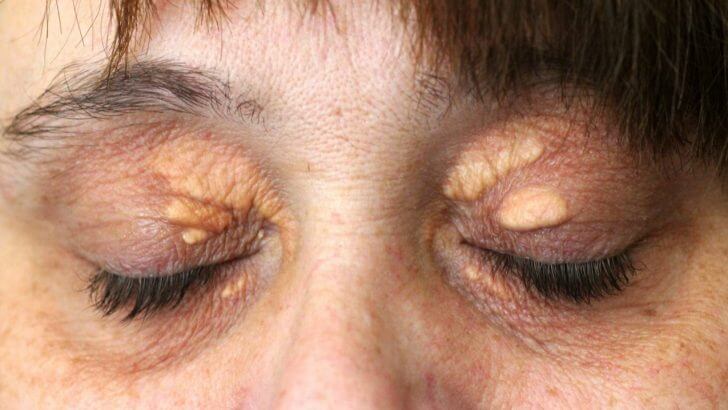
Xanthelasma Removal Options Compared
| Option | Where | Best For | Main Risks | What The Evidence Says |
|---|---|---|---|---|
| Xanthel® | At home | Small to medium plaques on the open lid skin | Redness while healing; keep away from the eye | Cosmetic cream; about one to two weeks of healing; results vary |
| CO2 laser | Clinic | Flat to moderately raised plaques | Skin color change | Over 75% improvement in over 90% of patients |
| Er:YAG laser | Clinic | Flat to moderately raised plaques | Skin color change | Over 80% improvement; behind CO2 in comparisons |
| Surgery | Clinic | Large, deep plaques | Scar; lid pulled out of shape | Preferred for larger, deeper plaques |
| TCA peel | Clinic | Small, flat plaques | Scarring, color change | Behind CO2 laser in comparisons |
| Freezing | Clinic | Small, flat plaques | Scarring, color change | Can scar and discolor eyelid skin |
Can You Remove Xanthelasma At Home?
Yes, for typical small to medium plaques on the open eyelid skin, with a cream made for the job. Xanthel® is a cosmetic cream made for xanthelasma removal at home: one application per plaque, with enough for a second on larger ones, and about one to two weeks of healing.
- See your doctor first. Confirm it’s xanthelasma and have your cholesterol, thyroid, liver and blood sugar checked.
- Prepare the skin. Remove makeup, clean the area and work in good light.
- Apply precisely. Only on the plaque, never near the eye, following the supplied guide.
- Wait and rinse. Leave it for the time the guide states, then rinse it off.
- Look after the skin. Keep it clean, use the recommended antibacterial cream and don’t pick while it heals.
- Protect the new skin. Once healed, use sun protection on the area.
Removal at home means no appointments, no waiting lists and no clinic fees, which is why so many people want it. It isn’t right for every plaque, and we’ll say so: large, deep or lid-edge plaques belong with a specialist. Our page on how to remove xanthelasma at home goes through each step, and our xanthelasma removal cream guide explains how creams compare.

If you’re managing the cause with your doctor and want to deal with the plaques themselves at home, this is the cream we make for xanthelasma.
Who Is Xanthel® Right For?
People with typical small to medium xanthelasma plaques on the open eyelid skin, away from the lash line, whose doctor has confirmed the diagnosis and checked the cause.
Xanthel® Suits
- Small to medium plaques
- Flat or gently raised plaques
- Plaques on the lid skin, not the lash line
- A diagnosis confirmed by a doctor
See A Specialist Instead
- Large, thick or deep plaques
- Plaques at the lid edge or very near the eye
- Any doubt about the diagnosis
- A mark that’s firm, bleeding or changing fast
That second list matters. Other eyelid conditions can look like xanthelasma, from enlarged oil glands to, less often, a type of skin cancer, and StatPearls recommends a skin biopsy when the diagnosis is uncertain.[1] Our guide to what can be mistaken for xanthelasma covers the look-alikes. Xanthel® is for the eyelids only, not for xanthomas elsewhere on the body.

What Home Remedies Should You Avoid?
Garlic, apple cider vinegar, squeezing, cutting and wart-freezing kits. None of them removes xanthelasma, and some have caused burns and scars on the face, right beside the eye.
- Garlic. A review of 39 garlic burn cases found mostly second-degree burns, some leaving scars, especially on the face.[5]
- Apple cider vinegar. It has caused chemical burns when used on skin spots at home, with a risk of scarring and darkening.[6]
- Castor oil. We’ve found no published evidence that it removes xanthelasma.
- Squeezing or popping. The fat sits inside cells deep in the skin, so there’s nothing to push out.
- Wart-freezing kits. Made for thick skin on hands and feet, not for thin eyelid skin.
See why you can’t squeeze out xanthelasma or pop xanthelasma.

Does Xanthelasma Come Back After Removal?
It can, whichever method is used. StatPearls gives recurrence as generally under 50%, rising to around 60% after repeat procedures, and deeper plaques come back more often.
Recurrence is part of the condition, not a failure of any one method.[1] The same eyelid skin keeps the same tendencies, so new plaques can form in the same area or nearby. Anyone who promises removal for good is overpromising.
The best thing you can do is manage what’s behind it: follow your doctor’s advice on cholesterol and any other cause they find. Read more on whether xanthelasma comes back and how to prevent xanthelasma.

Can You Cover Xanthelasma With Makeup?
Yes, while you decide on removal. A color corrector in a lilac or soft purple tone neutralizes yellow, and a creamy concealer matched to your skin on top hides most flat plaques.
Raised plaques are harder to hide, because makeup covers color but not texture, and heavy layers tend to crease on the eyelid. Dab rather than rub, set lightly with powder, and remove it gently at night. Never put makeup on skin that’s healing after any removal method.
Our guides on how to cover xanthelasma with makeup and how to hide xanthelasma with makeup take you through it step by step.

Which Doctor Should You See About Xanthelasma?
Start with your family doctor for the diagnosis and blood tests. For clinic removal, a dermatologist or an eyelid (oculoplastic) surgeon is the usual specialist.
StatPearls says the first assessment usually happens in primary care, ophthalmology or dermatology, and that people who want plaques removed are often referred to a dermatologist or oculoplastic surgeon.[1] If you’d rather remove typical plaques at home, your family doctor’s confirmation of the diagnosis and check of the cause is still the place to begin.
Our pages on what doctor removes xanthelasma and who removes xanthelasma explain the options.

Where Should You Start In Our Xanthelasma Guides?
With the question you have right now. We publish around 155 guides, each answering one question people search for, backed by numbered scholarly sources, and they link to each other so you can go as deep as you like.
- New to it? Read our quick xanthelasma facts.
- Want it gone? Start with how to get rid of xanthelasma.
- Comparing creams? See our xanthelasma cream guide.
- Everything else. Browse every guide in Xanthelasma Guides.
Every guide follows the same rules: answer first, plain English, a numbered source for every medical fact, and an honest word when a clinic would suit you better. You can read more about us or contact us with any question.

What’s The Bottom Line On Xanthelasma Removal?
Xanthelasma is harmless in itself but rarely goes away by itself, and it can point to a lipid disorder or higher heart risk, so see your doctor about the cause first. Then choose your removal route by the plaques: a clinic for large, deep or lid-edge plaques, or removal at home for typical small to medium ones.
Xanthel® is a cosmetic cream made for xanthelasma removal at home, sold by Xanthelasma.com. You’ll find it in the section above and at the foot of this page, or read more about Xanthel® xanthelasma removal cream.
Common Questions About Xanthelasma Removal
What Is The Best Way To Remove Xanthelasma?
It depends on size, depth and position: small to medium plaques on the open lid skin can be removed at home with a cream made for it, while large, deep or lid-edge plaques are best with a dermatologist or eyelid surgeon.
Can Xanthelasma Be Removed At Home?
Yes, typical small to medium plaques can be removed at home with Xanthel®, a cosmetic cream made for xanthelasma removal, once a doctor has confirmed the diagnosis and checked the cause.
Does Xanthelasma Go Away On Its Own?
Rarely; it usually stays the same or slowly grows, so removal is the practical way to clear it.
Is Xanthelasma A Sign Of High Cholesterol?
Sometimes; about half of people with xanthelasma have a lipid disorder, so a blood test is worth having.
Is Xanthelasma Dangerous?
The plaques themselves are harmless, but they’re linked with higher heart risk, so the cause should be checked by a doctor.
Will Xanthelasma Come Back After Removal?
It can; recurrence after removal is generally under 50%, so managing the cause with your doctor matters.
How Much Is Xanthel®?
Xanthel® is $169 with free international delivery.
How Long Does Healing Take After Xanthel®?
About one to two weeks, with one application per plaque and enough for a second on larger ones.
Sources
- Blair K. Xanthelasma Palpebrarum. StatPearls, National Library of Medicine (NCBI Bookshelf), updated 2026.
- Christoffersen M, Frikke-Schmidt R, Schnohr P, Jensen GB, Nordestgaard BG, Tybjaerg-Hansen A. Xanthelasmata, arcus corneae, and ischaemic vascular disease and death in general population: prospective cohort study. BMJ, 2011.
- Chang HC, Sung CW, Lin MH. Serum lipids and risk of atherosclerosis in xanthelasma palpebrarum: a systematic review and meta-analysis. Journal of the American Academy of Dermatology, 2020;82(3):596-605.
- Malekzadeh H, Ormseth B, Janis JE. A Practical Review of the Management of Xanthelasma Palpebrarum. Plastic and Reconstructive Surgery Global Open, 2023;11(5):e4982.
- Hitl M, Kladar N, Gavaric N, Srdenovic Conic B, Bozin B. Garlic burn injuries: a systematic review of reported cases. American Journal of Emergency Medicine, 2021.
- Feldstein S, Afshar M, Krakowski AC. Chemical Burn from Vinegar Following an Internet-based Protocol for Self-removal of Nevi. Journal of Clinical and Aesthetic Dermatology, 2015;8(6).