
Can Xanthelasma Go Away On Its Own
The Honest Answer Is No, Here’s Why, and What to Do Instead
Hoping xanthelasma will fade on its own? The honest answer is that it almost never does. This page explains why waiting will not work, and what actually clears the marks if you want them gone.
By Xanthelasma.com
Can Xanthelasma Go Away On Its Own?
The honest answer is no, xanthelasma almost never goes away on its own. It is a common and understandable hope, the marks appeared without you doing anything, so it feels like they might leave the same way, but that is not how these deposits behave. Once formed, xanthelasma plaques tend to stay put, and over months and years they more often slowly grow or multiply than fade. Waiting for them to disappear is, unfortunately, waiting for something that rarely happens.
That is worth knowing early, because it saves you months of hoping before acting. The good news is that while they will not clear themselves, they can be cleared if you want them gone. This page explains why they do not self-resolve, and what actually works instead. The marks are harmless, so there is no rush, removing them is entirely a cosmetic choice, and the least invasive route is an at-home cream: Xanthel ® is a cosmetic skincare cream formulated to remove xanthelasma plaques at home. Our overview of what xanthelasma is gives the background.
Why It Doesn’t Go Away on Its Own
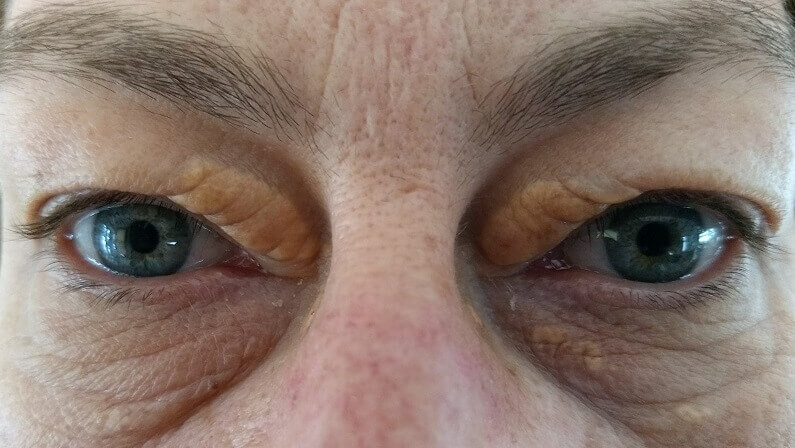
Understanding why xanthelasma is so persistent makes the “no” easier to accept, and it comes down to what the mark actually is. A xanthelasma is a stable build-up of cholesterol-filled cells sitting in the eyelid skin. The body’s clean-up cells (macrophages) that took up the fat have become engorged with it and settled in place; unlike a bruise or a spot, there is no natural process that efficiently clears them away again. So the deposit just stays.
Worse for the “wait and see” hope, the conditions that formed the plaque often persist too. If cholesterol-rich material continues to reach the eyelid skin, the deposit tends to be topped up rather than depleted, which is why xanthelasma so often grows or spreads over time rather than shrinking. This is also why it differs from some skin marks that do fade, those resolve through processes the body actually runs, whereas xanthelasma has no such exit route. It needs to be actively removed. Our page on why xanthelasma occurs explains how the deposit forms.
Will Managing Cholesterol Make It Disappear?
This is the most reasonable follow-up question, since the marks are cholesterol, so surely lowering cholesterol would clear them? It is a fair thought, and managing your cholesterol is genuinely worthwhile, but it usually will not make existing xanthelasma disappear. Lowering blood lipids can slow or reduce the formation of new deposits, and is good for your wider health, but the plaques already sitting in the skin tend to remain even when blood levels improve.
So cholesterol management is best understood as prevention rather than removal: it helps stop new marks and is worth doing for your heart regardless, but it is not a way to clear the ones you have. The same goes for diet, weight, and stopping smoking, all helpful for limiting new deposits, none a reliable way to erase existing ones. This is an important distinction, because hoping a healthier lifestyle alone will dissolve the marks leads to disappointment. If you want existing plaques gone, that takes a removal method. Our page on what xanthelasma indicates covers the cholesterol link.

What Not to Wait For, or Try
Since waiting does not work, it is worth heading off the things people try instead while hoping, because some are useless and some are risky. Do not wait expecting the marks to “run their course”, they have no course to run. And do not try to force them off at home by squeezing, picking, or scratching: the deposit is within the skin, not a spot to be popped, and these only risk infection, scarring, and damage to the delicate eyelid.
Equally, give “natural” home cures a miss. Garlic, castor oil, apple cider vinegar, and similar remedies are widely suggested for making xanthelasma “go away”, but none has good evidence behind it, and applying them near the eye can irritate or chemically burn the thin skin and the eye itself. The eyelid is the wrong place to experiment. The methods that actually clear xanthelasma are the proven ones below, not waiting and not improvised remedies. Our page on whether you can squeeze out xanthelasma explains why force does not work.

What Actually Clears It
Since it will not go on its own, here is what does work, the active removal methods. The clinic options are surgical excision (effective for large plaques, most invasive, with the highest scarring risk), laser (precise, often several sessions), cryotherapy (freezing, quick but with a pigment-change risk), and electrosurgery. These are carried out by a dermatologist or oculoplastic surgeon, tend to be costly, and are rarely covered by insurance since removal is cosmetic.
The least invasive route is an at-home cream. Xanthel ® is a cosmetic skincare cream formulated to remove xanthelasma plaques at home, applied to the plaque so the mark is reduced or removed as the skin heals, without the cost or downtime of a clinic. For typical eyelid xanthelasma it is a reasonable first option. Whichever method you choose, pairing it with a cholesterol check gives the most lasting result, since none changes the underlying tendency. It is worth looking at the at-home removal option or the full range of removal options.


Can Xanthelasma Go Away On Its Own: The Bottom Line
No, xanthelasma almost never goes away on its own. It is a stable deposit of cholesterol-filled cells that the body does not clear, so without intervention it tends to stay the same or slowly grow rather than fade. Managing your cholesterol is worthwhile and can limit new marks, but usually will not erase existing ones, and waiting, squeezing, or “natural” remedies do not work and can cause harm near the eye.
The marks are harmless, so there is no rush, but if you want them gone, that takes active removal, by a clinic procedure or, least invasively, an at-home cream. It is worth looking at the at-home removal option, and reading whether xanthelasma comes back once removed.
Common Questions About Whether Xanthelasma Goes Away
Can xanthelasma go away on its own?
No, it almost never does. Xanthelasma is a stable deposit of cholesterol-filled cells in the eyelid skin that the body does not naturally clear, so without treatment it tends to stay the same or slowly grow over time rather than fade. If you want the marks gone, they need to be actively removed; waiting for them to disappear is not effective.
Why doesn’t xanthelasma disappear by itself?
Because it is a settled build-up of fat-laden cells with no natural process to clear them, unlike a bruise or spot that the body resolves. The conditions that formed the deposit often persist too, so the plaque tends to be topped up rather than depleted. This is why xanthelasma so often grows or spreads over time instead of fading.
Will xanthelasma go away if I lower my cholesterol?
Usually not for existing marks. Lowering cholesterol can slow or reduce the formation of new deposits and is good for your health, but the plaques already in the skin tend to remain even when blood levels improve. Cholesterol management is best seen as prevention of new marks rather than a way to clear the ones you already have.
How long does it take for xanthelasma to go away naturally?
It does not reliably go away naturally at all, so there is no timeframe to wait for. Left alone, xanthelasma typically persists indefinitely and often grows slowly. Rather than waiting for a disappearance that rarely comes, the marks are cleared by active removal, a clinic procedure or an at-home cream, if their appearance bothers you.
Can natural remedies make xanthelasma go away?
There is no good evidence that natural remedies like garlic, castor oil, or apple cider vinegar make xanthelasma go away, and applying them near the eye can irritate or burn the delicate skin. Squeezing or picking the marks does not work either and risks infection and scarring. Proven removal methods, not home cures, are what clear xanthelasma.
Is it safe to just leave xanthelasma alone?
Yes, medically it is fine to leave it. Xanthelasma is benign, painless, and harmless, so there is no health need to remove it, and no harm in leaving it beyond its appearance. The only caveat is that, being cholesterol, it is worth a one-off lipid check with your doctor. Whether to remove it is purely a cosmetic choice.
If it won’t go away, what are my options?
Active removal. The clinic options are surgery, laser, cryotherapy, and electrosurgery, carried out by a dermatologist or oculoplastic surgeon, while the least invasive route is an at-home cosmetic cream. For typical eyelid xanthelasma, a cream is a reasonable first try, with clinic methods reserved for large or stubborn plaques. None requires waiting and hoping.
Will the marks come back after I remove them?
They can, since no removal method changes the underlying tendency to form the deposits, especially if a cause like raised cholesterol is unmanaged. This is where cholesterol management does help, reducing the chance of new marks after removal. Combining removal with managing any underlying cause through your doctor gives the most lasting result.
Xanthel ® is a cosmetic skincare cream made to remove xanthelasma plaques at home, not a medical treatment for any underlying condition. Because xanthelasma does not clear on its own and can occasionally point to lipid, thyroid, or cardiovascular factors, it is worth a simple check with your doctor, who can confirm the diagnosis and give you the full picture of your health.