
What Foods Cause Xanthelasma?
Whether Food Really Causes the Yellow Eyelid Marks, and Which Foods Actually Contribute
No single food directly causes xanthelasma, the marks form from cholesterol in the skin. But foods that push blood cholesterol up, mainly saturated and trans fats, can contribute to the conditions that allow them to form. Here is the honest picture.
By Xanthelasma.com
Do Foods Cause Xanthelasma?
It is worth answering the literal question carefully, because the honest answer is more nuanced than “yes, this food causes it.” No specific food directly creates xanthelasma. The marks are deposits of cholesterol in the eyelid skin, so what food can do is influence your blood cholesterol, and through that, contribute to the conditions in which xanthelasma is more likely to form, especially if you already have a genetic tendency. So diet is a contributing factor working through cholesterol, not a direct cause in the way “eating X gives you the marks” would suggest.
The other half of the honest picture: around half of people with xanthelasma have completely normal cholesterol, which tells you that food and cholesterol are only part of the story, genetics and individual factors matter a great deal too. So for some people diet plays a real role, and for others it plays very little. This page explains which foods contribute and why, and where diet fits. Our sibling page what to eat for xanthelasma covers the foods to favour, and the causes of xanthelasma covers the wider picture. If you would like to clear existing marks, Xanthel ® is a cosmetic skincare cream made for xanthelasma removal at home.
How Food Connects to Xanthelasma
To understand which foods contribute, it helps to see the mechanism, because it is indirect. Certain foods raise LDL (“bad”) cholesterol or lower HDL (“good”) cholesterol in the blood. Over time, raised blood lipids make it more likely that cholesterol-rich material is deposited in tissues, including the eyelid skin, where it shows up as xanthelasma. So the chain is: food influences blood cholesterol, and blood cholesterol influences the likelihood of deposits forming.
This is why “what foods cause xanthelasma” is really “what foods raise the cholesterol that can lead to xanthelasma.” It also explains why diet is not the whole answer: if your cholesterol is already normal (as it is for about half of people with the marks), then dietary fats are not the driver in your case, and a genetic or individual tendency is doing the work instead. Keeping this in mind stops the diet question being overblown, it matters, but it is one factor among several. Our page on whether xanthelasma indicates raised cholesterol covers the cholesterol link, and whether it is genetic covers the inherited side.

The Foods That Contribute Most
With that mechanism in mind, the foods worth limiting are the ones that tend to raise LDL cholesterol, principally those high in saturated and trans fats. Saturated fat is the main one: it is found in fatty and processed meats (bacon, sausages, fatty cuts of beef, pork, and lamb), full-fat dairy (butter, cream, and a lot of cheese), and in many commercial baked goods like cakes, pastries, and biscuits. Some plant oils, coconut and palm oil, are also high in saturated fat despite being plant-based.
Trans fats are worth singling out because they affect cholesterol particularly unfavourably, raising LDL and lowering HDL. They turn up in some processed, fried, and baked products; the label clue is “partially hydrogenated” oils. Beyond specific fats, heavily processed foods, fast food, and high-cholesterol foods eaten in excess (such as a lot of egg yolks, organ meats, or certain shellfish) can also play a part, though for most people dietary cholesterol matters less than saturated and trans fats. The practical move is moderation and swaps, not total elimination. Our what to eat for xanthelasma page covers the healthier alternatives in detail.

What Food Cannot Do
Here is an important limit worth being clear about: while certain foods can contribute to the cholesterol behind xanthelasma, no change of diet will clear a mark that has already formed. Once a xanthelasma plaque is in the skin, cutting out saturated fat does not dissolve it, food influences whether new deposits form, not whether existing ones disappear. So diet is about prevention and reducing the chance of new marks, not about removal.
This is the same honest point that applies to cholesterol management generally: it is worthwhile for preventing new marks and for your overall health, but existing marks need to be removed by a proper method if their appearance bothers you. Expecting an established plaque to fade by eating differently leads to disappointment. The realistic approach pairs the two: eat in a way that supports healthy cholesterol to limit new marks, and remove any existing ones separately. Our pages on how to prevent xanthelasma and whether it comes back cover the prevention side.

Diet, Removal, and the Cholesterol Check Together
Because food contributes to the cause but cannot clear existing marks, the complete approach has three honest parts. First, if you want to reduce the chance of new marks, favour a heart-healthy way of eating (less saturated and trans fat, more fibre, fruit, vegetables, and unsaturated fats) alongside activity, a healthy weight, and not smoking. Second, get a simple cholesterol check with your doctor, this tells you whether raised cholesterol is actually part of your picture, which is what determines how much diet will help your marks at all. Third, remove any existing marks if you wish.
For that removal step, the clinic options (surgery, laser, freezing) work but involve cost, recovery, and a scarring risk near the eye, while the least invasive route is an at-home cosmetic cream made for the purpose. Xanthel ® is a cosmetic skincare cream made for xanthelasma removal at home, applied to the plaque, with the skin healing over one to two weeks. Diet handles the future, removal handles the present, and the cholesterol check tells you how relevant diet is for you. Our pages on how to remove xanthelasma and the xanthelasma removal cream cover the removal side.

What Foods Cause Xanthelasma? The Bottom Line
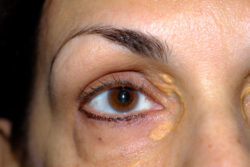
No single food directly causes xanthelasma; the marks are cholesterol deposits in the skin, and food contributes only indirectly, by influencing blood cholesterol. The foods that contribute most are those high in saturated fat (fatty and processed meats, full-fat dairy, butter, commercial baked goods, coconut and palm oil) and trans fats (some processed, fried, and baked products with “partially hydrogenated” oils), with heavily processed and high-cholesterol foods playing a smaller part. But around half of people with xanthelasma have normal cholesterol, so diet is one factor among several, not the whole story.
Crucially, while diet can help prevent new marks, it will not clear existing ones, those need removal. If you would rather avoid a clinic, xanthelasma removal at home with a cream made for the purpose is the least invasive route, and a cholesterol check with your doctor tells you how much diet matters in your case. Our is xanthelasma common and treating xanthelasma pages cover more.

Common Questions About Foods and Xanthelasma
What foods cause xanthelasma?
No single food directly causes it, the marks are cholesterol deposits in the skin. But foods that raise blood cholesterol can contribute, mainly those high in saturated fat (fatty and processed meats, full-fat dairy, butter, commercial baked goods, coconut and palm oil) and trans fats (some processed and fried foods). They work indirectly, by affecting the cholesterol that can lead to deposits forming.
Does eating fatty food give you xanthelasma?
Not directly. Fatty food, particularly saturated and trans fats, can raise blood cholesterol, which over time makes cholesterol deposits like xanthelasma more likely, especially with a genetic tendency. But it is an indirect contribution, not a direct cause, and around half of people with xanthelasma have normal cholesterol, so diet is only part of the picture.
Can changing what I eat get rid of xanthelasma?
No. Diet can help prevent new marks by supporting healthy cholesterol, but it will not dissolve a plaque already in the eyelid skin. Existing marks need to be removed by a proper method. So food is about prevention and general health, while removal deals with marks you already have, the two work together.
Does diet matter if my cholesterol is normal?
For the marks, probably not much. Around half of people with xanthelasma have normal cholesterol, so if that is you, dietary fats were not the driver, and changing them is unlikely to affect the marks. A heart-healthy diet is still good for your general health, though. A simple lipid test tells you whether cholesterol is part of your picture.
Are eggs bad for xanthelasma?
Egg yolks are high in dietary cholesterol, so very high intake can play a small part, but for most people saturated and trans fats affect blood cholesterol more than dietary cholesterol does. Eggs can be part of a balanced diet in moderation. If you have raised cholesterol, your doctor or a dietitian can advise on what is sensible for you.
What foods should I limit to prevent xanthelasma?
Limit foods high in saturated fat (fatty and processed meats, full-fat dairy, butter, pastries and cakes, coconut and palm oil) and trans fats (processed, fried, and baked goods with “partially hydrogenated” oils). Cutting back on heavily processed and fast foods helps too. It is about moderation and healthier swaps rather than total elimination.
Is xanthelasma caused by a bad diet?
Not solely, and not always. Diet can contribute through its effect on cholesterol, but xanthelasma also forms in people with normal cholesterol and good diets, because genetics and individual factors play a large role. So while a diet high in unhealthy fats can be a contributing factor, it is not the whole cause, and a healthy diet does not guarantee you will avoid the marks.
Xanthel ® is a cosmetic skincare cream made for xanthelasma removal at home, not a medical treatment for any underlying condition, so it addresses the appearance of the xanthelasma rather than any underlying cause. The marks themselves are benign, but because xanthelasma can sometimes signal raised cholesterol or another lipid issue, it is worth seeing your doctor for a simple check.