
What Is Xanthomas?
A Plain Guide to Cholesterol Deposits in the Skin, Their Types, and What They Signal
Xanthomas are cholesterol deposits that build up in the skin as waxy bumps or patches. This guide explains what they are, how they form, the different types, and what their appearance can tell you about your health.
By Xanthelasma.com
What Are Xanthomas?
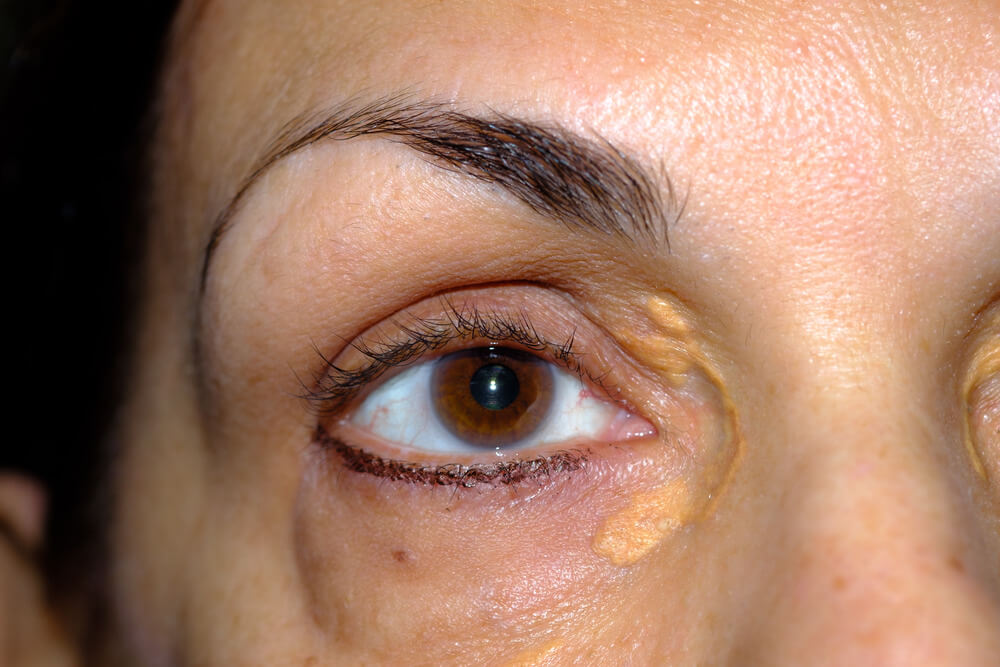
Xanthomas are skin lesions formed by deposits of lipids, mainly cholesterol, beneath the skin. They typically appear as raised, waxy bumps or flatter patches, and can be skin-coloured, pink, or yellow. They can develop in various places, the trunk, arms, legs, tendons, and around the eyes, and range from tiny to sizeable, sometimes merging into larger patches. While the lesions themselves are benign, they often signal an underlying issue with how the body handles fats.
The word covers a family of related deposits rather than a single condition, which is why their significance varies a lot depending on the type and location. The most familiar type to most people is xanthelasma, the soft yellow form on the eyelids. This guide explains the whole family and what each can mean. If your interest is specifically the eyelid form and removing it, Xanthel ® is a cosmetic skincare cream made for xanthelasma removal at home, intended for the eyelid type only. Our xanthomas overview and the page on what a single xanthoma is cover related ground.

How Xanthomas Form
Understanding how xanthomas form makes their significance clearer. The process starts with lipids in the bloodstream. When cholesterol or triglyceride levels are abnormal, or sometimes simply due to local factors in the skin, fatty material can be deposited in the tissue. The body’s immune cells, called macrophages, move in and engulf this material, becoming swollen and foamy, hence their name, “foam cells.”
As these lipid-laden foam cells accumulate and cluster together, they form the visible plaque or nodule we recognise as a xanthoma. This is why xanthomas are so closely tied to lipid levels: they are, in effect, cholesterol made visible in the skin. It also explains why their appearance can be a useful clue to underlying conditions like high cholesterol, inherited lipid disorders, diabetes, or thyroid problems, and why a doctor will usually want to check lipid levels when xanthomas appear. Our page on skin xanthomas and xanthoma on the skin go further into how they sit in the skin.

The Different Types of Xanthomas
The family of xanthomas is grouped by where they appear and what they look like, and the type matters because it points to different things. The main types are: eruptive xanthomas, small yellowish-red bumps that erupt in crops, often on the buttocks, shoulders, or limbs, and frequently linked to very high triglycerides; tendon xanthomas, firm lumps over tendons such as the Achilles, strongly associated with inherited high cholesterol; and tuberous xanthomas, firm painless nodules over pressure points like the elbows and knees, again tied to high cholesterol.
Then there are plane xanthomas, flat patches that can appear in various places; palmar xanthomas, yellowish deposits in the creases of the palms that point to specific lipid disorders; and xanthelasma, the soft yellow plaques on the eyelids, which is the most common and most often a cosmetic concern. Each type carries slightly different implications, which is why identifying which one you have matters. Our dedicated pages cover eruptive xanthoma, tendon xanthomas, tuberous xanthoma, plane xanthoma, and palmar xanthoma individually.

What Xanthomas Can Signal
Because xanthomas are made of cholesterol, their main importance, beyond appearance, is as a visible clue to your lipid health. Most types are associated with lipid abnormalities such as raised LDL cholesterol or triglycerides, and some are strongly linked to inherited conditions like familial hypercholesterolemia. They can also be associated with diabetes, an underactive thyroid, or liver conditions that affect how the body processes fats. In the case of very high triglycerides, eruptive xanthomas can even flag a risk of pancreatitis.
This is why the appearance of xanthomas (other than a clearly cosmetic eyelid mark) is treated by doctors as a prompt for a lipid blood test and a wider health check, since catching a lipid disorder early benefits your cardiovascular health. There is one important exception worth keeping in proportion: xanthelasma, the eyelid type, can occur with raised cholesterol but around half of people who have it have completely normal cholesterol. So while the systemic types are firmly a medical matter, eyelid xanthelasma is often simply cosmetic. Our page on what causes the cholesterol deposits around the eyes covers the eyelid link.

How Xanthomas Are Diagnosed and Managed
If you have what looks like a xanthoma, a doctor can usually recognise it on sight, sometimes confirming with a small skin biopsy, and will typically arrange a lipid profile blood test, and possibly glucose, thyroid, or liver tests, to look for an underlying cause. They may also distinguish it from look-alike conditions such as lipomas or other skin lesions. The purpose is not just to label the lump but to identify any treatable lipid disorder behind it.
Management follows from the type. For the systemic types, the priority is treating the underlying lipid disorder with diet, lifestyle, and lipid-lowering medication where appropriate, with lesion removal a secondary step. For the eyelid type, xanthelasma, which is usually cosmetic, removal is more often the main goal, and the least invasive route is an at-home cosmetic cream made for the purpose; the systemic types should not be self-treated. Whatever the type, managing the underlying lipids is the foundation. Our guide to xanthoma treatment and the page on what can be mistaken for xanthelasma cover these further.


What Is Xanthomas? The Bottom Line
Xanthomas are benign skin deposits of cholesterol and other lipids, appearing as waxy bumps or patches, and they form when lipid-laden foam cells accumulate in the skin. They come in several types, eruptive, tendon, tuberous, plane, palmar, and the eyelid form (xanthelasma), and the type matters because most signal an underlying lipid issue worth checking, while eyelid xanthelasma is often simply cosmetic.
For any xanthoma other than a clearly cosmetic eyelid mark, the sensible step is to see your doctor for a lipid check and assessment. If your concern is the eyelid type specifically and you would rather avoid a clinic, xanthelasma removal at home with a purpose-made cream is the least invasive route, intended for that type alone. Our xanthomas overview and the causes of xanthelasma give more detail.
Common Questions About Xanthomas
What is a xanthoma?
A xanthoma is a benign skin lesion formed by a deposit of cholesterol-rich material under the skin, appearing as a waxy bump or patch that can be skin-coloured, pink, or yellow. Xanthomas form when lipid-laden immune cells (foam cells) accumulate in the skin, and they often signal an underlying issue with lipid metabolism.
What is the difference between a xanthoma and xanthelasma?
Xanthoma is the general term for cholesterol deposits in the skin, which can appear in several forms around the body. Xanthelasma is one specific type, the soft yellow plaques that form on the eyelids. So all xanthelasma are xanthomas, but not all xanthomas are xanthelasma. The eyelid type is usually cosmetic, while other types more often signal lipid disorders.
Are xanthomas dangerous?
The lesions themselves are benign and not cancerous. Their importance is what they can signal, since most types are linked to lipid abnormalities that raise cardiovascular risk, and some to conditions like diabetes or, with very high triglycerides, pancreatitis. So while the bumps are harmless, they are an important prompt for a medical check of your lipids and overall health.
What causes xanthomas?
They are caused by lipids, mainly cholesterol, accumulating in the skin, usually driven by raised blood lipid levels. Causes include high cholesterol or triglycerides, inherited lipid disorders like familial hypercholesterolemia, and conditions such as diabetes, hypothyroidism, or liver disease. Genetic and lifestyle factors both play a role.
What are the different types of xanthomas?
The main types are eruptive xanthomas (small crops of bumps, often with high triglycerides), tendon xanthomas (over tendons, linked to inherited high cholesterol), tuberous xanthomas (firm nodules over joints), plane xanthomas (flat patches), palmar xanthomas (in the palm creases), and xanthelasma (soft yellow plaques on the eyelids), the most common and usually cosmetic type.
Do xanthomas mean I have high cholesterol?
Often, yes, for most types, since they are made of cholesterol and commonly reflect raised lipids or an inherited lipid disorder. The notable exception is eyelid xanthelasma, where around half of people have normal cholesterol. A lipid blood test is the way to know for sure, which is why a medical check is recommended when xanthomas appear.
Can xanthomas be removed?
Yes, though approach depends on the type. For most types, managing the underlying lipid disorder comes first, with lesion removal (surgery or laser) secondary. For the eyelid type, xanthelasma, removal is more often the main goal and can be done in a clinic or, least invasively, with an at-home cream made for the purpose. The systemic types should be managed by a doctor.
Should I see a doctor about a xanthoma?
Yes, for any xanthoma other than a clearly cosmetic eyelid mark, because most types signal a lipid disorder that needs assessment. Even for eyelid xanthelasma, a simple lipid check is worthwhile. A doctor can confirm the type, run blood tests, and identify any underlying cause that benefits from management.
Xanthel ® is a cosmetic skincare cream made for xanthelasma removal at home, intended for the eyelid type and not for the systemic xanthoma types, which need medical care. Whatever the lesion, it is worth seeing your doctor, since xanthomas can sit alongside lipid, thyroid, or cardiovascular factors worth identifying and managing for your wider health.