The Growth Timeline Explained: How Xanthelasma Starts, How Quickly It Widens, What Speeds It Up, What Fast Change Means, And Why Removing It Small Makes Sense
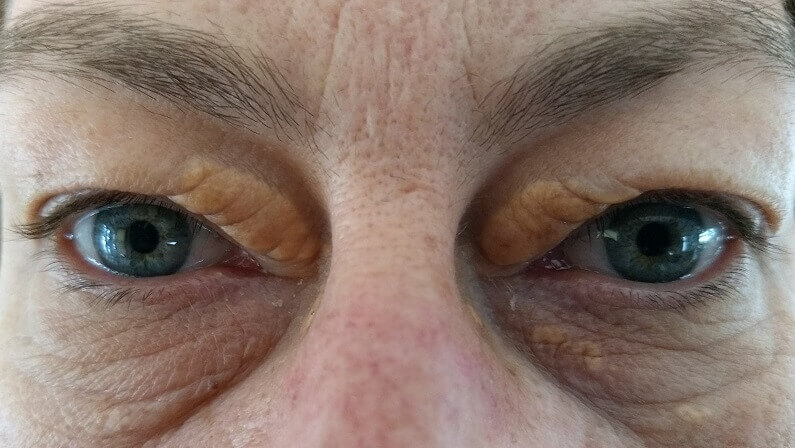
Xanthelasma grows slowly, usually over months to years rather than days or weeks. It tends to start as a small yellow spot near the inner corner of the eyelid, then widens, thickens or gains new patches that can join up, and it rarely shrinks by itself. Anything that appears or changes within days or weeks deserves a doctor’s look, because it may be something else.
Xanthelasma grows slowly, over months and years. A small yellow spot at the inner corner of the eyelid may widen, thicken or be joined by new patches, while some plaques stay the same for years. It rarely fades by itself. Yellow spots that appear or change within days or weeks should be checked by a doctor.
Key Takeaways
- Xanthelasma grows over months to years, not days or weeks.
- The pace varies: some plaques widen steadily, others barely change.
- It rarely fades by itself once it has formed.
- About half of people with it have a lipid disorder that can feed growth.
- Sudden crops of yellow bumps or fast-spreading patches need a doctor.
- Deeper, longer-standing plaques are more likely to come back after removal.
On This Page 15 sections
How Fast Does Xanthelasma Grow?
Slowly. Most people notice change over months or years, often only by comparing old photos. A plaque may widen a few millimeters, thicken a little or be joined by a new spot, and the pace differs a lot from person to person.
Xanthelasma is a build-up of cholesterol-filled immune cells, called foam cells, in the eyelid skin.[1] Those cells collect gradually as fat-carrying particles seep out of tiny blood vessels and are swallowed, so the plaque grows at the pace of that slow accumulation, not overnight. StatPearls, the National Library of Medicine’s clinical reference, notes the condition is seen from about age 20 to 70 and most often between 35 and 55, which fits a process that unfolds across adult life.[1]
No study has measured a typical growth rate in millimeters per year, so beware of anyone who quotes one. What doctors agree on is the pattern: slow, steady or stop-start, and rarely reversing. Our page on whether xanthelasma can get bigger looks at size in more detail.
How Does Xanthelasma Start?
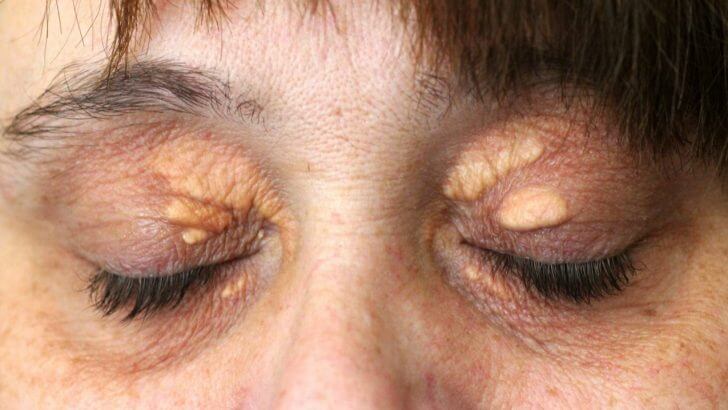
As a small, soft, flat yellow spot, usually on the upper eyelid near the inner corner. At first it can be easy to mistake for a smudge of makeup or a shadow.
- Squeeze. Every blink compresses the tiny capillaries in the eyelid.[1]
- Leak. With age the vessels grow leakier, letting cholesterol-carrying particles escape.[1]
- Swallow. Immune cells called macrophages take up the fat and become foam cells.[1]
- Gather. Foam cells cluster around the vessels in the deeper skin layer.
- Show. Once enough have built up, a pale yellow spot appears on the surface.
By the time you can see it, the process has been going on beneath the skin for some time. Our pages on how xanthelasma starts and how xanthelasma forms explain each step.

What Is The Typical Growth Timeline For Xanthelasma?
There’s no fixed schedule, but a common pattern runs from a faint spot, to a clearer plaque over the first months, to slow widening, thickening or new patches over the following years. Many people find it reaches a size and then changes little.
- First signs. A faint, flat, pale yellow mark at the inner corner of one or both upper lids.
- The first months. The mark becomes clearer, with a defined edge, and you start to notice it in the mirror.
- The first year or two. It may widen along the lid, grow slightly raised, or a second spot may appear nearby or on the other eye.
- Longer term. Neighboring spots can join into a band; some plaques extend toward the lower lid; others stay put.
- Settled stage. Many plaques reach a size and then change very little for years.
StatPearls describes the plaques as tending to stay the same or slowly progress, and rarely resolving by themselves.[1] Our page on what xanthelasma looks like shows plaques at different stages.

Does Xanthelasma Keep Growing, Or Does It Stop?
It can do either. Some plaques keep widening slowly for years, while others plateau and stay the same. What they very rarely do is shrink or disappear by themselves.
The fat in xanthelasma is held inside living cells woven into the deeper layer of the skin, so the body doesn’t simply clear it.[1] Even when blood fats come down with diet or medicine, StatPearls notes that lowering lipids may do little for plaques that have already formed.[1]
So a plaque that has stopped growing is likely to stay at that size until it’s removed. Our page on whether xanthelasma can go away on its own looks at the rare exceptions.

Does Xanthelasma Spread?
Only around the eyelids. New plaques can appear on the other eye, on the lower lid, or beside an existing spot, and neighboring plaques can merge. It isn’t contagious and doesn’t spread to the rest of the body.
- Both eyes. Plaques often appear on each side, sometimes in a matching pattern.[1]
- Upper and lower lids. Upper lids most often, lower lids too.[1]
- Merging. Small spots can join into a wider band along the lid.
- Not to the body. Yellow lumps on tendons, elbows or palms are other types of xanthoma, not spread from the eyelid.
“Spreading” around the lids is the same slow growth process happening in more than one place. Our guides on whether xanthelasma spreads and to the different types of xanthomas explain the difference.

What Makes Xanthelasma Grow Faster?
Anything that puts more cholesterol-carrying particles into the blood or makes the eyelid vessels leakier. That means lipid disorders first, plus conditions and medicines that raise blood fats.
Lipid Disorders
- High LDL cholesterol (type IIa)
- High cholesterol and triglycerides (type IIb)
- High triglycerides (type IV)
- Low HDL, the protective cholesterol
Other Contributors
- Diabetes and an underactive thyroid
- Primary biliary cholangitis, a liver condition
- Nephrotic syndrome, a kidney condition
- Taking retinoid or estrogen medicines
That list follows StatPearls, which reports a primary or secondary lipid disorder in about half of people with xanthelasma.[1] The other half have normal blood fats, and their plaques can still grow, so local factors in the eyelid skin seem to matter as well. Our guide to the causes of xanthelasma covers each one, and our page on whether xanthelasma indicates raised cholesterol explains the blood tests.

Why Can Xanthelasma Start Young Or Grow Faster In Some Families?

Because an inherited lipid disorder can push cholesterol high from birth. Familial hypercholesterolemia is the best-known example, and it can bring xanthelasma and tendon lumps from a young age.
GeneReviews, the National Library of Medicine’s genetics reference, puts familial hypercholesterolemia at about 1 in 250 to 1 in 500 people, passed on with a 50% chance to each child.[3] It can cause xanthelasma and lumps on the Achilles tendons, elbows, hands and knees, and without care about half of affected men had a heart event by 50; statins are the first-line medicine.[3]
StatPearls advises considering an inherited lipid disorder whenever xanthelasma appears in a young person.[1] If your plaques started in your twenties or early thirties, or run in your family, get your cholesterol checked promptly. Our page on whether xanthelasma is genetic explains more.

How Can You Track Whether Your Xanthelasma Is Growing?
Take a clear photo every month or two in the same light, at the same distance, with your eyes in the same position. Change is easier to see side by side than in the mirror.
- Same setup. Daylight from a window, no makeup, phone at arm’s length.
- Two angles. Eyes open looking ahead, and eyes gently closed to show the upper lid.
- Add a scale. A small ruler held below the eye makes widening easier to judge.
- Keep notes. Date, any new spots, and whether a plaque feels softer, firmer or more raised.
- Compare. Look at photos months apart rather than week to week.
Bring the photos to your doctor. A plaque that has stayed the same for a year is reassuring, while one that changed fast, became firm or bled needs a closer look.

What Does It Mean If Yellow Spots Appear Or Grow Fast?
Fast change isn’t typical of xanthelasma, so it’s worth a prompt check. Sudden crops of small yellow bumps can be eruptive xanthomas from very high triglycerides, and widespread flat yellow patches can be plane xanthoma, which sometimes signals a blood disorder.
Eruptive xanthomas can appear when triglycerides rise above 1,000 mg/dL, often with uncontrolled diabetes, and at that level the risk of pancreatitis rises too.[4] Diffuse plane xanthoma, flat yellow patches spreading beyond the eyelids in people with normal blood fats, has been linked with monoclonal gammopathy, an abnormal protein made by blood cells.[5]
Any eyelid spot that is firm, pearly, bleeding, crusting or ulcerated should also be checked, because rarely a skin cancer can appear on the lid. Our pages on eruptive xanthoma, plane xanthoma and what can look like xanthelasma help you tell them apart.

Slow Or Fast: Yellow Spots Compared
| Condition | How Fast | Look | Where | What To Do |
|---|---|---|---|---|
| Xanthelasma | Months to years | Soft, flat or slightly raised yellow plaques | Eyelids, inner corners | Blood tests; remove if you wish |
| Eruptive xanthoma | Sudden crops | Small yellow bumps, often with a red rim | Buttocks, arms, legs | See a doctor promptly for triglycerides |
| Plane xanthoma | Can spread widely | Flat yellow patches | Eyelids, neck, trunk, skin folds | Doctor’s check, including blood proteins |
| Milia | Weeks | Tiny hard white beads | Around the eyes and cheeks | Harmless; a doctor can remove |
| Skin cancer (rare) | Grows and changes | Firm, pearly, bleeding or ulcerated | Often the lower lid | See a doctor promptly |
Can You Slow Down Xanthelasma Growth?
You may be able to slow new growth by managing any lipid problem, but that rarely shrinks plaques that are already there. Heart-healthy habits and, where needed, cholesterol-lowering medicine are the main tools.
StatPearls recommends lifestyle changes and lipid-lowering medicines where a lipid disorder is found, while noting their limited effect on established plaques.[1] The bigger reason to act is your heart: in a study of almost 13,000 people followed for decades, xanthelasma was linked with a higher risk of heart attack and heart disease, independent of cholesterol.[6]
- Get a fasting lipid profile, plus liver, thyroid and glucose tests.[1]
- Follow your doctor’s plan for any lipid, thyroid or blood sugar problem.
- Eat less saturated fat, stay active and don’t smoke.
- Review medicines such as retinoids or estrogens with your doctor.
Our pages on how to stop xanthelasma from growing and how to prevent xanthelasma go into the details.

Should You Remove Xanthelasma While It’s Small?
There’s no medical urgency, but there are good reasons not to wait too long. Small, flat plaques are simpler to remove, and StatPearls notes that deeper plaques are more likely to come back after removal.
Recurrence after removal is generally under 50%, rising to around 60% after repeat procedures, and higher for deeper plaques.[1] A 2023 review of 49 studies found laser worked well on many plaques, with CO2 laser giving more than 75% improvement in over 90% of patients, while larger, deeper plaques were better suited to surgery.[2] Surgery on big plaques takes more of the thin eyelid skin, and StatPearls warns that removing too much can pull the lid out of shape.[1]
Our guides to how to remove xanthelasma, which specialists can remove it and whether xanthelasma can come back help you choose a route.

If your doctor has checked the cause and you’d like to deal with your plaques before they grow, without clinic appointments, this is the cream we make for small to medium eyelid plaques. Our xanthelasma removal cream guide explains how it compares.
When Should You See A Doctor About A Growing Xanthelasma?
Once when you first notice it, for the diagnosis and blood tests. Go promptly if spots appeared suddenly or in crops, are spreading beyond the eyelids, are firm, painful or bleeding, or if you’re young or have tendon lumps.
- Sudden crops of yellow bumps. Possible very high triglycerides.[4]
- Patches spreading beyond the lids. Possible plane xanthoma.[5]
- Young age or tendon lumps. Possible inherited lipid disorder.[3]
- Firm, bleeding or ulcerated spots. Rule out other skin conditions.
Take your photo record and a list of your medicines. Once the check is done and any cause is in hand, you don’t need ongoing care for slow, typical plaques; whether and when to remove them is your choice.

What’s The Bottom Line On How Fast Xanthelasma Grows?
Xanthelasma grows slowly, over months to years, starting as a small yellow spot at the inner corner of the eyelid and sometimes widening, thickening or gaining new patches. It can plateau but rarely fades by itself. Lipid problems can feed growth, so get your blood tests, and see a doctor promptly about anything that appears or changes fast. Removing plaques while they’re small is often simpler.
Xanthel® is a cosmetic cream made for xanthelasma removal at home, sold by Xanthelasma.com. You’ll find it in the removal section above and at the foot of this page, or read more about Xanthel® for removing xanthelasma before it grows. For everything else, browse all our xanthelasma guides.
Common Questions About How Fast Xanthelasma Grows
How Fast Does Xanthelasma Grow?
Slowly, over months to years, and the pace varies a lot from person to person.
Can Xanthelasma Appear Overnight?
No, it builds up gradually, so yellow spots that appear within days are more likely something else and should be checked.
Does Xanthelasma Keep Getting Bigger?
Not always; some plaques widen slowly for years, while others reach a size and stay the same.
Will Xanthelasma Stop Growing On Its Own?
It may plateau, but it very rarely shrinks or disappears without removal.
What Makes Xanthelasma Grow Faster?
Lipid disorders, diabetes, an underactive thyroid, some liver and kidney conditions, and retinoid or estrogen medicines can all add to growth.
Does Xanthelasma Spread To Other Parts Of The Body?
No, it only appears around the eyelids; yellow lumps elsewhere are other types of xanthoma.
Can Lowering Cholesterol Shrink Xanthelasma?
Rarely; it protects your heart and may slow new plaques, but existing plaques usually stay.
Should I Remove Xanthelasma Before It Grows?
There’s no medical urgency, but small plaques are simpler to remove and deeper ones are more likely to come back.
Sources
- Blair K. Xanthelasma Palpebrarum. StatPearls, National Library of Medicine (NCBI Bookshelf), updated 2026.
- Malekzadeh H, Ormseth B, Janis JE. A Practical Review of the Management of Xanthelasma Palpebrarum. Plastic and Reconstructive Surgery Global Open, 2023;11(5):e4982.
- Ison HE, Clarke SL, Knowles JW. Familial Hypercholesterolemia. GeneReviews, National Library of Medicine (NCBI Bookshelf), revised 2025.
- Mishra C, Tripathy K. Lipemia Retinalis. StatPearls, National Library of Medicine (NCBI Bookshelf), updated 2026.
- Szalat R, et al. Pathogenesis and treatment of xanthomatosis associated with monoclonal gammopathy. Blood, 2011.
- Christoffersen M, Frikke-Schmidt R, Schnohr P, Jensen GB, Nordestgaard BG, Tybjaerg-Hansen A. Xanthelasmata, arcus corneae, and ischaemic vascular disease and death in general population: prospective cohort study. BMJ, 2011.