
Why You Might Have Developed Those Yellow Eyelid Marks, and What You Can Do About Them
If you have spotted soft yellow patches near your eyes and are wondering why they appeared, this page explains what causes xanthelasma, what it can signal about your health, and the simplest way to clear the visible marks at home.
By Xanthelasma.com
Why Me?
If you have noticed yellow growths on or near your eyelids, you are most likely looking at xanthelasma, a buildup of cholesterol under the skin that forms flat or slightly raised patches. The first thing worth saying is that this is not your fault and it is not dangerous in itself. It tends to appear between the ages of 35 and 55, and plenty of people who develop it are otherwise perfectly healthy.
The second thing worth knowing is that you are not stuck with it. The marks rarely fade on their own, but they can be removed, and the at-home route is straightforward. Xanthel ® is a cosmetic skincare cream formulated to remove xanthelasma plaques at home, which means you do not have to live with them or book an expensive clinic procedure. The rest of this page explains why you got them and when to check in with your doctor, but keep that in mind as you read: there is a simple answer to the “how do I get rid of these” question. Our overview of what xanthelasma is is a good starting point if the term is new to you.

Cholesterol and Your Skin
Xanthelasma is made of cholesterol, so it can sometimes be a visible clue about the fats in your blood. In some people the marks go hand in hand with raised cholesterol, which is worth knowing because high cholesterol is a risk factor for heart disease. That is the one genuinely useful health signal these marks can carry.
But, and this matters for not worrying yourself unnecessarily, a large share of people with xanthelasma have completely normal cholesterol. Roughly half of those who get it do not have raised lipids at all, so the marks are often down to genetics or a personal tendency rather than a cholesterol problem. The sensible step is simple: a quick lipid blood test from your doctor tells you which camp you are in. If your cholesterol is fine, you can treat the marks as the purely cosmetic issue they are. If it is raised, you have caught something useful early. Either way, our piece on what causes xanthelasma digs deeper into the triggers.
Xanthomas and Systemic Disease
Xanthelasma is the eyelid-specific member of a wider family called xanthomas, which are cholesterol deposits that can form elsewhere on the body too. Because they are linked to how your body handles fats, they can occasionally point to underlying conditions worth ruling out, mainly raised blood lipids (hyperlipidemia), diabetes, or an underactive thyroid.
This is not a reason to panic, it is a reason to get one simple set of checks. If you have xanthelasma, it is reasonable for your doctor to check your lipids, blood sugar, and possibly thyroid function, especially if these conditions run in your family. Most of the time these come back fine, but the check is quick and worth doing. The broader family of these deposits is covered in our page on xanthomas if you want the fuller picture. Remember the split that runs through all of this: the underlying health side is your doctor’s job, and the visible mark on your eyelid is a separate, cosmetic matter you can deal with on its own.

The Look of Xanthelasma
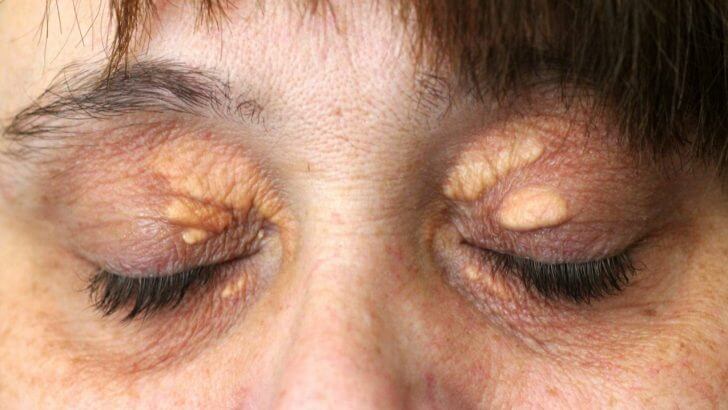
Xanthelasma is usually easy to recognize. It shows as yellowish patches on the upper or lower eyelids, most often near the inner corner closest to the nose, and it tends to appear on both eyes in a roughly symmetrical way. The texture can be soft or firmer, the marks are generally painless, and they can range from very small to fairly large, slowly growing over time if nothing is done.
If what you are seeing matches that description, a doctor can confirm it on sight, often without any tests beyond a possible lipid panel to check what is happening underneath. Once you know it is xanthelasma, the practical question becomes what to do about how it looks, since it will not disappear by itself and tends to spread or enlarge if left. Our look at how common xanthelasma is may also reassure you that you are far from alone in dealing with it.

The Significance of Lipid Levels
To pull the cholesterol question together, because it is the one most people fixate on: xanthelasma can be a sign of high lipids, it often runs alongside an inherited tendency to high cholesterol, but it absolutely can occur in people with normal cholesterol too. So having xanthelasma does not automatically mean your cholesterol is high.
That is why a comprehensive lipid panel is the sensible move if you develop the marks. It measures your total cholesterol, your LDL and HDL, and your triglycerides, and the results tell you and your doctor whether the marks are tied to raised lipids or whether you are among the many people whose cholesterol is normal. For anyone who does turn out to have high cholesterol, managing it protects your heart, which matters far more than the marks themselves. But, and this is the key practical point, managing your cholesterol does not reliably clear the plaques already on your eyelids. Those usually need direct removal, which is exactly the gap our at-home removal cream is built to fill.

Psychological and Social Impact
It is easy to dismiss xanthelasma as “just cosmetic,” but a visible mark on your face affects people more than that phrase suggests. Many people with xanthelasma feel self-conscious in photos, in meetings, or in close conversation, and some catch themselves angling their face away from others. Those feelings are completely valid, and wanting the marks gone is a perfectly reasonable response, not vanity.
Concealer can help as a temporary cover, and leaning on friends or family for support makes a difference, but most people ultimately want the marks actually gone rather than hidden each morning. That is the everyday problem the cosmetic cream we make is designed to solve: clearing the eyelid plaques at home so you can stop thinking about them and feel like yourself again. You do not need a clinic, and you do not need to put up with them.

Treatment Options for Xanthelasma
When it comes to clearing xanthelasma, there are a few routes, and they differ a lot on cost, invasiveness, and recovery. It is worth understanding them so your choice is informed.
The least invasive option is an at-home cosmetic cream. Xanthel ® is a cosmetic skincare cream formulated to remove xanthelasma plaques at home, working without the cutting, downtime, or clinic bill of a procedure, and it is made to give lasting visible results. The clinical alternatives, performed at a clinic, include surgical excision, laser, cryotherapy (freezing), and electrodessication. These can work, but they tend to be more expensive, may need repeat sessions, and carry a risk of scarring or skin-color changes on the delicate eyelid area. For most people who would rather avoid a procedure for a harmless cosmetic mark, the at-home cream is the natural place to start. You can weigh everything side by side in our full range of removal options.

Prevention and Management
Whether or not you remove the marks you have, a few habits help keep new ones from forming, and they happen to be the same habits that protect your heart. Keeping an eye on your cholesterol, eating a balanced diet lower in saturated fat, staying active, not smoking, and keeping up with regular check-ups all reduce the chance of fresh deposits, particularly if raised cholesterol is part of your picture.
The realistic plan for most people is to do both jobs at once: look after the underlying causes properly with your doctor to limit new plaques, and let Xanthel ® clear the visible deposits you already have. Managing your health alone will not clear existing marks, and removing existing marks without managing the cause can let new ones appear, so the two work best together. Our guide on how to prevent xanthelasma covers the prevention side in more detail.

So, Why Have You Got Xanthelasma?
The honest answer is usually a personal or inherited tendency to deposit cholesterol in the eyelid skin, sometimes alongside raised lipids and sometimes not. It is harmless, it is common, and it is not your fault. The two sensible steps are to get a quick lipid check with your doctor to rule out any underlying cause, and then to deal with the visible marks directly, which for most people means the simplest, least invasive route.
If you would rather not face surgery, laser, or freezing, it is worth looking at the at-home removal option made specifically for this. You can also read more on the causes of xanthelasma or on how long xanthelasma lasts before deciding what to do.

Your Xanthelasma Questions, Answered
Why did I get xanthelasma when I am otherwise healthy?
Very often it comes down to genetics or a personal tendency to deposit cholesterol in the eyelid skin, rather than anything you did wrong. Around half of people with xanthelasma have completely normal cholesterol. It is still worth a quick lipid test to be sure, but plenty of healthy people develop it simply through an inherited predisposition.
Does having xanthelasma mean I have high cholesterol?
Not necessarily. Xanthelasma can be a sign of raised lipids, but it also occurs in many people with normal cholesterol. The only way to know is a lipid panel from your doctor, which is a sensible step either way, since if your cholesterol is raised you will have caught something useful early.
Is xanthelasma dangerous?
The marks themselves are benign and painless, so they cause no physical harm. What matters is what they can occasionally signal, since they sometimes point to raised cholesterol, diabetes, or thyroid issues. A quick set of checks with your doctor rules that out, and from there the marks are a purely cosmetic matter.
Can I get rid of xanthelasma at home?

Yes. Xanthel ® is a cosmetic skincare cream formulated to remove xanthelasma plaques at home, designed as an alternative to surgery, laser, or freezing, without the cost, scarring risk, or downtime of a clinic procedure. For many people it is the simplest and most affordable way to clear the eyelid marks.
Will the marks go away if I fix my cholesterol?
Usually not on their own. Lowering your cholesterol protects your heart and may slow new deposits forming, but the plaques already on your eyelids generally do not disappear through diet or medication alone. Clearing the existing marks usually needs a direct cosmetic removal.
Will xanthelasma come back after removal?
It can, particularly if an underlying lipid issue is left unmanaged. That is why the best approach combines the two: manage your cholesterol and any related condition with your doctor to reduce the chance of new marks, while a cosmetic removal clears the ones already there.
Is it normal to feel embarrassed about xanthelasma?
Completely normal. Because the marks sit on your face, they can affect your confidence in photos and in person, and wanting them gone is a reasonable response rather than vanity. There is a gentle at-home option made specifically for the eyelid form, so you do not have to simply put up with them.
Should I see a doctor about xanthelasma?
Yes, it is worth one visit. Even though the marks are cosmetic, a doctor can confirm the diagnosis and run a simple lipid test, plus check blood sugar or thyroid function if relevant, to rule out any underlying cause. You can deal with the appearance separately once you have that peace of mind.
Xanthel ® is a cosmetic skincare product, not a medical treatment. Because xanthelasma can occasionally sit alongside lipid, thyroid, or cardiovascular factors, it is worth raising with your doctor, who can give you the full picture of your health to go alongside any cosmetic approach.