Say It Right: The Syllables, The Common Mistakes, The Full Medical Name, And Every Related Word You’ll Hear At The Doctor
How is xanthelasma pronounced? Zan-thuh-LAZ-muh, with the stress on the third syllable, “LAZ”. The X sounds like a Z and the “th” is soft, as in “thin”. Here’s a simple guide to saying it, the mistakes almost everyone makes, where the word comes from, and how to pronounce the other medical terms you’re likely to hear.
Xanthelasma is pronounced zan-thuh-LAZ-muh, with four syllables and the stress on “LAZ”. The X sounds like a Z, and the “th” is soft, as in “thin”. The full medical name, xanthelasma palpebrarum, is zan-thuh-LAZ-muh pal-puh-BRAR-um. It means yellow plaques of the eyelids.
Key Takeaways
- Say it zan-thuh-LAZ-muh, stressing the third syllable.
- The X is a Z sound, not “ks”.
- The “th” is soft, as in “thin”, not a hard T.
- The word comes from Greek for “yellow” and “plate”.
- Xanthoma is zan-THOH-muh, with the stress in a different place.
- The pronunciation is much the same in American and British English.
On This Page 16 sections
How Is Xanthelasma Pronounced?
Xanthelasma is pronounced zan-thuh-LAZ-muh. It has four syllables, and the stress falls on the third one, “LAZ”.
If you’ve been unsure how to say it, you’re in good company. Words starting with X are rare in English, and this one also has a “th” in the middle and the stress in an unexpected place. Once you know the pattern, though, it’s easy: the opening sounds like “zan”, as in the start of “Zanzibar”, and the stressed part rhymes with “jazz”.
A good way to practice is to say “zan” and “thuh” quickly and lightly, then lean on “LAZ”, and let “muh” trail off. Our guides on how to pronounce xanthelasma, how to say xanthelasma and how you pronounce xanthelasma offer more tips.
How Do You Say Xanthelasma Syllable By Syllable?
Zan, thuh, LAZ, muh. The first two syllables are quick and light, the third is stressed, and the last is soft.
- ZAN. Like “Zan” in Zanzibar. The X makes a Z sound.
- thuh. A soft “th”, as in “thin”, followed by a quick, unstressed “uh”.
- LAZ. The stressed syllable, rhyming with “jazz”.
- muh. A short, soft ending, like the “ma” in “comma”.
Put together: zan-thuh-LAZ-muh. If it helps, think of it as “Zan the Lazma”, run together quickly. The plural, xanthelasmas, just adds a “z” sound at the end: zan-thuh-LAZ-muhz.
What Are The Most Common Mistakes When Saying Xanthelasma?
Saying the X as “ks”, saying the “th” as a hard T, and putting the stress on the first or second syllable instead of “LAZ”.
Common Mistakes
- “KSAN-thuh-laz-muh”, with a “ks” sound
- “zan-TELL-az-muh”, with a hard T
- “ZAN-thuh-laz-muh”, stressing the first syllable
- “zan-THEL-uh-smuh”, stressing the second
The Right Way
- Start with a Z sound: “zan”
- Keep the “th” soft, as in “thin”
- Stress the third syllable: “LAZ”
- End softly: “muh”
Don’t worry if you’ve been saying it differently. Doctors hear all sorts of versions, and what matters most is that you get the plaques checked.
Is Xanthelasma Pronounced Differently In American And British English?
Only slightly. Both say zan-thuh-LAZ-muh with the stress on “LAZ”. British speakers may use a slightly broader “a” sound in places, but the word is recognizable everywhere.
Medical words borrowed from Greek tend to sound much the same across English-speaking countries, and this one is no exception. Whichever accent you have, the key points are the same: the Z sound at the start, the soft “th” and the stress on the third syllable. Spelling is the same in both too, unlike some medical words such as “hyperlipidemia” (American) and “hyperlipidaemia” (British).

How Do You Pronounce Xanthelasma Palpebrarum?
Zan-thuh-LAZ-muh pal-puh-BRAR-um. “Palpebrarum” is Latin for “of the eyelids”, so the full name means yellow plaques of the eyelids.
Doctors sometimes use the full name to be precise, because the word xanthelasma is occasionally used for yellow fatty patches elsewhere, such as in the stomach lining. “Palpebra” is Latin for eyelid, which is why you’ll also hear eyelid-related terms such as “palpebral”. In everyday use, xanthelasma and xanthelasma palpebrarum mean the same thing. Our guide to xanthelasma palpebrarum covers the condition under its full name.
Where Does The Word Xanthelasma Come From?
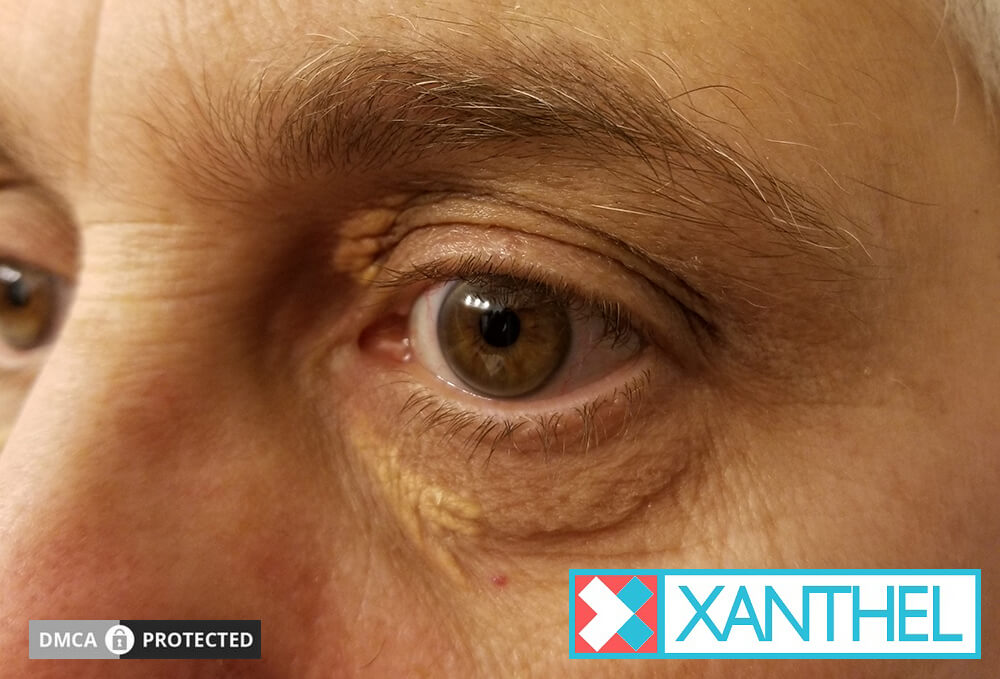
From two Greek words: “xanthos”, meaning yellow, and “elasma”, meaning a beaten metal plate. Together they describe a flat, yellow plate, which is a good picture of how the plaques look.
Many medical words come from Greek or Latin, which is why they can feel tricky to say. In Greek-derived words, an X at the start is usually said as a Z in English, as in xylophone and xenon. The same “xanth-” root for yellow appears in xanthoma, the wider family of yellow fatty deposits, and in a few other scientific words describing yellow pigments.
So when you say xanthelasma, you’re essentially saying “yellow plate”. Our guides on what xanthelasma means, what’s meant by xanthelasma and the meaning of xanthelasma in medical terms go further.

How Do You Pronounce The Other Words You’ll Hear?

Xanthoma is zan-THOH-muh, xanthomata is zan-THOH-muh-tuh, and xanthomatosis is zan-thoh-muh-TOH-sis. The table below covers these and the medical words you’re likely to hear at an appointment.
Notice that xanthoma is stressed on the second syllable, “THOH”, while xanthelasma is stressed on the third, “LAZ”. It’s an easy pair to mix up. Xanthoma is the umbrella term for all fat-filled deposits in the skin and tendons, and xanthelasma is the eyelid type and the most common one.[1] Our guides to xanthoma, xanthomata and xanthomatosis explain each term.
At an appointment, you might also hear words about your blood fats, such as “dyslipidemia” (an abnormal blood fat level) or “familial hypercholesterolemia” (an inherited high cholesterol condition), and words for removal methods, such as “excision” (cutting out) or “blepharoplasty” (eyelid surgery). Knowing how to say them makes it easier to ask questions.

Xanthelasma Pronunciation Guide
| Word | Say It | What It Means |
|---|---|---|
| Xanthelasma | zan-thuh-LAZ-muh | Yellow fatty plaques on the eyelids |
| Palpebrarum | pal-puh-BRAR-um | Of the eyelids |
| Xanthoma | zan-THOH-muh | Any fat-filled deposit in skin or tendons |
| Xanthomata | zan-THOH-muh-tuh | More than one xanthoma |
| Xanthomatosis | zan-thoh-muh-TOH-sis | Multiple xanthomas |
| Macrophage | MAK-roh-fayj | The immune cell that fills with fat |
| Dyslipidemia | dis-lip-ih-DEE-mee-uh | Abnormal blood fat levels |
| Hypercholesterolemia | hy-per-kuh-les-tuh-ruh-LEE-mee-uh | High blood cholesterol |
| Hypothyroidism | hy-poh-THY-roy-diz-um | An underactive thyroid |
| Blepharoplasty | BLEF-uh-roh-plas-tee | Eyelid surgery |
| Oculoplastic | ok-yuh-loh-PLAS-tik | Eyelid and eye-area surgery specialty |
| Ectropion | ek-TROH-pee-on | A lower eyelid that turns outward |
Which Similar-Sounding Words Mean Something Different?
Xanthoma, xanthelasma and xanthogranuloma all start with “xanth-” for yellow, but they’re different things. Xanthan gum, a food thickener, has nothing to do with any of them.
- Xanthelasma (zan-thuh-LAZ-muh). Yellow fatty plaques on the eyelids, usually harmless.[1]
- Xanthoma (zan-THOH-muh). The family name for fat-filled deposits anywhere in the skin or tendons.[1]
- Necrobiotic xanthogranuloma (nek-roh-by-OT-ik zan-thoh-gran-yuh-LOH-muh). A rare condition causing firm yellow-orange plaques around the eyes that can ulcerate, strongly linked to blood protein disorders.[5]
- Xanthan gum (ZAN-thun). A thickener used in foods; it shares the “yellow” root only because of the bacteria it was first made from.
If a doctor uses a word you don’t recognize, it’s always fine to ask them to spell it or write it down, so you can read about it later.

How Do You Say The Blood Test Words?
You’ll probably hear “lipid profile” (LIP-id), “LDL” and “HDL” (said as letters), “triglycerides” (try-GLISS-uh-rydz) and sometimes “apolipoprotein B” (ap-oh-lip-oh-PROH-teen bee). These measure the fats in your blood.
Because about half of people with xanthelasma have a blood fat disorder, a blood test is the usual first step: a fasting lipid profile, a liver panel, thyroid tests and a blood sugar test.[1] Here’s what the words mean:
- Lipid profile (LIP-id PROH-fyl). A blood test measuring cholesterol and triglycerides, ideally after fasting.
- LDL (el-dee-el). Low-density lipoprotein, often called “bad” cholesterol.
- HDL (aych-dee-el). High-density lipoprotein, often called “good” cholesterol.
- Triglycerides (try-GLISS-uh-rydz). Another type of blood fat, raised by diabetes and diet.
- Apolipoprotein B (ap-oh-lip-oh-PROH-teen bee). A measure of the number of LDL-type particles.
- HbA1c (aych-bee-ay-wun-see). A test of average blood sugar over recent months.
Knowing these words makes it much easier to understand your results and ask what they mean for you.

How Do You Say The Removal Words?
The main ones are excision (ek-SIZH-un), cryotherapy (KRY-oh-ther-uh-pee), trichloroacetic acid (try-klor-oh-uh-SEE-tik), radiofrequency (RAY-dee-oh-FREE-kwen-see) and erbium YAG laser (ER-bee-um yag).
- Excision (ek-SIZH-un). Cutting out the plaque surgically; used for larger, deeper plaques.[2]
- Blepharoplasty (BLEF-uh-roh-plas-tee). Eyelid surgery, sometimes combined with excision.
- CO2 laser (see-oh-too). A laser that vaporizes the plaque; one review found more than 75% improvement in over 90% of patients.[2]
- Erbium YAG (ER-bee-um yag). Another laser type, with more than 80% improvement reported.[2]
- Trichloroacetic acid, or TCA (try-klor-oh-uh-SEE-tik). A chemical peel, most effective on small plaques.[3]
- Cryotherapy (KRY-oh-ther-uh-pee). Freezing; often avoided on the eyelids because of swelling.[3]
- Radiofrequency (RAY-dee-oh-FREE-kwen-see). Controlled heat, useful for plaques near the eye.[3]
Our guide to the removal of xanthelasma compares each option in detail.

What Is Xanthelasma, Now You Can Say It?
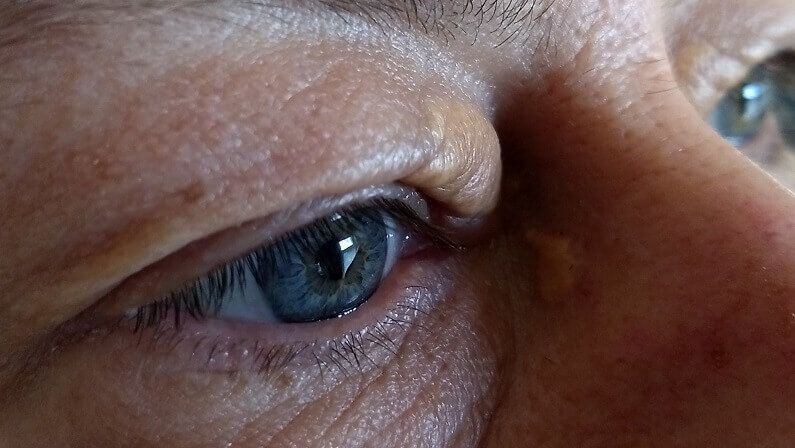
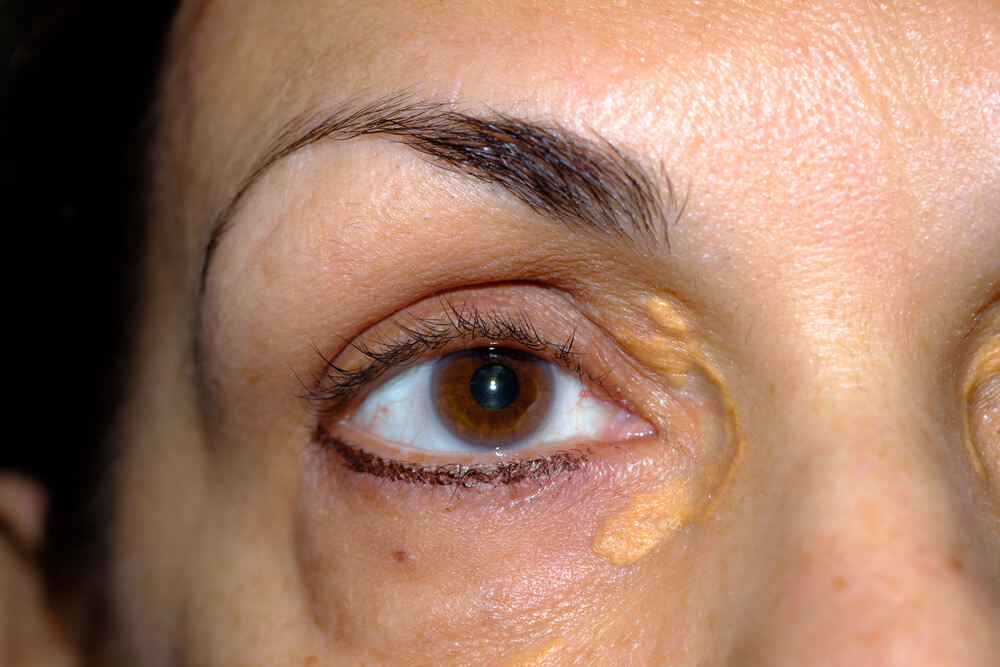
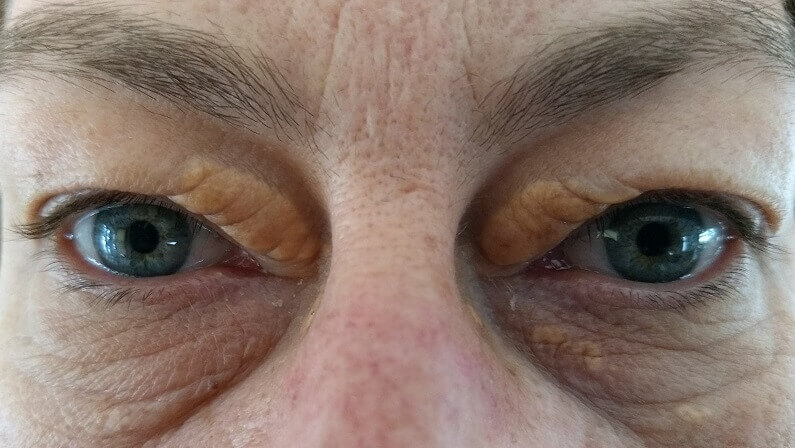
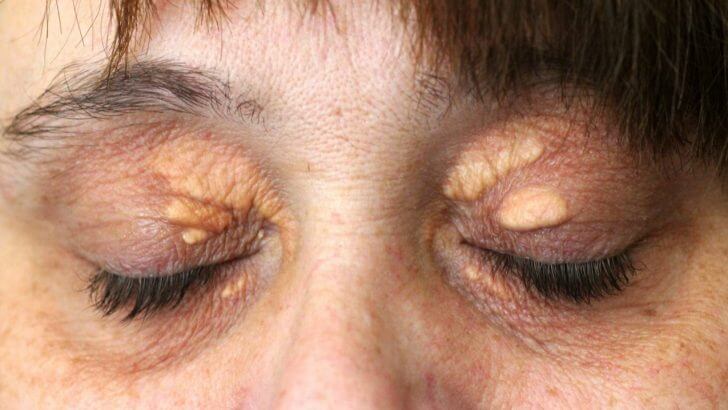
Xanthelasma is a harmless buildup of fat-filled immune cells in the eyelid skin, seen as soft yellow patches near the inner corners of the eyes. It affects about 1.1% of women and 0.3% of men, and about half of people with it have a blood fat disorder.
The plaques form when fat leaks from tiny eyelid blood vessels and is swallowed by macrophages, which swell into foam cells.[1] They’re painless and don’t affect vision, but they rarely fade on their own. Because about half of people with xanthelasma have a primary or secondary lipid disorder, a fasting lipid profile, liver panel, thyroid tests and blood sugar test are recommended.[1] It’s usually seen between 35 and 55.[1]
Our guides to xanthelasma, what it looks like and the causes of xanthelasma explain the condition in full.

Can Xanthelasma Be Removed?
Yes. It can be removed at a clinic by laser, surgery, chemical peel or radiofrequency, or at home with a removal cream made for xanthelasma. Lowering cholesterol rarely clears existing plaques.
A review of 49 studies found CO2 laser gave more than 75% improvement in over 90% of patients, with skin color change the most common complication, and surgery was used for larger, deeper plaques.[2] Recurrence after laser has been reported at 13% to 16%.[3] Surgery can turn the lower lid outward (ectropion), and freezing or chemical methods can scar or discolor the skin.[1] Our guides to the removal of xanthelasma and xanthelasma cream compare the options.
Once your doctor has checked your cholesterol, if you’d like to remove your plaques at home, this is the cream we make for xanthelasma.

How Do You Talk To Your Doctor About Xanthelasma?
You don’t need perfect pronunciation. Say you have soft yellow patches on your eyelids, ask whether they’re xanthelasma, and ask for a cholesterol check. Writing down a few questions beforehand helps.
- “I have yellow patches on my eyelids. Are they xanthelasma?”
- “Could you check my cholesterol, thyroid and blood sugar?”
- “Is there any sign of an inherited cholesterol condition?”
- “What are my options for removing them, and what are the risks?”
- “Should I see a dermatologist or an oculoplastic surgeon?”
Doctors can usually confirm xanthelasma just by looking.[3] If your plaques appeared at a young age, mention it, as doctors then look harder for an inherited lipid disorder,[1] such as familial hypercholesterolemia, which affects about 1 in 250 to 1 in 500 people.[4] Our guide on which doctor to see about xanthelasma explains the options.
How Is Xanthelasma Pronounced? The Bottom Line
Say zan-thuh-LAZ-muh: a Z sound at the start, a soft “th”, and the stress on “LAZ”. The word means “yellow plate”, and it describes harmless yellow plaques on the eyelids that are worth one check-up.
Now you can say it, you can ask about it. Have your cholesterol checked, then decide whether to remove the plaques. Xanthel® is a cosmetic cream made for xanthelasma removal at home, sold by Xanthelasma.com. You’ll find it at the foot of this page, or read more about Xanthel® xanthelasma removal cream and browse all our xanthelasma guides.
Common Questions About Pronouncing Xanthelasma
How Do You Pronounce Xanthelasma?
Zan-thuh-LAZ-muh, with four syllables and the stress on the third syllable, “LAZ”.
Why Is The X In Xanthelasma Pronounced Like A Z?
In English words that come from Greek, an X at the start is usually said as a Z, as in xylophone and xenon.
What Is The Most Common Pronunciation Mistake?
Stressing the wrong syllable. Many people stress “ZAN” or “THEL”, but the stress belongs on the third syllable, “LAZ”.
Is Xanthelasma Pronounced Differently In The UK And US?
Only slightly. Both say zan-thuh-LAZ-muh with the stress on “LAZ”, and the spelling is the same.
How Do You Pronounce Xanthoma?
Zan-THOH-muh, with the stress on the second syllable. Xanthoma is the family name for fat-filled deposits, and xanthelasma is the eyelid type.
How Do You Pronounce Xanthelasma Palpebrarum?
Zan-thuh-LAZ-muh pal-puh-BRAR-um. Palpebrarum is Latin for “of the eyelids”.
What Does Xanthelasma Mean?
It comes from Greek words meaning “yellow” and “plate”, and it describes soft yellow plaques of fat-filled cells on the eyelids.
Can Xanthelasma Be Removed?
Yes, at a clinic by laser, surgery, chemical peel or radiofrequency, or at home with a removal cream such as Xanthel®, once a doctor has checked your cholesterol.
Sources
- Blair K. Xanthelasma Palpebrarum. StatPearls, National Library of Medicine (NCBI Bookshelf), updated 2026.
- Malekzadeh H, Ormseth B, Janis JE. A Practical Review of the Management of Xanthelasma Palpebrarum. Plastic and Reconstructive Surgery Global Open, 2023;11(5):e4982.
- Patadia A, Rana HS, Stewart K, Yen MT, Lee H. Xanthelasma. EyeWiki, American Academy of Ophthalmology, reviewed 2026.
- Ison HE, Clarke SL, Knowles JW. Familial Hypercholesterolemia. GeneReviews, National Library of Medicine (NCBI Bookshelf), revised 2025.
- Kamboj A, Santilli C, Yamanuha J, Harrison A, Maltry A, Hou J, Mokhtarzadeh A, Vercellotti G. Necrobiotic Xanthogranuloma. EyeWiki, American Academy of Ophthalmology, updated 2026.