
How To Pronounce Xanthelasma
The Syllable-by-Syllable Guide to Saying It Right
Stuck on how to say xanthelasma? Here is the simple syllable-by-syllable breakdown, zan-thuh-LAZ-muh, with a quick guide to the sounds so you can say it confidently out loud.
By Xanthelasma.com
How to Pronounce Xanthelasma
Here is the answer, straight away. Xanthelasma is pronounced:
zan-thuh-LAZ-muh
Four syllables, with the stress on the third one, “LAZ”. If you say it slowly a couple of times, zan / thuh / LAZ / muh, then speed up, it stops feeling awkward very quickly. It is one of those words that looks far harder written down than it is to say.
The fuller medical name is xanthelasma palpebrarum (pal-puh-BRAR-um), where “palpebrarum” just means “of the eyelids”, but almost everyone, including doctors, simply says xanthelasma. So if you have been hesitating over the word, that is really all you need. The sections below break down each syllable in case any part is tripping you up. If you would like the same guidance in slightly different forms, our pages on how to say xanthelasma and how xanthelasma is pronounced cover it too.

Syllable by Syllable
Breaking it into its four parts makes it easy:
zan , the opening syllable. The “x” is pronounced as a soft “z”, not “eks”, so it starts like “zan” (rhyming with “fan” or “can”), never “eksan”. This is the part that catches most people out.
thuh , a short, soft, unstressed syllable. The “th” is soft, as in “thin” or “theory”, not hard like “the” in “those”. It is said lightly and quickly, almost gliding into the next syllable.
LAZ , the stressed syllable, where the emphasis lands. It rhymes with “jazz”. Giving this syllable a little more weight than the others is what makes the whole word sound right.
muh , a short, soft ending, like the “ma” in “mama” said quickly and gently. Don’t linger on it.
Put together with the stress on the third part, it flows as zan-thuh-LAZ-muh.

A Quick Way to Practise
The easiest way to get comfortable is to build the word up in pieces rather than tackling it whole. Start slow: say “zan”, then “zan-thuh”, then “zan-thuh-LAZ”, then the full “zan-thuh-LAZ-muh”. Each time you add a syllable, keep the stress firmly on “LAZ”. Once the pieces connect, gradually speed up to a natural pace.
Two things to keep in mind as you do: the “x” stays a soft “z” throughout (trust your ear, not the spelling), and the weight always lands on the third syllable. Those are the two details that make the difference between sounding unsure and sounding natural. Accent makes little difference, the core pronunciation, zan-thuh-LAZ-muh, holds steady across British, American, Australian, and other English accents, with only tiny variation in how softly the “th” is said. A few repetitions and it will feel like second nature.

What the Word Means
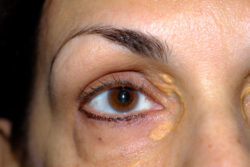
Now that you can say it, here is what it refers to, briefly. Xanthelasma is the name for soft yellow patches of cholesterol that form on or around the eyelids. The name comes from the Greek “xanthos”, meaning yellow, which is also why it shares a root with “xanthoma”, the broader term for cholesterol deposits anywhere on the body. Xanthelasma is the specific eyelid type.
The marks are harmless and painless and do not affect vision; for most people the only concern is how they look. They can occasionally be a sign of raised cholesterol, so a simple check with your doctor is worth doing, though around half of people who get them have normal cholesterol. They will not fade on their own, but they can be cleared if you want them gone, Xanthel ® is a cosmetic skincare cream formulated to remove xanthelasma plaques at home. Our overview of what xanthelasma is explains the condition in full, and the at-home removal option covers the cream if that is relevant to you.

How To Pronounce Xanthelasma: In Short
Xanthelasma is pronounced zan-thuh-LAZ-muh, four syllables with the stress on the third, “LAZ” (rhyming with “jazz”). The “x” takes a soft “z” sound, and the “th” is soft as in “thin”. Build it up syllable by syllable, keep the emphasis on “LAZ”, and it quickly becomes easy to say.
If looking up the word means you, or someone you know, may have the condition, you can read what xanthelasma looks like to confirm it, or look at the at-home removal option if you would like the marks gone.

Common Questions About Saying Xanthelasma
How do you pronounce xanthelasma?
It is pronounced zan-thuh-LAZ-muh, four syllables with the stress on the third, “LAZ” (which rhymes with “jazz”). The “x” takes a soft “z” sound, so it begins “zan”, and the “th” is soft as in “thin”. The full medical name adds palpebrarum (pal-puh-BRAR-um), meaning “of the eyelids”.
Which syllable is stressed in xanthelasma?
The stress falls on the third syllable, “LAZ”. Saying it with the emphasis there, zan-thuh-LAZ-muh, is what makes the word sound correct. Putting the stress on the first syllable instead is a common error that can make the word harder for listeners to recognise.
Why is the “x” in xanthelasma pronounced as a “z”?
This follows the word’s Greek origin, from “xanthos” meaning yellow. In English, an “x” at the start of a word taken from Greek is usually pronounced as a “z” sound. So xanthelasma begins “zan”, not “eksan”, and the same applies to the related word xanthoma.
Is the “th” in xanthelasma hard or soft?
It is soft, as in “thin”, “theory”, or “thimble”, not hard as in “the” or “those”. The second syllable, “thuh”, is short and unstressed, said lightly as it glides toward the stressed “LAZ”. Keeping the “th” soft is one of the small details that makes the pronunciation sound natural.
Is xanthelasma pronounced the same in British and American English?
Essentially yes. The core pronunciation, zan-thuh-LAZ-muh, with a soft “z” start and the stress on the third syllable, stays consistent across British, American, Australian, and other English accents. The only differences are very minor, such as slight variation in how softly the “th” is said.
What is xanthelasma palpebrarum?
It is the full medical name for xanthelasma, pronounced zan-thuh-LAZ-muh pal-puh-BRAR-um. “Palpebrarum” means “of the eyelids”, so the full term literally describes yellow cholesterol patches on the eyelids. In everyday use, including by doctors, it is almost always shortened to just xanthelasma.
What does xanthelasma mean?
Xanthelasma refers to soft yellow patches of cholesterol that form on or around the eyelids. The name comes from the Greek for yellow. It is the eyelid-specific type of xanthoma, the wider family of cholesterol deposits. The marks are harmless but can occasionally be a sign of raised cholesterol.
Can xanthelasma be removed?
Yes. The marks will not fade on their own, but they can be cleared. Xanthel ® is a cosmetic skincare cream formulated to remove xanthelasma plaques at home, offering an alternative to clinic procedures like surgery, laser, and freezing, without the cost, scarring risk, or downtime.
Xanthel ® is a cosmetic skincare product, not a medical treatment. Because xanthelasma can sometimes sit alongside lipid, thyroid, or cardiovascular factors, it is worth discussing with your doctor, who can give you the full picture of your health to pair with any cosmetic approach.