
Why You, Why Your Eyelids, And Why Now: The Real Reasons Xanthelasma Appears, Even With Normal Cholesterol
You have xanthelasma because fat from your blood has leaked into the thin skin of your eyelids and been taken up by immune cells that turn yellow with it. About half the time a blood fat disorder is behind it; the rest of the time age, your genes and local factors in the eyelid skin do the work, which is why it can appear even when cholesterol is normal.
You likely have xanthelasma because lipid leaks from tiny eyelid blood vessels, which blinking squeezes and age makes leakier, and immune cells fill with it. About half of people have a blood fat disorder; others have an inherited tendency, a thyroid, diabetes or liver condition, or normal blood fats. A blood test shows which applies to you.
Key Takeaways
- Xanthelasma forms when lipid leaks into the eyelid skin and fills immune cells.
- Blinking and thin, aging eyelid skin explain why it appears there.
- About half of people with it have a blood fat disorder.
- Normal cholesterol is common; local and hormonal factors may play a part.
- It’s more common in women and usually appears between 35 and 55.
- A blood test tells you which reason applies; removal is a separate choice.
On This Page 15 sections
Why Do I Have Xanthelasma?
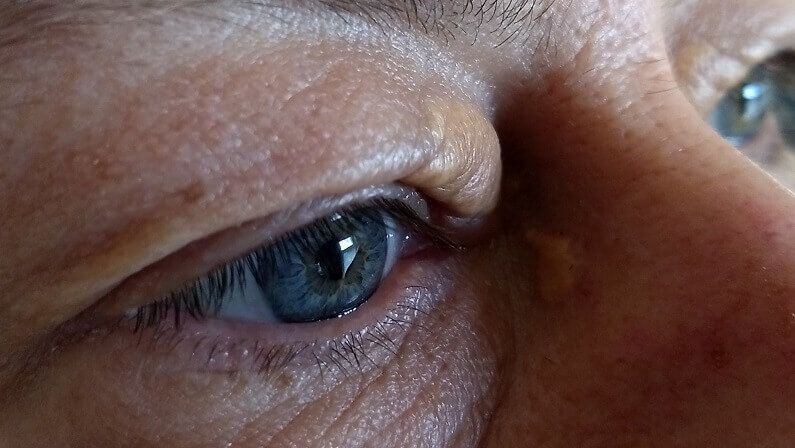
Because lipid from your blood has seeped out of tiny vessels in your eyelids and been swallowed by immune cells, which fill up and show through the skin as yellow plaques. What made that happen in you is usually a mix of blood fats, age, genes and local eyelid factors.
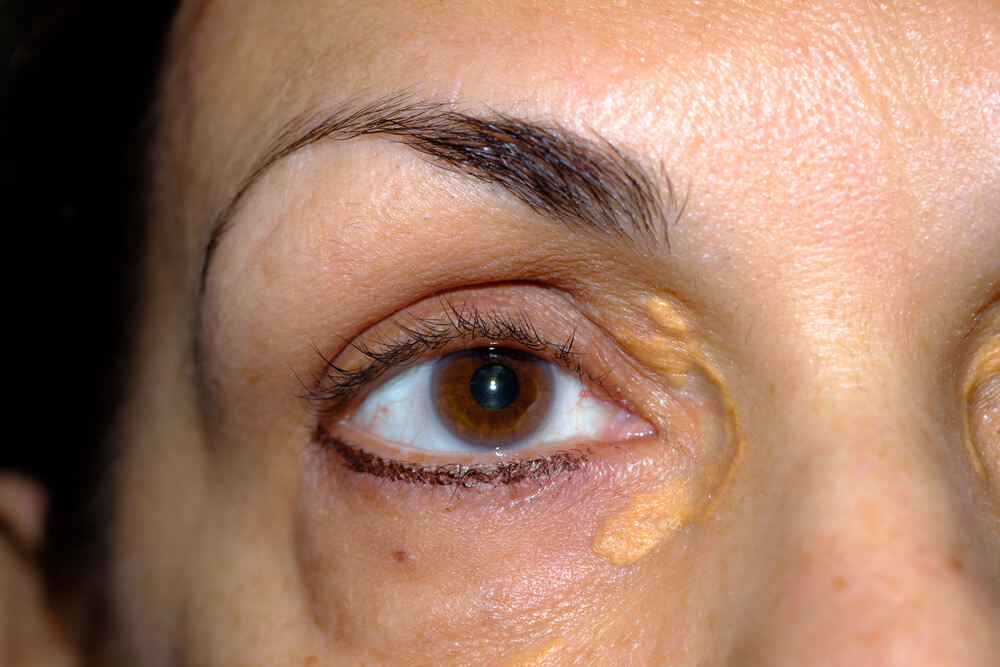
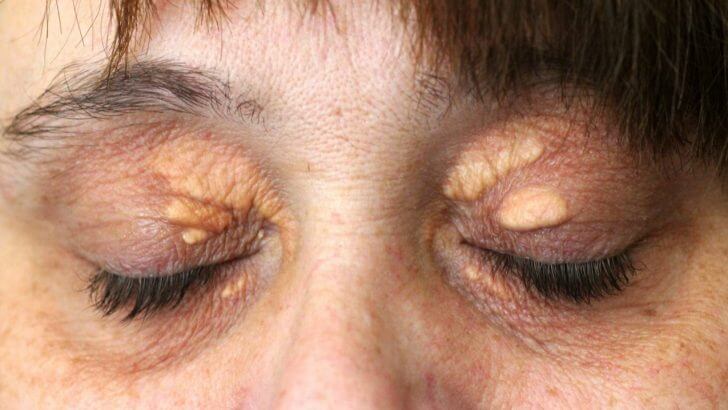
Xanthelasma palpebrarum is a buildup of lipid-laden immune cells, called foam cells, in the eyelid skin. About half of people with it have a primary or secondary lipid disorder.[1] The other half have normal blood fats, which tells you that cholesterol isn’t the whole story: something about the eyelid itself matters too.
So “why do I have xanthelasma?” really breaks into three questions: why your eyelids, why now, and why you and not someone else with the same cholesterol. This page takes them in turn. For the full medical list of causes, see the causes of xanthelasma, and if you want to work out which cause is yours, why have I got xanthelasma walks you through it.

Why Does Xanthelasma Appear On My Eyelids?
Because the eyelids are constantly moving and their skin is thin. Every blink compresses the small blood vessels there, and over time those vessels leak lipid into the surrounding skin, where immune cells collect it.
The leading explanation is mechanical. Blinking compresses the capillaries of the eyelids, the vessels become leakier with age, and lipid that escapes is taken up by macrophages, immune cells that become foam cells when they’re overloaded with fat. These collect in the deeper layer of the skin around the vessels, with some inflammation.[1]
That’s why xanthelasma favors the eyelids, especially near the inner corners, rather than skin that moves less. Our guides on how xanthelasma forms and why xanthelasma occurs go into the process in more detail.

Why Have I Got Xanthelasma Now?
Because age is part of the process. Eyelid vessels become leakier as you get older, and xanthelasma usually appears between 20 and 70, most often between 35 and 55. A change in your blood fats or health can also tip the balance.
Xanthelasma is seen from about age 20 to 70 and most often between 35 and 55.[1] In a study of 42 patients, the average age was about 47.[2] Because leakier vessels are part of how plaques form,[1] it makes sense that they tend to turn up in midlife rather than youth.
Something else may have changed too: weight gain, a new diagnosis of diabetes or an underactive thyroid, or starting a medicine that raises blood fats can all shift the picture. If yours appeared at a young age, that’s a reason to check for an inherited cholesterol condition (see below). Our guide on whether xanthelasma is common shows how typical your age is.
Why Do I Have Xanthelasma When Others Don’t?
Often because of your blood fat pattern. On average, people with xanthelasma have higher total and LDL cholesterol and apolipoprotein B, and lower HDL and apolipoprotein A1. Genes, age and local eyelid factors explain the rest.
A meta-analysis of 15 case-control studies with 854 patients found people with xanthelasma had higher total cholesterol, LDL cholesterol and apolipoprotein B, and lower apolipoprotein A1, than people without it.[3] In the 42-patient study, median HDL, the protective “good” cholesterol, was 36.2 mg/dL in patients against 50.5 mg/dL in matched controls.[2]
The lipid disorders involved include type IIa, IIb and IV hyperlipidemia and low HDL.[1] Low HDL is easy to miss if you’ve only been told your total cholesterol, so ask for the full breakdown. Our guide to what xanthelasma is caused by explains each pattern.

Why Do I Have Xanthelasma If My Cholesterol Is Normal?
It’s common. More than half the patients in one study had normal cholesterol, and researchers think local, hormonal or immune-cell factors in the eyelid explain these cases. Leaky eyelid vessels can let lipid in even when blood levels are normal.
In the 42-patient study, 54.8% had normal cholesterol and 45.2% had high cholesterol. The authors suggested that local, hormonal or macrophage factors may explain plaques in people with normal blood fats.[2] That fits the mechanical explanation: if blinking and age make eyelid vessels leaky, lipid can escape at ordinary blood levels.[1]

Normal results are good news, but it’s still worth looking after your heart. A study of almost 13,000 people followed for decades found xanthelasma was linked with a higher risk of heart attack and heart disease independent of cholesterol.[4] Our guide on what xanthelasma indicates explains that link.

Do I Have Xanthelasma Because It Runs In My Family?
Possibly. In one study, about a quarter of patients had familial hyperlipidemia, and an inherited condition called familial hypercholesterolemia can cause xanthelasma, especially in younger people. Each child of an affected parent has a 50% chance of inheriting it.
In the 42-patient study, 26.2% had familial hyperlipidemia.[2] Doctors look harder for an inherited lipid disorder when xanthelasma appears in young people.[1] Familial hypercholesterolemia affects about 1 in 250 to 1 in 500 people and is passed on in a dominant pattern. Its signs include xanthelasma and tendon xanthomas on the Achilles tendons, elbows, hands, knees and feet.[5]
It’s important to know about because, without management, about half of men with it have a coronary event by 50 and about 30% of women by 60, and statins are the first-line medicine.[5] If a parent, brother or sister had high cholesterol or an early heart attack, tell your doctor. Our guide on whether xanthelasma is genetic explains more.

Why Do More Women Have Xanthelasma?
Nobody knows for sure, but it’s clearly more common in women: about 1.1% of women compared with 0.3% of men. Researchers have suggested hormonal factors may be involved.
Xanthelasma affects about 1.1% of women and 0.3% of men.[1] In the 42-patient study, 85.7% of patients were women, and the authors suggested hormonal factors as one possible explanation, alongside local and immune-cell factors.[2] Taking estrogen medicines is also among the recognized secondary causes.[1]
So if you’re a woman in midlife with yellow plaques on your eyelids, you fit the most common pattern. It’s still worth the blood tests, because the reason in your case could be any of those on this page.

Could A Thyroid, Diabetes Or Liver Problem Be Why I Have Xanthelasma?
Yes, sometimes. Conditions that raise blood fats can lead to xanthelasma: an underactive thyroid, diabetes, primary biliary cholangitis (a liver condition), nephrotic syndrome (a kidney condition), and taking retinoid or estrogen medicines.
- Underactive thyroid. Can raise cholesterol, and is one of the recognized secondary causes.[1]
- Diabetes. Linked with raised blood fats; HbA1c is checked if you have it.[1]
- Primary biliary cholangitis. A liver condition that produces an unusual cholesterol particle, lipoprotein X.[1]
- Nephrotic syndrome. A kidney condition that raises blood fats.[1]
- Medicines. Taking retinoid or estrogen medicines can raise blood fats.[1]
- Sarcoidosis. A rarer association.[1]
These are why your doctor will check more than cholesterol. Lifestyle matters too: weight, diet and alcohol can all affect blood fats, and our guide on what foods cause xanthelasma explains what’s known about diet.

Which Reason Is Yours? A Quick Self-Check
| Ask Yourself | If Yes, It May Point To | What To Do |
|---|---|---|
| Do I have soft yellow plaques on my eyelids? | Xanthelasma itself: harmless foam cells | See your doctor for blood tests; removal is your choice |
| Has my cholesterol been high, or HDL low? | A blood fat disorder | Fasting lipid profile; discuss management |
| Did it appear before my 30s, or do relatives have high cholesterol? | An inherited cholesterol condition | Lipid profile, family history; relatives may need tests |
| Am I tired, cold or gaining weight? | An underactive thyroid | Thyroid function tests |
| Do I have diabetes or high blood sugar? | Raised blood fats from diabetes | Fasting glucose, HbA1c |
| Do I take retinoid or estrogen medicines? | A medicine raising blood fats | Ask your doctor; don’t stop medicines yourself |
| Were all my results normal? | Local eyelid, hormonal or immune-cell factors | Look after your heart health; removal is your choice |
Is It My Fault That I Have Xanthelasma?
Usually not. Age, genes and the way eyelid vessels behave play a big part, and about half of people with xanthelasma have normal blood fats. Lifestyle can affect blood fats, but xanthelasma isn’t a verdict on how you live.
Many of the reasons on this page are outside your control: getting older, being a woman, inheriting a cholesterol condition, or having a thyroid problem. That said, things you can change, such as weight, diet, alcohol and smoking, affect blood fats and heart health, so a check-up is a good moment to look at them.
What doesn’t help is blaming yourself or trying to scrub, squeeze or burn the plaques away. Our guide on how to prevent xanthelasma covers what you can sensibly do.

What Tests Will Show Why I Have Xanthelasma?
A fasting lipid profile, a liver panel, thyroid function tests and fasting blood sugar, with HbA1c if you have diabetes. A biopsy is only needed if the diagnosis is unclear.
- See your family doctor. They can usually recognize xanthelasma by looking and will ask about family history and medicines.
- Fasting lipid profile. Total, LDL and HDL cholesterol and triglycerides.[1]
- Liver panel. Looks for conditions such as primary biliary cholangitis.[1]
- Thyroid function tests. Rule out an underactive thyroid.[1]
- Fasting glucose, and HbA1c in diabetes. Check blood sugar control.[1]
- Your heart risk. Blood pressure, smoking and family history, given the link with heart disease.[4]
Your results answer “why do I have xanthelasma?” far better than any list can. Our main xanthelasma guide explains what happens next.

If I Know Why I Have It, Can I Stop It Coming Back?
Managing the cause protects your health and gives you the best chance of fewer new plaques, but it rarely clears existing ones, and plaques can return after removal. Recurrence is generally under 50%.
Recurrence after removal is generally reported at under 50%, around 60% after repeat procedures, and higher for deeper plaques.[1] Because the eyelid factors that let lipid in don’t go away, keeping blood fats, thyroid and blood sugar under control is the sensible long-term plan. Our guide on whether xanthelasma comes back explains the odds.

Now I Know Why I Have Xanthelasma, How Do I Get Rid Of It?

By removing the plaques themselves, since managing the cause rarely clears them. Clinics use laser, surgery or peels, and many people with small to medium plaques remove them at home with a cream made for xanthelasma.
Knowing why you have xanthelasma deals with your health; removing it deals with how your eyelids look. Our guides to the removal of xanthelasma and how to get rid of xanthelasma compare clinic and home routes, and our xanthelasma cream guide explains the at-home option.
If you’re managing the cause with your doctor and want to deal with the plaques themselves at home, this is the cream we make for xanthelasma.

What’s The Bottom Line On Why You Have Xanthelasma?
You have xanthelasma because lipid has leaked into your eyelid skin, helped by blinking and age. In about half of people a blood fat disorder is behind it; in the rest, genes, hormones and local eyelid factors are. Blood tests show which applies to you.
It’s usually not your fault, and it isn’t dangerous in itself, but it’s a good reason to check your blood fats, thyroid, blood sugar and heart health. Then decide whether you want the plaques removed. Xanthel® is a cosmetic cream made for xanthelasma removal at home, sold by Xanthelasma.com. You’ll find it at the foot of this page, or read more about Xanthel® xanthelasma removal cream, see what causes xanthelasma and what to do about each cause, read why I have xanthelasma, and browse all our xanthelasma guides.
Common Questions About Why You Have Xanthelasma
Why Do I Have Xanthelasma?
Because lipid has leaked from tiny eyelid vessels into the skin and filled immune cells. About half of people have a blood fat disorder; for others, age, genes and local eyelid factors are behind it.
Why Do I Have Xanthelasma If My Cholesterol Is Normal?
It’s common. More than half the patients in one study had normal cholesterol, and local, hormonal or immune-cell factors in the eyelid are thought to explain it.
Why Is Xanthelasma On My Eyelids?
Blinking compresses the small eyelid vessels and they become leakier with age, so lipid escapes into the thin eyelid skin.
Is Xanthelasma Hereditary?
It can be. About a quarter of patients in one study had familial hyperlipidemia, and inherited high cholesterol is more likely when xanthelasma appears young.
Why Did I Get Xanthelasma At My Age?
It’s usually seen between 20 and 70, most often between 35 and 55, because eyelid vessels become leakier with age. Appearing young is a reason to check for inherited cholesterol.
Can A Thyroid Problem Cause Xanthelasma?
Yes, it can. An underactive thyroid raises blood fats and is a recognized cause, so thyroid tests are part of the usual check-up.
Is It My Fault I Have Xanthelasma?
Usually not. Age, genes and eyelid factors play a big part, though weight, diet and alcohol can affect blood fats.
What Should I Do Now I Have Xanthelasma?
See your doctor for a lipid profile, liver, thyroid and blood sugar tests, then decide whether you want the plaques removed.
Sources
- Blair K. Xanthelasma Palpebrarum. StatPearls, National Library of Medicine (NCBI Bookshelf), updated 2026.
- Kavoussi H, Ebrahimi A, Rezaei M, Ramezani M, Najafi B, Kavoussi R. Serum lipid profile and clinical characteristics of patients with xanthelasma palpebrarum. Anais Brasileiros de Dermatologia, 2016;91(4):468-471.
- Chang HC, Sung CW, Lin MH. Serum lipids and risk of atherosclerosis in xanthelasma palpebrarum: a systematic review and meta-analysis. Journal of the American Academy of Dermatology, 2020;82(3):596-605.
- Christoffersen M, Frikke-Schmidt R, Schnohr P, Jensen GB, Nordestgaard BG, Tybjaerg-Hansen A. Xanthelasmata, arcus corneae, and ischaemic vascular disease and death in general population: prospective cohort study. BMJ, 2011.
- Ison HE, Clarke SL, Knowles JW. Familial Hypercholesterolemia. GeneReviews, National Library of Medicine (NCBI Bookshelf), revised 2025.
Read Next
 Why Have I Got Xanthelasma?Find which cause is yours
 Causes Of XanthelasmaThe full medical explanation
 Xanthelasma: What Causes It?From cause to action
 Why I Have XanthelasmaMore on the reasons
 What Does Xanthelasma Indicate?What it signals for your health
 Removal Of XanthelasmaEvery method compared