
Eyelid Xanthelasma
Recognising the Yellow Marks on Your Eyelids, and Telling Them Apart from Other Eyelid Bumps
Eyelid xanthelasma is a soft yellow cholesterol deposit on the eyelid skin. It is harmless to your eyes and vision. This page helps you recognise it, distinguish it from other eyelid lesions, and understand what to do about it.
By Xanthelasma.com
What Is Eyelid Xanthelasma?
Eyelid xanthelasma is a soft, yellowish deposit of cholesterol that develops in the thin skin of the eyelids, most often near the inner corner where the eyelids meet close to the nose. Its medical name is xanthelasma palpebrarum. The marks tend to be flat or slightly raised, well-defined, and frequently appear symmetrically on both eyes. They are the most common form that cholesterol deposits in the skin take.
The first thing worth knowing is reassuring: eyelid xanthelasma is benign and does not harm your eyes, your vision, or how your eyelids work. It is a cosmetic feature rather than an eye problem. Its main significance beyond appearance is that it can sometimes point to raised cholesterol or, less often, a thyroid issue, which is why a quick check with your doctor is worthwhile. If you would like to remove the marks, the least invasive route is an at-home cream made for the purpose: Xanthel ® is a cosmetic skincare cream made for xanthelasma removal at home. Our what is xanthelasma page gives the full background.
How to Recognise It
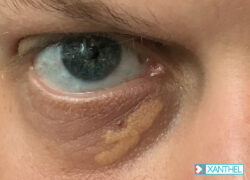
Eyelid xanthelasma has a fairly distinctive look that makes it recognisable. The marks are yellow, ranging from pale cream to a deeper gold, which is the single most telling feature. They are flat or slightly raised plaques with clear, sharp borders, rather than blending into the surrounding skin, and they can appear as a single patch or in clusters. The texture varies from soft and slightly doughy to firmer. They sit on or near the eyelids, classically at the inner corners, and very often on both eyes in a roughly mirror-image pattern.
They are also painless and do not itch, and they tend to develop gradually, often unnoticed at first because they start small, then becoming more apparent as they slowly enlarge over months and years. This combination, soft yellow, sharply defined, painless, symmetrical, near the inner eyelid, is characteristic enough that a doctor can usually recognise eyelid xanthelasma on sight. Our page on what xanthelasma looks like covers its appearance in more detail, with the colour and texture features.

Telling It Apart from Other Eyelid Lesions
The eyelid area is prone to several small bumps, so it helps to know how xanthelasma differs from the look-alikes. The yellow colour and sharp borders are the main distinguishers. Milia, by contrast, are tiny, firm, distinctly white or pearly grains (keratin, not cholesterol), rather than yellow plaques. Syringomas are firmer, dome-shaped bumps that often cluster under the eyes and are flesh-coloured to only faintly yellow. Sebaceous hyperplasia bumps usually have a small central dimple and a doughy feel. Skin tags hang from a small stalk rather than sitting flat.
The other distinguishing point is symptoms: xanthelasma is painless and does not itch, whereas some other eyelid conditions can be itchy or tender. Because these distinctions can be subtle, the reliable way to be sure is a quick look from a doctor, who can also run a simple lipid test if it is confirmed as xanthelasma. Self-diagnosis is reasonable as a first guess but worth confirming. Our page on what can look like xanthelasma runs through the look-alikes in full.

Is Eyelid Xanthelasma Harmful?
This is the question that worries most people, and the answer is reassuring: eyelid xanthelasma is benign. It is not cancerous, it does not spread, and crucially it does not damage the eye, threaten vision, or interfere with how the eyelid functions, even when it sits right at the lid margin. Physically, it is harmless, and the concern it causes is almost entirely cosmetic.
Its one genuine relevance to your health is indirect: because the marks are made of cholesterol, they can sometimes be an outward sign of raised blood lipids, and through that a flag for cardiovascular risk, or occasionally a thyroid issue. It is worth keeping this in proportion, though, around half of people with xanthelasma have completely normal cholesterol, so for many it carries no underlying health meaning at all. The sensible response is simply a quick lipid check with your doctor: either it reassures you, or it usefully catches something worth managing. Our pages on whether xanthelasma is dangerous and whether it indicates raised cholesterol cover this.

Removing Eyelid Xanthelasma
If the marks bother you, they can be removed, and because eyelid xanthelasma will not fade on its own and tends to grow slowly, removal is the way to clear it. The clinic options, surgical excision, laser, cryotherapy, radiofrequency, and electrosurgery, are all effective but tend to be costly, may need repeat sessions, carry a scarring or pigment-change risk on the delicate eyelid skin, and are rarely covered by insurance since removal is cosmetic.
The least invasive route is an at-home cream made for the purpose. Xanthel ® is a cosmetic skincare cream made for xanthelasma removal at home, applied precisely to the eyelid plaque following the supplied guide, with the skin then healing over one to two weeks. For most people weighing convenience and cost against a procedure right next to the eye, it is the natural first choice. Whichever route you choose, pairing removal with a cholesterol check is worthwhile, since the mark is treated but not the cause. Our treating xanthelasma and xanthelasma removal cream pages cover the options.

Eyelid Xanthelasma: The Bottom Line
Eyelid xanthelasma is a soft yellow cholesterol deposit in the eyelid skin, usually near the inner corners and often on both eyes. It is recognisable by its yellow colour, sharp borders, and painless, symmetrical pattern, which distinguish it from look-alikes such as milia, syringomas, and skin tags. Reassuringly, it is benign and does not harm your eyes or vision; its only real health relevance is that it can sometimes flag raised cholesterol, though around half of people with it have normal cholesterol.
A quick lipid check with your doctor covers the underlying side, and if you want the marks gone, the least invasive route is xanthelasma removal at home with a cream made for the purpose. You can also read our cream for xanthelasma page, or the eyelid-focused xanthelasma eyelid and xanthelasma palpebrarum pages.
Common Questions About Eyelid Xanthelasma
What is eyelid xanthelasma?
Eyelid xanthelasma is a soft, yellowish deposit of cholesterol in the thin skin of the eyelids, most often near the inner corners and frequently on both eyes. Its medical name is xanthelasma palpebrarum, and it is the most common form of cholesterol deposit in the skin. It is benign and a cosmetic concern rather than an eye problem.
Is eyelid xanthelasma dangerous to my eyes?
No. Eyelid xanthelasma is benign and does not damage the eye, threaten vision, or interfere with how the eyelid works, even when it sits near the lid margin. It is physically harmless. Its only health relevance is indirect: it can sometimes be a sign of raised cholesterol, which is worth checking with a doctor.
How do I know if a bump on my eyelid is xanthelasma?
Xanthelasma is recognisable by its soft yellow colour, sharp borders, flat or slightly raised plaque shape, and painless, often symmetrical pattern near the inner eyelid. Other eyelid bumps differ: milia are tiny white grains, syringomas are firmer dome-shaped bumps, skin tags hang from a stalk. A doctor can usually confirm it on sight.
What else could look like eyelid xanthelasma?
Several eyelid bumps can resemble it: milia (tiny white keratin cysts), syringomas (firm sweat-duct bumps), sebaceous hyperplasia (dimpled oil-gland bumps), and skin tags (stalked growths). The yellow colour and sharp borders help distinguish xanthelasma, but because the differences can be subtle, it is worth having a doctor confirm which one you have.
Does eyelid xanthelasma mean I have high cholesterol?
Not necessarily. Although the marks are made of cholesterol, around half of people with xanthelasma have normal blood cholesterol, since genetics plays a large role. It is still worth a simple lipid test to check, because catching raised cholesterol early benefits your heart, but the marks alone do not confirm a cholesterol problem.
Will eyelid xanthelasma go away on its own?
Almost never. Left alone, eyelid xanthelasma tends to persist and slowly grow or multiply over time. Improving your diet may help prevent new marks but rarely clears existing ones, so most people who want the marks gone choose to remove them rather than wait for them to fade.
How is eyelid xanthelasma removed?
Options include clinic procedures (surgery, laser, cryotherapy, radiofrequency, electrosurgery) and, least invasively, an at-home cream made for the purpose. Xanthel ® is a cosmetic skincare cream made for xanthelasma removal at home, applied to the eyelid plaque, with the skin healing over one to two weeks. The clinic routes work too but cost more and carry a scarring risk near the eye.
Should I see a doctor about eyelid xanthelasma?
Yes, one visit is worthwhile. A doctor can confirm the marks are xanthelasma rather than a look-alike, and run a simple lipid test for any underlying cholesterol issue, sometimes checking thyroid too. Once you have that reassurance, the marks are a cosmetic matter you can address separately, including at home.
Xanthel ® is a cosmetic skincare cream made for xanthelasma removal at home, not a medical treatment for any underlying condition. However the marks are removed, it is worth seeing your doctor for a simple check, since xanthelasma can sometimes sit alongside lipid, thyroid, or cardiovascular factors worth identifying and managing for your wider health.