The Full Medical Picture In Plain English: What These Eyelid Plaques Are Made Of, How They Form, Who Gets Them, How Doctors Diagnose Them, And The Outlook
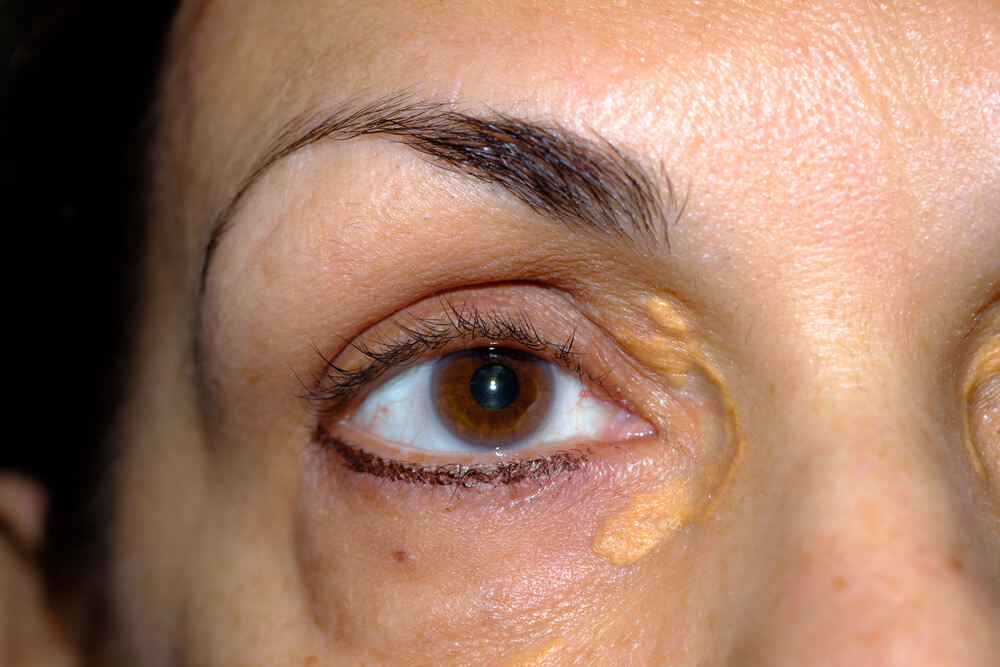
Xanthelasma palpebrarum is the medical name for soft, yellow, flat or slightly raised cholesterol deposits on the eyelids, usually near the inner corners. Under the microscope they’re clusters of fat-filled immune cells called foam cells around small blood vessels in the skin. They’re benign and don’t affect your sight, but about half of people with them have a lipid disorder, so diagnosis always comes with a blood test.
Xanthelasma palpebrarum is the eyelid type of xanthoma: benign yellow plaques of cholesterol-filled foam cells in the eyelid skin. It affects about 1.1% of women and 0.3% of men, mostly aged 35 to 55. About half have a lipid disorder. It rarely fades by itself and can be removed.
Key Takeaways
- It means “yellow plates of the eyelids” and is the medical name for xanthelasma.
- The plaques are foam cells around small vessels in the deeper skin layer.
- It affects about 1.1% of women and 0.3% of men.
- About half of people with it have a primary or secondary lipid disorder.
- It’s benign, with no potential to become cancer.
- It rarely fades by itself; recurrence after removal is generally under 50%.
On This Page 18 sections
What Is Xanthelasma Palpebrarum?
It’s a benign skin condition in which soft, yellow plaques of cholesterol-filled cells form on the eyelids, most often near the inner corners. It’s the eyelid type of xanthoma and the one people notice most.
StatPearls, the National Library of Medicine’s clinical reference, describes it as soft, yellowish, flat or slightly raised plaques, usually on the upper lids near the inner corner, sometimes on the lower lids too.[1] It’s painless, it doesn’t affect how the eyelid works, and it doesn’t harm the eye.
Most people simply call it xanthelasma. Our guides to xanthelasma palpebrarum and what xanthelasma is look at it from other angles.
What Does The Name Xanthelasma Palpebrarum Mean?
“Yellow plates of the eyelids.” Xanthos is Greek for yellow, elasma is Greek for a plate or thin sheet, and palpebrarum is Latin for “of the eyelids”.
The name is a straightforward description of what doctors see. It’s pronounced ZAN-thuh-LAZ-muh pal-puh-BRAIR-um, and you’ll also see it shortened to XP in some medical writing. Our pages on what xanthelasma means and the meaning of xanthelasma in medical terms go into the word in more depth.

What Is Xanthelasma Palpebrarum Made Of?
Foam cells: immune cells called macrophages, or histiocytes, that have swallowed so much cholesterol they look foamy under the microscope. They gather around small blood vessels in the superficial reticular dermis, with some inflammation around them.
That’s the picture StatPearls describes when a sample is examined.[1] The reticular dermis is the deeper, tougher layer of the skin, beneath the surface. Because the fat is held inside living cells woven into this layer, the plaques can’t be squeezed out and don’t simply drain away, which explains why they persist.

How Does Xanthelasma Palpebrarum Form?
Cholesterol-carrying particles leak from small eyelid blood vessels into the skin, where macrophages swallow them and turn into foam cells. Over time those cells build up into a visible plaque.
- Squeeze. Blinking repeatedly compresses the tiny capillaries in the eyelid.[1]
- Leak. Vessels become leakier with age, letting fat-carrying particles escape.[1]
- Swallow. Macrophages take up the fat and become foam cells.
- Gather. Foam cells collect around the vessels with some inflammation.
- Show. Enough build-up makes a soft yellow plaque you can see.
Higher blood cholesterol and lower HDL mean more material to build up, which is why lipid problems make plaques more likely. Our page on how xanthelasma forms explains more.

Who Gets Xanthelasma Palpebrarum?
About 1.1% of women and 0.3% of men. It’s seen from about age 20 to 70, most often between 35 and 55, and it’s much more likely at a young age if there’s an inherited lipid disorder.
Those figures are from StatPearls.[1] In one clinic study of 42 patients, 85.7% were women and the average age was about 47.[2] Familial hypercholesterolemia, which affects about 1 in 250 to 1 in 500 people, can cause xanthelasma and tendon lumps from a young age.[6] Our pages on whether xanthelasma is common and whether xanthelasma is genetic go further.

What Does Xanthelasma Palpebrarum Look Like?
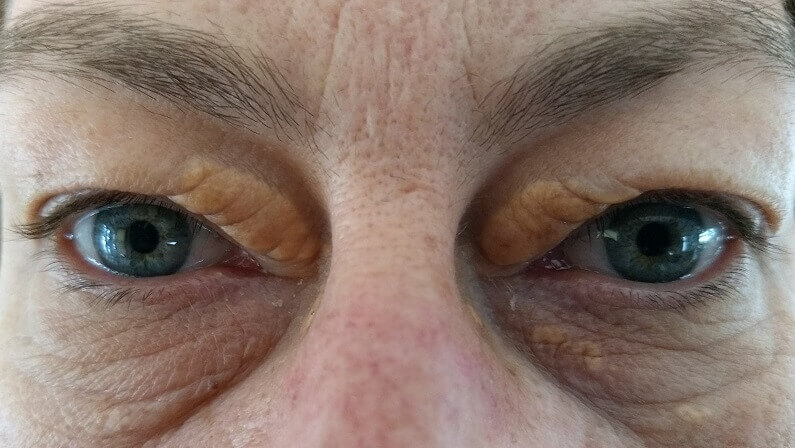
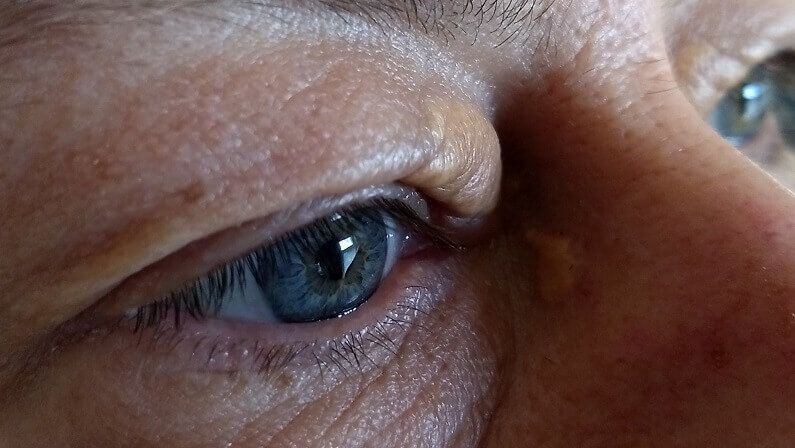
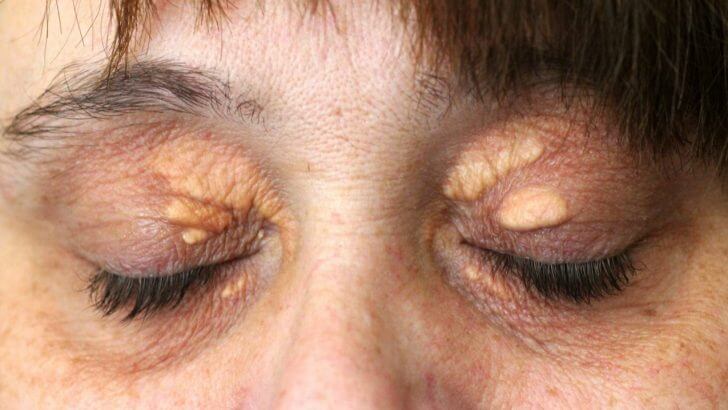
Soft, yellow to cream-colored patches, flat or slightly raised, with clear edges, usually near the inner corners of the eyelids. They’re painless and don’t itch.
- Color. Yellow, cream or orange-yellow.
- Feel. Soft and velvety, not hard.
- Shape. Flat or slightly raised, with defined borders.
- Site. Upper lids near the nose most often; lower lids too.[1]
- Pattern. Often on both eyes; can slowly widen or join up.
Our page on what xanthelasma looks like shows the range.

What Causes Xanthelasma Palpebrarum?
About half of cases are linked with a primary lipid disorder or a secondary cause. The other half occur with normal blood fats, where local, hormonal or immune-cell factors may play a part.
Primary Lipid Disorders
- High LDL (type IIa)
- High cholesterol and triglycerides (type IIb)
- High triglycerides (type IV)
- Low HDL
Secondary Causes
- Primary biliary cholangitis
- Diabetes, underactive thyroid, nephrotic syndrome
- Retinoid or estrogen medicines
- Sarcoidosis

That’s the StatPearls classification.[1] In the clinic study, 54.8% had normal total cholesterol, though median HDL was 36.2 mg/dL compared with 50.5 mg/dL in people without xanthelasma, and the authors suggested local, hormonal or immune-cell factors.[2] Our guide to the causes of xanthelasma goes into each.

How Is Xanthelasma Palpebrarum Diagnosed?
A doctor usually recognizes it on sight. They then arrange blood tests to look for a cause, and take a small biopsy only if the diagnosis is uncertain.
- Examination. The typical look and site are usually enough.
- Fasting lipid profile. Total cholesterol, LDL, HDL and triglycerides after a 12-hour fast.[1]
- Other tests. Liver panel, thyroid function and fasting glucose, with HbA1c in diabetes.[1]
- Biopsy if unsure. Shows foam cells around vessels in the reticular dermis.[1]
Your doctor may also ask about family history of high cholesterol or early heart disease, and check your blood pressure and other heart risk factors.
What Can Xanthelasma Palpebrarum Be Mistaken For?
Milia, syringomas, other xanthomas, and rarely certain skin cancers or more serious conditions around the eyes. Most are easy for a doctor to tell apart; anything firm, bleeding or fast-changing should be checked.
- Milia. Tiny hard white beads of keratin.
- Syringomas. Small firm skin-colored bumps, often under the eyes.
- Other xanthomas. Tendon or eruptive types appear elsewhere on the body.
- Skin cancers. Rarely, a basal cell carcinoma can appear on the lid; it’s usually pearly or ulcerated rather than soft and yellow.
Our guides to what can look like xanthelasma and whether xanthelasma can be cancerous explain the differences.
What Does Xanthelasma Palpebrarum Mean For Your Health?
The plaques themselves cause no medical problems. But the lipid disorders often found alongside them raise the risk of heart attack and heart disease, so it’s a useful prompt for a check.
StatPearls notes that the lesions cause no complications, while the associated dyslipidemia raises the risk of heart attack and ischemic heart disease.[1] In the Copenhagen City Heart Study of almost 13,000 people, xanthelasma was linked with higher risk of heart attack and heart disease independent of cholesterol.[4] A 2020 review of 15 studies with 854 patients found higher LDL and apolipoprotein B and thicker carotid artery walls in people with xanthelasma.[3] Our pages on whether xanthelasma indicates raised cholesterol and whether xanthelasma is dangerous explain more.
What Is The Outlook For Xanthelasma Palpebrarum?
Good. It’s benign with no potential to become cancer. It doesn’t usually resolve by itself and tends to stay the same or slowly grow, and after removal it comes back in generally fewer than half of cases.
StatPearls gives recurrence as generally under 50%, around 60% after repeat procedures, and higher for deeper plaques.[1] Managing any lipid problem protects your heart and may slow new plaques. Our guide on whether xanthelasma comes back covers this.

Does Xanthelasma Palpebrarum Affect Your Eyes Or Eyelids?
No. It sits in the eyelid skin, not the eye, and doesn’t affect your vision, blinking or tear film. Very large plaques can make the lid look heavier, but they don’t damage the eye.
StatPearls notes that the plaques themselves cause no medical complications.[1] The eye-related risks come from what people do about them: squeezing, picking or putting kitchen remedies on the lid can cause injury, infection or scarring right beside the eye. Removal is also something to plan carefully, because eyelid skin is thin and limited; taking out too much surgically can pull the lid down or away from the eye.[1] That’s why the method should match the size and depth of the plaque.

When Should You See A Doctor About Xanthelasma Palpebrarum?
As soon as you notice it, for a routine check and blood tests, and promptly if you’re young, have tendon lumps, a strong family history of early heart disease, or a mark that’s firm, bleeding or changing fast.
Young age and tendon lumps both point toward an inherited lipid disorder such as familial hypercholesterolemia, where early statin care makes a real difference.[6] StatPearls also advises considering an inherited dyslipidemia whenever xanthelasma appears in a young person.[1] Your family doctor can arrange the tests, and a dermatologist or oculoplastic (eyelid) surgeon can advise on clinic removal. Bring a list of your medicines, since retinoids and estrogens are recognized secondary causes.

Xanthelasma Palpebrarum At A Glance
| Feature | Details |
|---|---|
| What it is | Benign yellow plaques of cholesterol-filled foam cells on the eyelids |
| Name | “Yellow plates of the eyelids”; the eyelid type of xanthoma |
| Who | About 1.1% of women, 0.3% of men; peak 35 to 55 |
| Where | Inner corners, upper lids most often |
| Under the microscope | Foam cells around vessels in the superficial reticular dermis |
| Linked with | A lipid disorder in about 50%; diabetes, thyroid, liver, kidney, some medicines |
| Tests | Fasting lipids, liver, thyroid, glucose; biopsy if unsure |
| Outlook | Benign; rarely fades; recurrence generally under 50% |
How Is The Cause Of Xanthelasma Palpebrarum Managed?
With heart-healthy habits and, where needed, cholesterol-lowering medicine or care for diabetes, thyroid or liver conditions. This protects your heart, but it has limited effect on plaques that have already formed.
StatPearls recommends lifestyle changes and lipid-lowering medicines where a lipid disorder is found, and notes that lowering lipids may do little for the look of plaques once they’ve formed.[1] In familial hypercholesterolemia, statins are the first-line medicine.[6] That’s why managing the cause and removing the plaques are usually two separate steps.

Can Xanthelasma Palpebrarum Be Removed?
Yes. Options include laser, surgery, chemical peels, freezing and radiofrequency at a clinic, or a cream made for xanthelasma removal at home for small to medium plaques. Healing usually takes about one to two weeks.

In a 2023 review of 49 studies, CO2 laser gave over 75% improvement in over 90% of patients and erbium laser over 80%; surgery was recommended for larger, deeper plaques, and a change in skin color was the most common complication.[5] Our guides on how to get rid of xanthelasma palpebrarum, every removal method compared and xanthelasma home removal help you choose.

If you’ve had your check and would like the plaques gone, this is the cream we make for xanthelasma removal at home.
What’s The Bottom Line On Xanthelasma Palpebrarum?
Xanthelasma palpebrarum is the medical name for benign yellow cholesterol plaques on the eyelids, made of foam cells in the deeper skin. It affects about 1.1% of women and 0.3% of men, is linked with a lipid disorder in about half, and rarely fades by itself. Get the blood tests, manage any cause, and remove the plaques if you’d like them gone.
Xanthel® is a cosmetic cream made for xanthelasma removal at home, sold by Xanthelasma.com. You’ll find it in the removal section above and at the foot of this page, or read more about Xanthel® for xanthelasma palpebrarum. For everything else, browse all our xanthelasma guides, or see where it fits among the types of xanthoma.
Common Questions About Xanthelasma Palpebrarum
What Is Xanthelasma Palpebrarum In Simple Terms?
Soft, yellow cholesterol patches on the eyelids, made of fat-filled immune cells in the skin.
Is Xanthelasma Palpebrarum The Same As Xanthelasma?
Yes, xanthelasma palpebrarum is the full medical name; most people just say xanthelasma.
What Is Xanthelasma Palpebrarum Made Of?
Foam cells, macrophages packed with cholesterol, around small blood vessels in the deeper layer of the eyelid skin.
Who Gets Xanthelasma Palpebrarum?
About 1.1% of women and 0.3% of men, most often between 35 and 55.
Is Xanthelasma Palpebrarum Dangerous?
The plaques are benign, but they’re linked with lipid disorders and higher heart risk, so a check is worthwhile.
How Is Xanthelasma Palpebrarum Diagnosed?
Usually on sight, followed by fasting lipid, liver, thyroid and glucose tests, with a biopsy only if the diagnosis is uncertain.
Does Xanthelasma Palpebrarum Mean I Have High Cholesterol?
Not necessarily; about half of people with it have a lipid disorder, so a blood test is needed to know.
Can Xanthelasma Palpebrarum Be Removed?
Yes, with laser, surgery or other clinic methods, or a cream made for xanthelasma removal at home.
Sources
- Blair K. Xanthelasma Palpebrarum. StatPearls, National Library of Medicine (NCBI Bookshelf), updated 2026.
- Kavoussi H, Ebrahimi A, Rezaei M, Ramezani M, Najafi B, Kavoussi R. Serum lipid profile and clinical characteristics of patients with xanthelasma palpebrarum. Anais Brasileiros de Dermatologia, 2016;91(4):468-471.
- Chang HC, Sung CW, Lin MH. Serum lipids and risk of atherosclerosis in xanthelasma palpebrarum: a systematic review and meta-analysis. Journal of the American Academy of Dermatology, 2020;82(3):596-605.
- Christoffersen M, Frikke-Schmidt R, Schnohr P, Jensen GB, Nordestgaard BG, Tybjaerg-Hansen A. Xanthelasmata, arcus corneae, and ischaemic vascular disease and death in general population: prospective cohort study. BMJ, 2011.
- Malekzadeh H, Ormseth B, Janis JE. A Practical Review of the Management of Xanthelasma Palpebrarum. Plastic and Reconstructive Surgery Global Open, 2023;11(5):e4982.
- Ison HE, Clarke SL, Knowles JW. Familial Hypercholesterolemia. GeneReviews, National Library of Medicine (NCBI Bookshelf), revised 2025.