The Signs You Can See, The Symptoms You Won’t Feel, The Body Clues Worth Checking, And The Warning Signs That Mean It’s Something Else
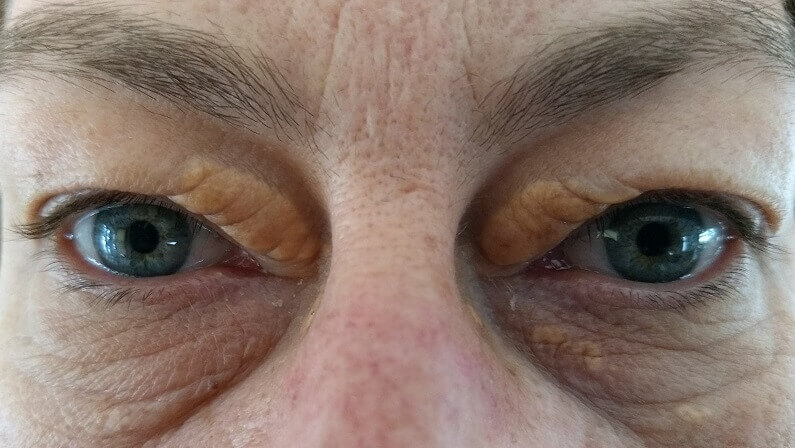
Xanthelasma’s main symptom is something you see rather than feel: soft, yellow, flat or slightly raised plaques on the eyelids, usually near the inner corners. It doesn’t hurt, itch or affect your sight. The more important symptoms may be elsewhere, because about half of people with xanthelasma have a blood fat disorder.
Xanthelasma symptoms are visible rather than felt: soft yellow plaques, flat or slightly raised, near the inner corners of the eyelids, often on both sides. They’re painless, don’t itch and don’t affect vision, and they tend to stay or slowly grow. Pain, bleeding, ulceration or fast change suggest something else and need a doctor.
Key Takeaways
- The main sign is soft yellow plaques near the inner eyelid corners.
- Xanthelasma doesn’t hurt, itch or affect your sight.
- Plaques tend to stay and may slowly grow or multiply.
- Pain, bleeding or a sore suggest a different condition.
- About half of people have a blood fat disorder with no symptoms of its own.
- Firm lumps on tendons or heel cords are worth mentioning to a doctor.
On This Page 16 sections
What Are Xanthelasma Symptoms?
The symptoms of xanthelasma are visible plaques rather than feelings: soft, yellow, flat or slightly raised patches on the eyelids, usually near the inner corners. There’s no pain, itching or effect on vision.
Xanthelasma palpebrarum is a buildup of fat-filled immune cells, called foam cells, in the eyelid skin.[1] Because those cells sit quietly in the skin, they don’t trigger pain or itching; what you notice is their yellow color showing through the thin eyelid skin. Classically, the plaques appear on both sides, above the inner corner of the eye.[3]
That makes xanthelasma a sign as much as a symptom: a visible clue that’s worth getting checked. Our main xanthelasma guide covers the condition in full.
What Are The Visible Signs Of Xanthelasma?
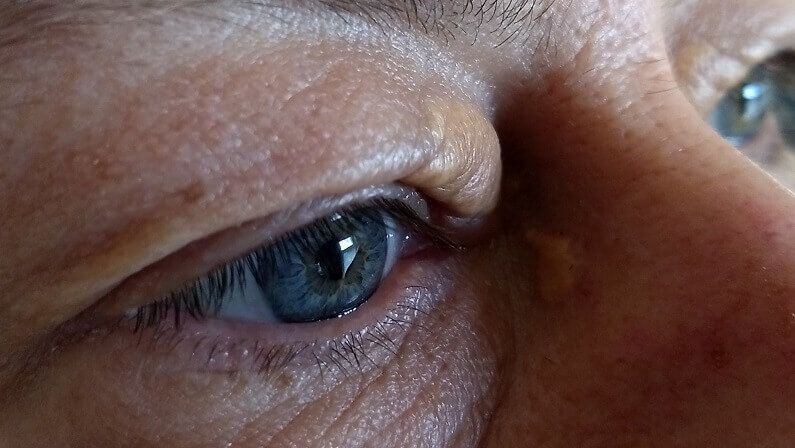
Yellow to yellow-orange color, a soft or velvety feel, a flat or slightly raised surface, clear edges, and a position near the inner corners of the eyelids, often on both sides.
- Color. Creamy to bright yellow, sometimes with an orange tint.
- Texture. Soft rather than hard; flat or slightly raised.
- Edges. Usually well defined.
- Position. Near the inner corners, classically on both sides.[3]
- Upper or lower lid. The upper lids are common; lower lids can be affected too.
- Number and size. From a single small spot to several plaques that can join together.
Our guides to what xanthelasma looks like, whether xanthelasma can be flat and whether xanthelasma can be white show the range of appearances.

Does Xanthelasma Hurt, Itch Or Affect Your Eyesight?
No. Xanthelasma is painless, doesn’t itch, and sits in the eyelid skin rather than the eye, so it doesn’t affect your sight. A sore, itchy or painful eyelid spot is more likely to be something else.
The plaques are a benign buildup of foam cells in the deeper layer of the skin,[1] which is why they’re usually found by looking in a mirror rather than by feel. A doctor can usually recognize xanthelasma just by looking at it.[2]
Very large plaques can add a little weight or bulk to the eyelid, but they don’t damage the eye itself. If your eyelid is red, swollen, tender or itchy, see a doctor, because those aren’t typical xanthelasma symptoms.
What Are The First Signs Of Xanthelasma?
Usually a small, faint yellowish patch or dot near the inner corner of one or both upper eyelids. It may look like a smudge of yellow at first and become more defined over months.
Early xanthelasma can be easy to mistake for a shadow or a trace of makeup. Signs it may be starting include a faint yellow tint that doesn’t wash off, a soft patch that feels slightly different from the surrounding skin, and a matching spot on the other eyelid. Our guide on how xanthelasma starts describes the early stages.
Noticing it early is useful: small, soft plaques that have been there less than a year are the simplest to remove.

How Do Xanthelasma Symptoms Change Over Time?
They tend to stay and may slowly grow, thicken or multiply over months and years. They rarely fade by themselves. Spots that appear suddenly and vanish within days are probably something else.
The process that forms xanthelasma, lipid leaking from eyelid vessels that blinking compresses and age makes leakier,[1] usually carries on, which is why plaques persist. Even after removal, they come back in under half of people, rising to around 60% after repeat procedures.[1]
Our guides on how fast xanthelasma grows, whether it can get bigger and whether xanthelasma spreads explain what to expect.

Who Usually Notices Xanthelasma Symptoms?

Mostly adults in midlife, and women more often than men. It affects about 1.1% of women and 0.3% of men, usually between 20 and 70 and most often between 35 and 55.
Xanthelasma’s prevalence is about 1.1% in women and 0.3% in men, peaking from 35 to 55.[1] In a study of 42 patients, 85.7% were women and the average age was about 47.[6] If it appears in your 20s or earlier, an inherited cholesterol condition is more likely, so it’s especially worth getting checked.[1] Our guide on whether xanthelasma is common has more.

How Can You Check Your Eyelids For Xanthelasma Symptoms?
Look in a mirror in good daylight, with your eyes gently closed and then open, and check both inner corners and both upper and lower lids. Take a photo so you can compare over time.
- Use natural light. Yellow tones are easier to see in daylight than under warm indoor bulbs.
- Remove makeup first. Concealer and eyeshadow can hide or mimic a yellow tint.
- Check both sides. Look at the inner corners of all four lids.
- Feel gently. Xanthelasma feels soft; a hard, tender or fixed lump is different.
- Photograph it. A dated photo every few months shows whether it’s changing.
Bring your photos to your appointment; they help a doctor see how the plaques have developed.

Xanthelasma Symptom Checker
| What You Notice | Typical Of Xanthelasma? | What To Do |
|---|---|---|
| Soft yellow plaques at the inner eyelid corners | Yes | Routine doctor’s check and blood tests |
| Plaques on both eyelids | Yes, classically | Routine check |
| Slow growth over months | Yes | Routine check; removal is easier while small |
| Tiny hard white dots | No; may be milia | Usually harmless; ask if unsure |
| Pain, redness, swelling or itching | No | See a doctor |
| Pearly bump, tiny vessels, bleeding or a sore | No | See a doctor promptly |
| Firm orange plaques spreading around the eyes | No | See a doctor; may need a biopsy |
Which Symptoms Suggest It Isn’t Xanthelasma?
Pain, itching, redness, bleeding, crusting or a sore that won’t heal; a pearly or pink bump with tiny vessels; firm, hard or orange nodules; or a single spot that’s changing fast. These point to other conditions.
A 2025 review of xanthelasma’s differential diagnosis lists syringoma, sebaceous hyperplasia and nodular basal cell carcinoma, a skin cancer, among the lookalikes, along with rare conditions such as necrobiotic xanthogranuloma, which causes yellowish or violaceous plaques around the eyes and is linked with blood protein disorders.[3] The diagnosis of xanthelasma is usually clinical, but a biopsy is advised if it’s uncertain or a rare mimic is suspected.[3]
Our guides on what can be mistaken for xanthelasma and whether xanthelasma can be cancerous explain the differences.

Are There Xanthelasma Symptoms Elsewhere In The Body?
Xanthelasma itself only affects the eyelids, but conditions linked with it can show elsewhere: firm lumps on the Achilles tendons or the backs of the hands, symptoms of an underactive thyroid or diabetes, or a personal or family history of early heart disease.
- Tendon lumps. Firm swellings on the Achilles, elbows, hands or knees can point to familial hypercholesterolemia, which also causes xanthelasma.[4] See tendon xanthomas.
- Underactive thyroid. Tiredness, feeling cold and weight gain can go with it; it’s a recognized secondary cause.[1]
- Diabetes. Thirst, passing urine often and tiredness can be signs; diabetes is linked with xanthelasma.[1]
- Heart symptoms. Chest pain or breathlessness on exertion always need prompt attention; xanthelasma is linked with a higher risk of heart attack and heart disease.[5]

Does High Cholesterol Cause Symptoms Alongside Xanthelasma?
Usually not. High cholesterol is generally silent, which is why a blood test matters. About half of people with xanthelasma have a blood fat disorder; the other half have normal levels.
About half of people with xanthelasma have a primary or secondary lipid disorder.[1] In a study of 42 patients, 45.2% had high cholesterol and 54.8% had normal cholesterol, and HDL was lower in patients than in controls.[6] A large population study found xanthelasma was linked with a higher risk of heart attack and heart disease, independent of cholesterol.[5]
So the plaques may be the only visible sign of something that otherwise has no symptoms. Our guides on what xanthelasma indicates and the causes of xanthelasma explain more.

Can Xanthelasma Affect How You Feel About Your Appearance?
Often, yes. Even though the plaques are painless, they sit in the middle of the face, and many people feel self-conscious about them. That’s a perfectly good reason to cover or remove them.
Because xanthelasma has no physical symptoms, its biggest effect for many people is on confidence: noticing it in photos, on video calls or when someone asks about it. You don’t need a medical reason to want the plaques gone. In the meantime, makeup can hide them well; the key is a lavender or purple color corrector to cancel the yellow before concealer, as our guide on how to cover xanthelasma with makeup explains.

When Should You See A Doctor About Xanthelasma Symptoms?
Book a routine appointment as soon as you notice the plaques. See a doctor promptly if a spot hurts, bleeds, ulcerates or changes quickly, and get urgent help for chest pain.
- Routine check. For typical yellow plaques, to confirm the diagnosis.
- Blood tests. A fasting lipid profile, liver panel, thyroid tests and fasting glucose, with HbA1c if you have diabetes.[1]
- Prompt appointment. For anything painful, bleeding, ulcerated or fast-changing.
- Biopsy, if needed. Only when the diagnosis is uncertain.[1]
- Urgent help. For chest pain or other signs of a heart attack.

Can You Get Rid Of The Visible Symptoms?
Yes. The plaques rarely fade by themselves, but they can be removed in a clinic with laser, surgery or peels, or at home with a removal cream made for xanthelasma, once your doctor has checked the cause.
Clinic removal works but carries some risk of scarring and color change, and plaques can return.[1] Many people with small to medium plaques prefer to remove them at home. Our guides to the removal of xanthelasma and xanthelasma cream compare the routes.

If your doctor has confirmed xanthelasma and you want to deal with the plaques at home, this is the cream we make for it.

What’s The Bottom Line On Xanthelasma Symptoms?
Xanthelasma symptoms are visible, not felt: soft yellow plaques near the inner eyelid corners that don’t hurt, itch or affect sight. Pain, bleeding or fast change suggest something else. The bigger concern is the silent blood fat disorder behind it in about half of people.
See your doctor to confirm it and check your blood fats, thyroid and blood sugar, then decide whether you want the plaques removed. Xanthel® is a cosmetic cream made for xanthelasma removal at home, sold by Xanthelasma.com. You’ll find it at the foot of this page, or read more about Xanthel® xanthelasma removal cream, and browse all our xanthelasma guides.
Common Questions About Xanthelasma Symptoms
What Are The Symptoms Of Xanthelasma?
Soft, yellow, flat or slightly raised plaques near the inner corners of the eyelids, often on both sides. There’s no pain, itching or effect on vision.
Does Xanthelasma Hurt Or Itch?
No. A painful, tender or itchy eyelid spot is more likely to be something else and should be checked.
Does Xanthelasma Affect Your Eyesight?
No. The plaques sit in the eyelid skin, not in the eye.
What Are The First Signs Of Xanthelasma?
Usually a faint yellow patch near the inner corner of an upper eyelid that doesn’t wash off and becomes more defined over months.
Do Xanthelasma Symptoms Get Worse?
The plaques tend to stay and may slowly grow or multiply, but they don’t become painful or harmful.
What Symptoms Mean It Isn’t Xanthelasma?
Pain, bleeding, crusting, a sore, a pearly bump with tiny vessels, or firm orange plaques spreading around the eyes.
Does High Cholesterol Cause Symptoms Too?
Usually not; high cholesterol is generally silent. About half of people with xanthelasma have a blood fat disorder, so a blood test is important.
When Should I See A Doctor?
As soon as you notice the plaques, for a routine check and blood tests, and promptly if a spot hurts, bleeds or changes quickly.
Sources
- Blair K. Xanthelasma Palpebrarum. StatPearls, National Library of Medicine (NCBI Bookshelf), updated 2026.
- Patadia A, Rana HS, Stewart K, Yen MT, Lee H. Xanthelasma. EyeWiki, American Academy of Ophthalmology, reviewed 2026.
- Van Alfen B, Hatch J, Conley M, Seeliyur Duraiswamy S. A Case Report of Xanthelasma and the Associated Differential Diagnosis. Cureus, 2025;17(4):e81971.
- Ison HE, Clarke SL, Knowles JW. Familial Hypercholesterolemia. GeneReviews, National Library of Medicine (NCBI Bookshelf), revised 2025.
- Christoffersen M, Frikke-Schmidt R, Schnohr P, Jensen GB, Nordestgaard BG, Tybjaerg-Hansen A. Xanthelasmata, arcus corneae, and ischaemic vascular disease and death in general population: prospective cohort study. BMJ, 2011.
- Kavoussi H, Ebrahimi A, Rezaei M, Ramezani M, Najafi B, Kavoussi R. Serum lipid profile and clinical characteristics of patients with xanthelasma palpebrarum. Anais Brasileiros de Dermatologia, 2016;91(4):468-471.