
How Is Xanthelasma Pronounced
Am I Saying It Wrong? The Simple Answer and the Common Mistakes
Not sure how to say xanthelasma? You are far from alone, it trips most people up. This page gives you the correct pronunciation, the mistakes to avoid, and a quick explanation of what the word actually means.
By Xanthelasma.com
How to Pronounce Xanthelasma
Here is the simple answer you came for. Xanthelasma is pronounced:
zan-thuh-LAZ-muh
The stress falls on the third syllable, “LAZ”. Broken down: “zan” (the x sounds like a z, not “eks”), “thuh” (a soft th as in “thin”), “LAZ” (rhymes with “jazz”), and “muh” (like the start of “mother”). Say it slowly a couple of times, zan-thuh-LAZ-muh, and it quickly stops feeling awkward.
The fuller medical name is xanthelasma palpebrarum, where “palpebrarum” (pal-puh-BRAR-um) simply means “of the eyelids”. Most people, including doctors, just say xanthelasma. So if you have been hesitating over the word, you now have it. If you would like to see other ways it is written out, our pages on how to pronounce xanthelasma and how do you say xanthelasma offer the same guidance in slightly different forms.

Common Mistakes to Avoid
A few predictable slip-ups catch people out, and avoiding them is most of the battle:
The “x” is not “eks”. It takes a soft “z” sound, so the word starts “zan”, not “eksan”. This is the single most common mistake.
The “th” is soft, as in “thin” or “thimble”, not hard as in “the” or “this”. So it is “thuh”, not “duh”.
The stress goes on “LAZ”, the third syllable, not the first. Saying “ZAN-thel-as-ma” with the emphasis up front sounds off; let the weight land on “LAZ” instead.
Get those three things right, soft z, soft th, stress on the third syllable, and you are saying it correctly. Nobody will blink, and most people who have the condition had to learn it the same way.

What the Word Actually Means
Now that you can say it, here is what it is. Xanthelasma is the name for soft yellow patches of cholesterol that form on or around the eyelids. The word comes from Greek, “xanthos” meaning yellow, which is why it shares its root with “xanthoma”, the broader term for cholesterol deposits anywhere on the body. Xanthelasma is the specific type on the eyelids.
The marks are harmless and painless, and they do not affect vision, the concern for most people is simply how they look. They can occasionally be a sign of raised cholesterol, so a quick check with your doctor is worthwhile, but around half of people who get them have completely normal cholesterol. Our overview of what xanthelasma is explains the condition in full, and what causes it covers where it comes from.

Now You Know the Word, What About the Marks?
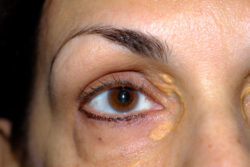
If you have looked up how to say xanthelasma, there is a fair chance you, or someone you know, actually has it. The good news is that the marks, while they will not fade on their own, can be cleared, and you do not need a clinic to do it. Xanthel ® is a cosmetic skincare cream formulated to remove xanthelasma plaques at home, designed as an alternative to surgery, laser, or freezing, without the cost, scarring risk, or downtime of a clinic procedure.
If that is relevant to you, you can read what xanthelasma looks like to confirm what you are seeing, compare the full range of removal options, or look at the at-home removal option directly. A quick lipid check with your doctor is worth doing alongside, to rule out any underlying cause.

Common Questions About Saying Xanthelasma
How do you pronounce xanthelasma?
It is pronounced zan-thuh-LAZ-muh, with the stress on the third syllable, “LAZ” (which rhymes with “jazz”). The “x” takes a soft “z” sound, and the “th” is soft as in “thin”. The full medical name, xanthelasma palpebrarum, adds pal-puh-BRAR-um, meaning “of the eyelids”.
Why is the “x” pronounced as a “z”?
This follows the Greek origin of the word, from “xanthos” meaning yellow. In English, an “x” at the start of a word taken from Greek is typically pronounced as a “z” sound, which is why xanthelasma begins “zan” rather than “eksan”. The same applies to related words like xanthoma.
What is the most common pronunciation mistake?
Saying the “x” as “eks”, so “eksan-thelasma”, is the most frequent error. It should be a soft “z”, giving “zan”. The other common slips are using a hard “th” instead of a soft one, and putting the stress on the first syllable instead of the third.
Is it pronounced differently in British and American English?
The differences are minimal. The core pronunciation, zan-thuh-LAZ-muh, is the same in both, with only very slight variation in how softly the “th” is said. The stress pattern and the soft “z” start stay consistent across accents.
What does xanthelasma mean?
Xanthelasma refers to soft yellow patches of cholesterol that form on or around the eyelids. The name comes from the Greek for yellow. It is the eyelid-specific type of xanthoma, the broader family of cholesterol deposits. The marks are harmless but can occasionally signal raised cholesterol.
What is xanthelasma palpebrarum?
It is the full medical name for xanthelasma, pronounced zan-thuh-LAZ-muh pal-puh-BRAR-um. “Palpebrarum” means “of the eyelids”, so the term literally describes yellow cholesterol patches on the eyelids. In everyday use, including by doctors, it is usually shortened to just xanthelasma.
Can xanthelasma be removed?
Yes. The marks will not fade on their own, but they can be cleared. Xanthel ® is a cosmetic skincare cream formulated to remove xanthelasma plaques at home, offering an alternative to clinic procedures like surgery, laser, and freezing, without the cost, scarring risk, or downtime.
Should I see a doctor about xanthelasma?
Yes, one visit is worthwhile. A doctor can confirm the marks are xanthelasma and run a simple lipid test to check for any underlying cholesterol issue. Once you have that reassurance, the marks are a cosmetic matter you can deal with separately, including at home.
Xanthel ® is a cosmetic skincare product, not a medical treatment. Because xanthelasma can sometimes sit alongside lipid, thyroid, or cardiovascular factors, it is worth discussing with your doctor, who can give you the full picture of your health to pair with any cosmetic approach.