
What Are Xanthelasma Symptoms
What You Actually Notice, and Why Xanthelasma Has No Symptoms in the Usual Sense
Looking for xanthelasma symptoms? Here is the surprising part: it causes no pain, itch, or discomfort. The “symptoms” are really just what you can see. This page covers the visible signs and what to watch for.
By Xanthelasma.com
What Are the Symptoms of Xanthelasma?
Here is the slightly surprising answer: xanthelasma has almost no symptoms in the usual sense. It does not hurt, itch, burn, or cause any physical discomfort, and it does not affect your vision. So unlike most conditions, there is nothing you feel, the “symptoms” of xanthelasma are really just what you can see: soft yellow patches on the eyelids. That is genuinely the whole of it for most people, which is reassuring.
Because it is a visible sign rather than a felt symptom, recognising xanthelasma is about knowing what to look for. This page covers the visible signs, how they typically appear and change, and, separately, the symptoms of the underlying conditions xanthelasma can occasionally point to, which are worth knowing about. The marks themselves are harmless and will not fade on their own, but they can be removed if you want them gone, Xanthel ® is a cosmetic skincare cream formulated to remove xanthelasma plaques at home. Our overview of what xanthelasma is gives the background, and what it looks like goes deeper into appearance.

The Visible Signs
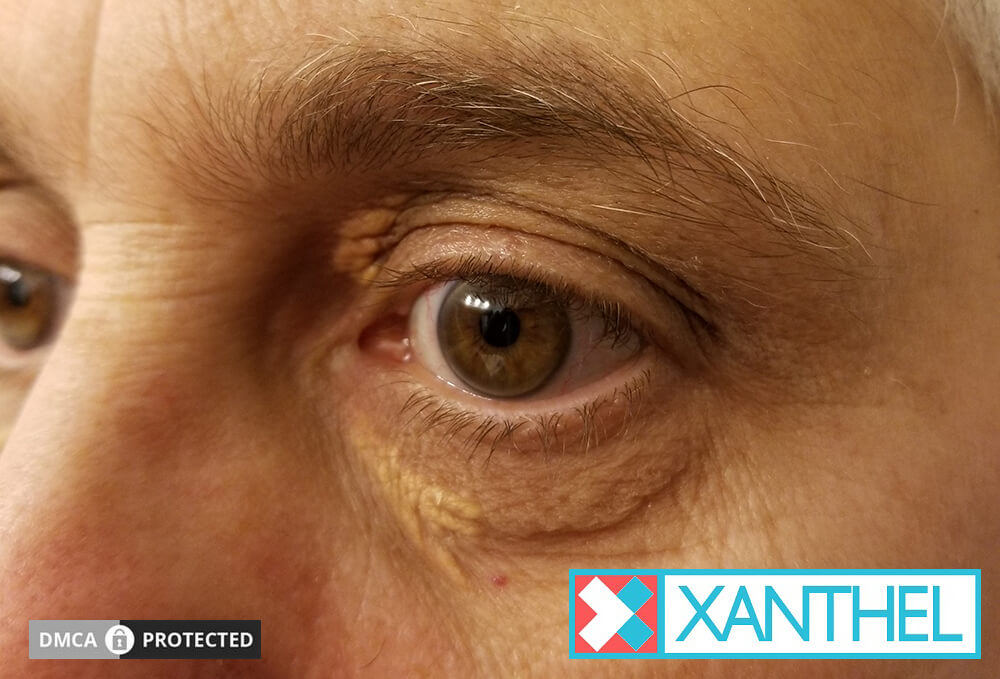
Since the visible appearance is what you actually notice, here is what to look for. Colour is the giveaway: xanthelasma is yellow, ranging from a pale creamy tone to a deeper yellow-orange, taking its colour from the cholesterol within. Texture is soft to the touch, often described as soft or velvety, and the patches are flat or only slightly raised, with fairly defined edges.
Location is highly characteristic: the marks appear on the eyelids, most often near the inner corner (the inner canthus, nearest the nose), and they tend to show up symmetrically, affecting both eyes in roughly matching spots. They can sit on the upper lid, the lower lid, or both, with the upper lid often affected first. In size they range from a small spot to a larger patch, and there may be one or several. If what you are seeing matches that picture, soft, yellow, symmetrical, near the inner eyelids, xanthelasma is very likely what it is.

How It Changes Over Time
One feature worth knowing is how xanthelasma behaves once it appears, since that is part of recognising it. Unlike a spot, a stye, or many other temporary blemishes that come and go, xanthelasma is persistent: it does not resolve on its own. Left alone, the marks tend to stay put and very often grow slowly in size or increase in number over months and years.
This persistence is actually a useful identifying feature. If a yellowish mark near your eye has been there for a while and is gradually becoming more noticeable rather than clearing up, that fits xanthelasma. Something that appears suddenly and then fades, by contrast, is more likely to be something else. The slow, steady, non-resolving pattern is characteristic, and it is also why many people eventually decide to have the marks removed rather than wait for a change that does not come. Our page on how long xanthelasma lasts covers this.

Telling It Apart From Other Eyelid Bumps
Because the “symptom” is visual, distinguishing xanthelasma from other things that appear near the eyes is the main diagnostic step. Several other harmless bumps can show up in the same area but look or feel different. Milia are small, firm, white (not yellow) cysts. Syringomas are small skin-coloured bumps. Styes are red, tender, and often painful, the opposite of xanthelasma’s painless yellow softness. Skin tags hang off the skin rather than sitting flat within it.
The combination that points specifically to xanthelasma is the yellow colour, the soft flat texture, the position near the inner eyelid, and the painless, symmetrical, persistent nature. If a mark does not fit that pattern, particularly if it is painful, bleeds, changes rapidly, or looks unusual, it is worth getting it checked by a doctor to be sure, not because xanthelasma is dangerous, but because correctly identifying any eyelid growth is sensible. A doctor can usually confirm xanthelasma on sight.
Symptoms to Watch for Elsewhere
While xanthelasma itself causes no symptoms, it can occasionally be an outward sign of an underlying condition, and those conditions sometimes do have symptoms worth noticing. This is the one area where “symptoms” genuinely come into play, just not in the eyelid marks themselves.
Because xanthelasma is cholesterol-based, it can occasionally accompany raised lipids; high cholesterol itself is usually silent, which is exactly why a simple blood test matters. It can also sometimes sit alongside an underactive thyroid (whose symptoms can include fatigue, weight gain, and feeling the cold) or diabetes (increased thirst, frequent urination, tiredness). None of these is a given, around half of people with xanthelasma have completely normal cholesterol, but if you notice the marks alongside any of those wider symptoms, it is worth mentioning to your doctor. A simple set of checks settles it. Our page on what xanthelasma indicates covers this side in more depth.

What to Do If You Recognise the Signs
If what you are seeing matches xanthelasma, the sensible response is calm and twofold. First, see your doctor for confirmation and a simple check: they can identify the marks, usually on sight, and run a lipid blood test (often with a thyroid and blood-sugar check) to rule out any underlying cause. If something is found, managing it protects your wider health; if not, you have reassurance.
Second, the marks themselves are a cosmetic matter, separate from the health side. They will not fade on their own, so if they bother you, they can be removed, and you do not need a clinic. Xanthel ® is a cosmetic skincare cream formulated to remove xanthelasma plaques at home, as an alternative to surgery, laser, or freezing. You can look at the at-home removal option or compare the full range of removal options. There is no urgency, since the marks are harmless, so the decision is entirely about how you feel about their appearance.

What Are Xanthelasma Symptoms: The Bottom Line
Xanthelasma has no symptoms in the usual sense, it causes no pain, itch, or discomfort and does not affect vision. Its “symptoms” are simply the visible signs: soft, flat, yellow patches near the inner corners of the eyelids, usually symmetrical, that persist and slowly grow rather than clearing up. The main step in recognising it is telling it apart from other harmless eyelid bumps, which a doctor can do on sight.
If you recognise the signs, a simple check with your doctor confirms it and rules out any underlying cause, and the marks themselves can be removed if you wish. It is worth looking at the at-home removal option, and reading what causes xanthelasma to understand why the marks form.

Common Questions About Xanthelasma Symptoms
What are the symptoms of xanthelasma?
Xanthelasma causes no pain, itching, or discomfort and does not affect vision, so it has no symptoms in the usual sense. Its only signs are visible: soft, flat, yellow patches on the eyelids, usually near the inner corners and often symmetrical on both eyes. The marks persist and tend to grow slowly rather than clearing up.
Does xanthelasma hurt or itch?
No. Xanthelasma is painless and does not itch, burn, or cause any physical discomfort. This is one of the features that distinguishes it from other eyelid problems like styes, which are red and tender. If a mark near your eye is painful, it is unlikely to be xanthelasma and is worth getting checked.
What does xanthelasma look like?
It appears as soft yellow patches, from pale creamy to deeper yellow-orange, usually near the inner corner of the eyelids and often symmetrically on both eyes. The patches are flat or slightly raised with fairly defined edges, soft to the touch, and range from small spots to larger marks. They persist and slowly grow over time.
How do I know if a bump is xanthelasma or something else?
Xanthelasma is yellow, soft, flat, painless, and sits near the inner eyelids, often symmetrically. Other bumps differ: milia are white and firm, syringomas are skin-coloured, styes are red and tender. If a mark does not fit the yellow, painless, persistent pattern, or it bleeds or changes rapidly, see a doctor, who can confirm xanthelasma on sight.
Are there any symptoms that mean my xanthelasma is serious?
The marks themselves are always harmless. What is worth noting is whether you have symptoms of an associated condition, since xanthelasma can occasionally accompany raised cholesterol (usually silent), an underactive thyroid (fatigue, weight gain), or diabetes (thirst, frequent urination). If you notice these alongside the marks, mention it to your doctor, who can run simple checks.
Does xanthelasma affect eyesight?
No. Xanthelasma sits in the skin of the eyelids and does not affect the eye itself or your vision. It is purely a surface deposit. In very rare cases where a plaque becomes large, it could theoretically affect eyelid movement, but for typical xanthelasma there is no impact on sight at all.
Will xanthelasma go away on its own?
Almost never. A defining feature of xanthelasma is that it persists rather than resolving, and it often slowly grows or multiplies over time. This is unlike temporary blemishes that come and go. Because it will not fade by itself, most people who want the marks gone choose to have them removed directly.
Should I see a doctor if I have xanthelasma symptoms?
Yes, one visit is worthwhile. A doctor can confirm the marks are xanthelasma, usually on sight, and run a simple lipid test, plus check thyroid or blood sugar if relevant, to rule out any underlying cause. Once confirmed, the marks are a cosmetic matter you can address separately, including at home.
Xanthel ® is a cosmetic skincare product, not a medical treatment. Because xanthelasma can sometimes sit alongside lipid, thyroid, or cardiovascular factors, it is worth discussing with your doctor, who can give you the full picture of your health to pair with any cosmetic approach.