Where Can You Find Xanthelasma?
The Places These Yellow Marks Appear, on the Eyelids and Beyond
Where can you find xanthelasma? Most often on the upper eyelids near the inner corner of the eye, frequently on both sides. This page explains where the marks tend to appear, why the eye area in particular, and what they signal.
By Xanthelasma.com
Where Can You Find Xanthelasma?
Xanthelasma are soft yellow cholesterol deposits that form in the skin, and they have a strong preference for one area: the eyelids, particularly the upper lid near the inner corner of the eye, close to the nose. They often appear symmetrically, showing up on both eyes in roughly matching spots. The lower eyelid can be involved too, though that is less common, and occasionally the marks extend across more of the lid.
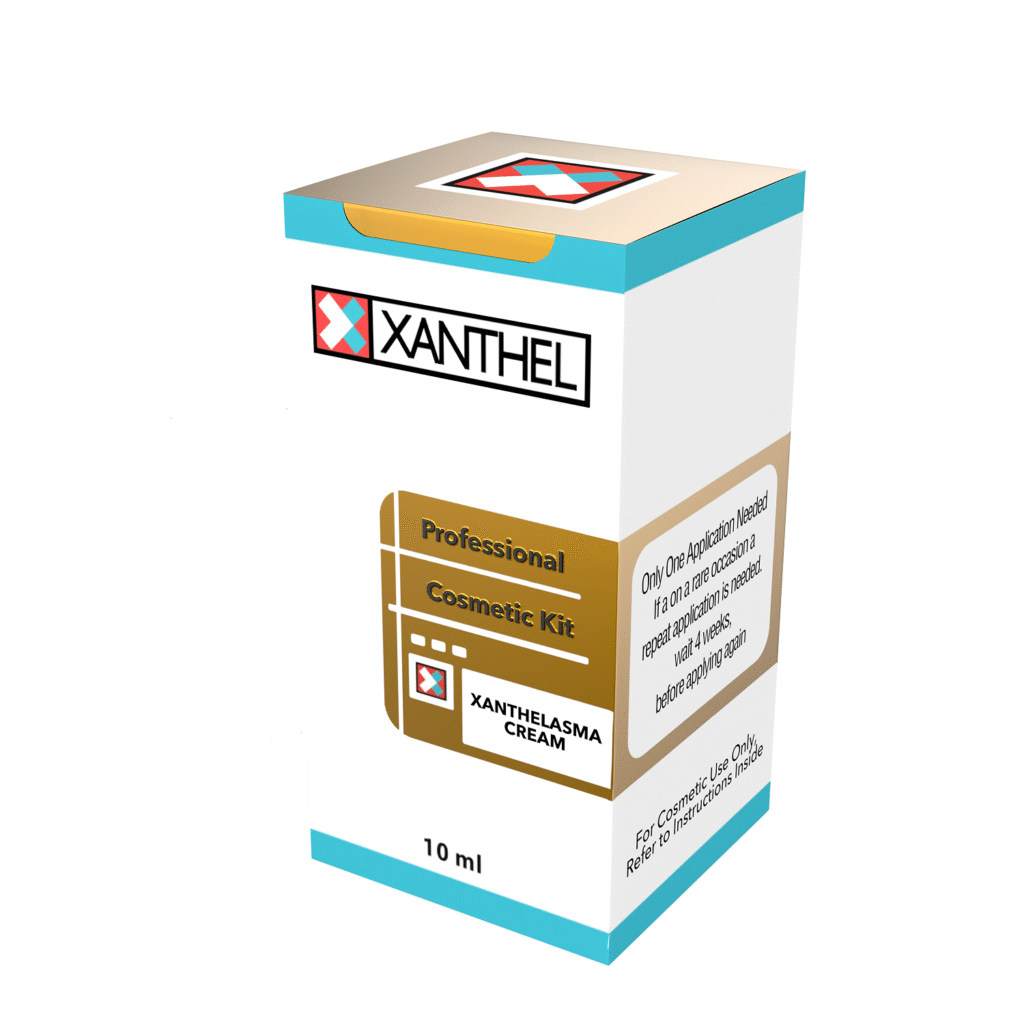
So if you have noticed a yellowish patch near your eye and are wondering whether it is in a “typical” place, the inner upper eyelid is the classic site. The rest of this page covers why the eye area specifically, how the upper and lower lids differ, and what the marks can signal about your health. The good news is they are harmless and removable, and the least invasive route is at home: Xanthel ® is a cosmetic skincare cream made for xanthelasma removal at home, the at-home answer this page returns to. Our xanthelasma overview covers the basics.

Why the Eyelids in Particular
It is a fair question why cholesterol deposits favour the eyelids over other areas. The likely reason comes down to the skin there. Eyelid skin is the thinnest on the body and contains relatively little underlying fat, which seems to make it more prone to the visible accumulation of cholesterol-rich material just beneath the surface. The deposits that form there, made of lipid-laden cells, show through the delicate skin as the familiar soft yellow patches.
This preference for thin skin around the eyes is why the medical name for the eyelid form is xanthelasma palpebrarum, “palpebrarum” referring to the eyelids. While the wider family of xanthomas can appear in many places on the body, the eyelid form is distinct enough, and common enough, to have its own name. The symmetry, where marks often mirror each other on both eyes, also reflects this shared tendency across the eyelid skin rather than a single isolated spot. Our pages on the eyelid form of xanthelasma and what causes the cholesterol deposits around the eyes go further.

Upper Lid Versus Lower Lid
The two eyelids are affected differently, which is worth knowing when you are working out what you are seeing. The upper eyelid is the more frequent site, especially the inner corner near the nose. When marks here grow larger, they can sit within the natural fold of the lid and become more noticeable, though they do not affect eyesight. In some cases a sizeable plaque can affect the shape of the lid, which is one reason people choose to have them removed.
The lower eyelid is involved less often, and marks there tend to be less obvious unless they are looked for or grow in size. Wherever they sit, the marks are typically soft, flat or slightly raised, and yellow to yellow-orange, and they commonly appear on both eyes rather than just one. Keeping a casual eye on any change in size or colour is sensible, not because the marks are dangerous, but because a change can be a prompt to check in with your doctor. Our page on whether xanthelasma can be flat covers the variation in appearance.

Could the Mark Be Somewhere Unusual, or Not Xanthelasma at All?
Because xanthelasma so strongly favours the inner eyelid, a yellowish mark in an unexpected spot, or one that looks different from the classic soft flat plaque, is worth a second look. Sometimes what appears near the eyes is a look-alike rather than xanthelasma: milia (tiny white keratin bumps), syringomas (small firm sweat-duct bumps, often on the lower lid), or sebaceous hyperplasia (yellowish bumps with a central dimple) can all be mistaken for it. These are harmless too, but they are not cholesterol deposits and are dealt with differently.
If a mark is in an atypical location, has an unusual colour or texture, or is changing, a quick check with a doctor is the sensible step, both to confirm it is xanthelasma and, occasionally, to rule out anything else. A doctor can usually tell on sight, sometimes with a small biopsy if there is any doubt. Our guide to what can be mistaken for xanthelasma sets out the common look-alikes and how they differ.

What the Location Signals, and What to Do
Wherever on the eyelids your xanthelasma sits, the marks carry the same general meaning: they are deposits of cholesterol, harmless in themselves but occasionally a clue to your lipid health. They can be associated with raised cholesterol, and sometimes with factors like an underactive thyroid or diabetes, which is why a simple lipid blood test is worth having when they appear. It is worth keeping in proportion, though: around half of people with xanthelasma have completely normal cholesterol, so for many the marks are simply a cosmetic feature.
On the practical side, since the marks do not fade on their own, removal is the way to clear them if the appearance bothers you. The least invasive route is the at-home cream, Xanthel ®, which avoids the clinic, anaesthetic, and recovery the procedures involve; clinic options like laser, cryotherapy, surgery, and electrosurgery are available for larger or stubborn marks. If you would rather skip the clinic, xanthelasma removal at home with Xanthel ® is the simplest starting point. Our pages on how xanthelasma is removed and getting rid of it without surgery cover the options.


Where Can You Find Xanthelasma? The Bottom Line
Xanthelasma is found most often on the upper eyelids near the inner corner of the eye, frequently on both sides, with the lower lid involved less commonly. The eye area is favoured because the skin there is thin with little underlying fat, which lets the soft yellow cholesterol deposits show through. The marks are harmless and do not affect vision, though a sizeable one can affect the shape of the lid.
If a mark is in an unusual spot or looks different from the classic plaque, it is worth checking with a doctor, since look-alikes like milia and syringomas can appear near the eyes too. Wherever the marks sit, a simple lipid check is worthwhile, and since they will not fade on their own, removal clears them. If you would rather avoid a clinic, xanthelasma removal at home with Xanthel ® is the least invasive route. You can also read whether xanthelasma can disappear on its own.

Common Questions About Where Xanthelasma Appears
Where does xanthelasma usually appear?
Most often on the upper eyelids, particularly near the inner corner of the eye close to the nose. It frequently appears symmetrically, on both eyes in matching spots. The lower eyelid can be affected too, though less commonly. The marks are soft, flat or slightly raised, and yellow to yellow-orange.
Why does xanthelasma form on the eyelids?
The skin on the eyelids is the thinnest on the body and has little underlying fat, which seems to make it more prone to the visible accumulation of cholesterol-rich material just beneath the surface. The deposits show through the delicate skin as soft yellow patches, which is why this form is named xanthelasma palpebrarum.
Can xanthelasma appear on the lower eyelid?
Yes, though it is less common than on the upper lid. Lower-lid marks tend to be less noticeable unless they are looked for or grow in size. Xanthelasma often appears symmetrically, so marks may show on both upper and lower lids across both eyes in some cases.
Does xanthelasma appear on both eyes?
Often, yes. Xanthelasma commonly appears symmetrically, showing up on both eyes in roughly matching positions, usually the inner upper eyelids. This reflects a shared tendency across the eyelid skin rather than a single isolated spot, though some people do have marks on only one eye.
Can you get xanthelasma somewhere other than the eyelids?
The eyelid form, xanthelasma, is specific to the eye area. The wider family of xanthomas can appear elsewhere on the body, over tendons, elbows, knees, or palms, but those are different types with their own names. A yellowish mark well away from the eyes may be a different kind of xanthoma or another condition, worth checking with a doctor.
Does the location of xanthelasma affect my eyesight?
No. Although xanthelasma forms on the eyelids, the marks do not affect eyesight. A large plaque on the upper lid can affect the shape or fold of the eyelid, which is a cosmetic matter rather than a visual one. If a mark is changing or affecting the lid, it is worth seeing a doctor.
A yellowish mark near my eye is not where xanthelasma usually appears, what could it be?
It may be a look-alike rather than xanthelasma. Milia (tiny white bumps), syringomas (firm bumps often on the lower lid), and sebaceous hyperplasia (bumps with a central dimple) can all appear near the eyes and be mistaken for xanthelasma. They are harmless but differ in cause and treatment, so a doctor’s check is sensible to confirm what it is.
Xanthel ® is a cosmetic skincare cream made for xanthelasma removal at home, not a medical treatment for any underlying condition. However your xanthelasma is removed, a simple check with your doctor is worthwhile, since xanthelasma can sometimes sit alongside lipid, thyroid, or cardiovascular factors worth identifying and managing for your wider health.