How Does Xanthelasma Work?
The Biology Behind the Yellow Eyelid Marks, from Cholesterol to Visible Plaque
How does xanthelasma work? It forms when cholesterol-rich material builds up in the eyelid skin and immune cells turn it into a visible yellow plaque. This page explains that process, why it favours the eyelids, and what it means for clearing the marks.
By Xanthelasma.com
How Does Xanthelasma Work?
Xanthelasma is the localised build-up of cholesterol-rich material in the skin of the eyelids, showing as soft yellow patches. To understand how it works, it helps to follow the process from the inside out: cholesterol settles in the eyelid skin, the body’s immune cells respond to it, and the result is the visible plaque you can see. It is benign, but the way it forms explains a lot, including why it does not simply fade on its own.
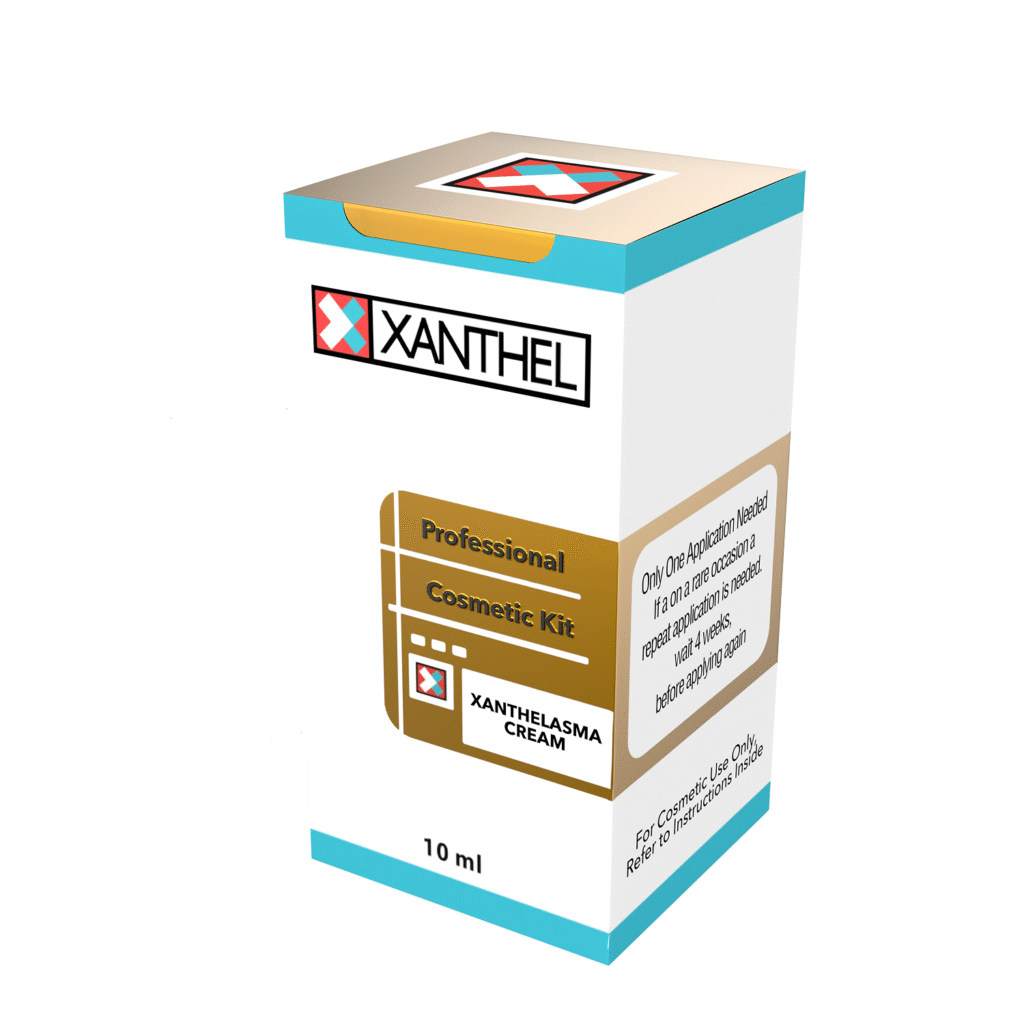
This page walks through that mechanism step by step, then covers why the eyelids in particular, and what it all means in practice. The short version of the practical part: because the deposit is a settled accumulation rather than a temporary blemish, clearing it means removing it, and the least invasive route is at home. Xanthel ® is a cosmetic skincare cream made for xanthelasma removal at home, the at-home answer this page returns to. Our xanthelasma overview covers the basics, and how xanthelasma forms is a close companion to this page.

The Process: Cholesterol to Foam Cells to Plaque
At the centre of how xanthelasma works are cholesterol and a type of immune cell. The process begins when cholesterol-rich material, particularly low-density lipoprotein (LDL, the “bad” cholesterol), settles in the dermis, the deeper layer of the eyelid skin. This can happen because blood lipid levels are raised, or, in many people, simply because of local factors in the skin even when blood cholesterol is normal.
The body’s immune system then responds. Macrophages, a kind of white blood cell, move into the area and engulf the excess lipid. As they fill with cholesterol they swell and take on a foamy appearance, which is why they are called “foam cells.” When enough foam cells gather and cluster together, they form the soft yellow plaque that shows through the skin as xanthelasma. High-density lipoprotein (HDL, the “good” cholesterol) works in the opposite direction, helping carry cholesterol back to the liver, which is part of why the balance of LDL and HDL matters. Our page on the causes of xanthelasma covers the drivers behind this in more detail.

Why the Eyelids, and Why It Does Not Self-Clear
Two features of how xanthelasma works are worth drawing out. The first is location: xanthelasma overwhelmingly favours the eyelids, especially the upper lid near the inner corner. The likely reason is that eyelid skin is the thinnest on the body with little underlying fat, which seems to make it more prone to the visible accumulation of cholesterol-rich material just beneath the surface, and lets the yellow deposit show through. The marks are often symmetrical across both eyes, reflecting this shared tendency in the eyelid skin.
The second feature is persistence. Because the plaque is a settled accumulation of lipid-laden cells, the body has no easy way to reabsorb it, so an untreated xanthelasma typically stays put or grows slowly rather than fading. This is the key practical consequence of how it works: waiting for it to clear on its own rarely succeeds. Our pages on where xanthelasma is found and whether xanthelasma can disappear follow these two points further.

What the Mechanism Means for Your Health
Since xanthelasma is, in effect, cholesterol made visible in the skin, the way it works gives it a secondary role as a possible clue to your lipid health. It can be associated with raised LDL or low HDL, and sometimes with inherited lipid disorders or conditions like an underactive thyroid, diabetes, or liver problems that affect how the body handles fats. This is why a doctor will often suggest a simple lipid blood test when xanthelasma appears.
It is important to keep this in proportion, though. The same mechanism can operate locally in the skin without raised blood cholesterol, which is why around half of people with xanthelasma have completely normal cholesterol. So the marks are a prompt to check, not proof of a problem. Where a lipid issue is found, managing it benefits your wider cardiovascular health; where levels are normal, the marks are simply cosmetic. Our pages on whether xanthelasma indicates raised cholesterol and whether it is genetic cover this side.

How This Shapes Removal
Understanding how xanthelasma works makes the approach to clearing it clearer. Because the visible mark is a settled deposit, removing it means physically clearing that deposit, and because the underlying process can continue, managing any cause helps prevent new marks. The two are separate jobs: removal handles what you can see, cause-management reduces the chance of more.
For removing the mark, the least invasive route is at home with Xanthel ®, which avoids the clinic, anaesthetic, and recovery that procedures involve; clinic options like laser, cryotherapy, surgery, and radiofrequency are available for larger or stubborn marks. To be straightforward about it, no removal method changes your underlying tendency, so recurrence is possible if a cause is left unmanaged, which is why a cholesterol check alongside removal is worthwhile. If you would rather skip the clinic, xanthelasma removal at home with Xanthel ® is the simplest starting point. Our guides to xanthelasma removal and how xanthelasma is removed compare the options.


How Does Xanthelasma Work? The Bottom Line
Xanthelasma works like this: cholesterol-rich material settles in the thin skin of the eyelids, the body’s immune cells (macrophages) engulf it and become foamy “foam cells,” and clusters of these form the visible yellow plaque. It favours the eyelids because the skin there is thin with little fat, and because the deposit is a settled accumulation, the body does not readily reabsorb it, so it rarely fades on its own.
Since it is cholesterol made visible, it can occasionally signal a lipid issue worth checking, though around half of people with it have normal cholesterol. Clearing the marks means removing them, with the least invasive route being at home with Xanthel ®, and managing any underlying cause helps prevent new ones. If you would rather avoid a clinic, xanthelasma removal at home with Xanthel ® is the simplest place to start. You can also read what xanthelasma looks like to confirm what you are seeing.

Common Questions About How Xanthelasma Works
What causes xanthelasma to form?
It forms when cholesterol-rich material, particularly LDL cholesterol, settles in the eyelid skin. The body’s immune cells (macrophages) engulf the lipid and become foamy foam cells, which cluster to form the visible yellow plaque. This can happen with raised blood cholesterol or, in many people, due to local factors in the skin even when cholesterol is normal.
What are foam cells in xanthelasma?
Foam cells are immune cells called macrophages that have engulfed excess cholesterol-rich material and swollen into a foamy appearance. When many of them gather and cluster in the eyelid skin, they form the soft yellow plaque seen as xanthelasma. They are central to how the marks form and why they have their characteristic colour.
Why does xanthelasma form on the eyelids specifically?
The skin on the eyelids is the thinnest on the body and has little underlying fat, which seems to make it more prone to the visible accumulation of cholesterol-rich material just beneath the surface. The yellow deposit shows through the delicate skin, and the marks often appear symmetrically across both eyes.
Does xanthelasma mean my cholesterol is high?
Not necessarily. The same process that forms xanthelasma can operate locally in the skin without raised blood cholesterol, so around half of people with it have normal levels. It can be linked to raised LDL or low HDL, which is why a simple lipid test is worthwhile when it appears, either as reassurance or to flag something worth managing.
Why doesn’t xanthelasma go away on its own?
Because the plaque is a settled accumulation of cholesterol-laden cells in the skin, and the body has no easy way to reabsorb it. Unlike a temporary blemish, it does not run a course and clear, so an untreated xanthelasma usually persists or grows slowly. Clearing it means actively removing it, the least invasive route being at home with Xanthel ®.
Can understanding how xanthelasma works help prevent it?
To an extent. Since the marks are cholesterol made visible, managing your lipid levels where they are raised, through diet, activity, not smoking, and any medication your doctor advises, can reduce the chance of new marks forming. This helps prevent new xanthelasma but rarely clears existing ones, which still need removal.
Is the way xanthelasma works the same as other xanthomas?
Broadly, yes. All xanthomas form through cholesterol-rich material accumulating in the skin and being taken up by foam cells. What differs is location and the strength of the link to lipid disorders: the eyelid form (xanthelasma) is often cosmetic, while types elsewhere on the body are more strongly tied to lipid problems that need a doctor’s attention.
Xanthel ® is a cosmetic skincare cream made for xanthelasma removal at home, not a medical treatment for any underlying condition. However your xanthelasma is removed, a simple check with your doctor is worthwhile, since xanthelasma can sometimes sit alongside lipid, thyroid, or cardiovascular factors worth identifying and managing for your wider health.