
What Is Xanthoma
The Family of Cholesterol Deposits, the Types, and What Each One Signals
A xanthoma is a deposit of cholesterol-rich material in the skin or tendons. There are several types, in different places, and each signals something different about your health. This page explains them.
By Xanthelasma.com
What Is a Xanthoma?
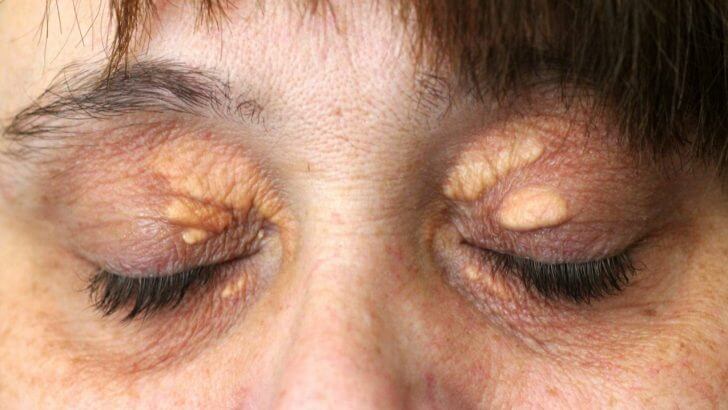
A xanthoma is a deposit of cholesterol-rich, fatty material that builds up in the skin or tendons, showing through as a firm or soft lump or patch, often yellowish, sometimes skin-coloured, pink, or orange. The word covers a whole family of these deposits, which can appear in very different places, the eyelids, the tendons, the palms, the elbows and knees, the buttocks, or more widely across the skin, and look quite different depending on the type.
The single most important thing to understand is that a xanthoma is usually harmless in itself, but it is often a visible sign of something going on with your body’s lipids (fats). For most types, the deposit is the body flagging raised cholesterol or triglycerides, or a related condition, which is why a xanthoma is worth a doctor’s assessment rather than being treated as just a skin blemish. The main exception is the eyelid type, which is frequently just cosmetic. This page explains the family, the types, and what each one signals. Our overview of xanthomas covers the group too.

What Causes Xanthomas
Across the family, the common thread is lipids. Xanthomas form when cholesterol and other fats deposit in the skin or tendons, and that usually happens because there is an excess of these fats in the blood, or a problem in how the body handles them. So a xanthoma is, in most cases, an outward sign of a lipid issue rather than a skin problem that arises on its own.
The specific drivers vary. Raised cholesterol or triglycerides (hyperlipidemia) is the common one, sometimes inherited, as in familial hypercholesterolemia, a genetic condition that runs in families and carries real cardiovascular risk. Other contributors include diabetes, an underactive thyroid, and certain liver conditions, all of which affect lipid metabolism. Diet, weight, and lifestyle play a part in the overall lipid picture too. Because the underlying cause matters so much more than the lump, identifying it through a doctor is the key step with any xanthoma. Our page on the causes behind these deposits covers the lipid side in more detail.

The Types of Xanthoma, and What Each Signals
This is the useful part, because the type tells you a lot. The main types are:
Eruptive xanthomas: crops of small yellow-red bumps that appear suddenly, often on the buttocks, shoulders, or limbs, and signal very high triglycerides, which can carry a risk of pancreatitis. Tendinous (tendon) xanthomas: firm lumps on tendons like the Achilles or the knuckles, a classic sign of familial hypercholesterolemia. Tuberous xanthomas: firm, painless yellow-orange nodules over the joints (elbows, knees), usually signalling high cholesterol. Plane xanthomas: flat yellowish patches that can appear anywhere, sometimes linked to particular liver or blood conditions.
And then xanthelasma: the type on the eyelids, which is the most common of all. It stands a little apart from the rest, because while it can be associated with raised cholesterol, around half of people who have it have completely normal lipids, so it is often purely cosmetic. The pattern to take away is that most xanthoma types are meaningful health signals worth investigating, with eyelid xanthelasma being the one that is frequently just a cosmetic matter. Our pages on tendon xanthomas, tuberous xanthoma, and plane xanthoma cover the individual types.

How Xanthomas Are Diagnosed
Because the type and the underlying cause both matter, diagnosis is about more than identifying the lump. A doctor can often recognise a xanthoma by its appearance and location alone, the type frequently being apparent from where it is and what it looks like. Where there is any doubt, a small biopsy can confirm it, showing the characteristic fat-laden cells under the microscope.
The more important part of the workup, though, is the blood testing that usually follows. A lipid profile checks your cholesterol and triglycerides, and tests for diabetes, thyroid function, and liver function may be done too, because these are the conditions xanthomas can flag. This is what turns a xanthoma from a skin finding into useful health information: it can prompt the discovery and management of an underlying issue you might not otherwise have known about. For any xanthoma, this assessment with a doctor is the sensible first step. Our page on what xanthelasma indicates covers the health-signal side for the eyelid type.

How Xanthomas Are Managed
Management follows from the type and cause, and for most xanthomas the priority is not the lump. Because the great majority are driven by a lipid disorder, the main treatment is managing that underlying cause with your doctor, through diet, lifestyle, and often lipid-lowering medication such as statins. This protects your wider health and frequently improves the lesions; eruptive xanthomas in particular can shrink or clear once high triglycerides are controlled.

Direct removal of the lesions is a secondary, more cosmetic consideration, and where it is done the methods are surgery, laser, freezing, or electrosurgery, carried out by a doctor. The eyelid type, xanthelasma, is the one where cosmetic removal is most often the main concern, since it is harmless, and for that type an at-home option exists. Xanthel ® is a cosmetic skincare cream formulated to remove xanthelasma plaques at home, made specifically for the eyelid type, not for tendon, eruptive, palmar, or other body xanthomas, which need the medical approach above. Our removal options page covers the methods for the eyelid type.

What Is Xanthoma: The Bottom Line
A xanthoma is a deposit of cholesterol-rich material in the skin or tendons, usually harmless in itself but typically a visible sign of a lipid issue worth investigating. There are several types, eruptive, tendinous, tuberous, plane, and eyelid (xanthelasma), in different places, and each signals something different, from very high triglycerides to inherited high cholesterol. For most types, the priority is identifying and managing the underlying cause with a doctor, which matters more than the lump.
The eyelid type, xanthelasma, is the exception that is frequently just cosmetic, and for that type the at-home removal option is one route once any underlying cause has been checked. For any xanthoma, though, a doctor’s assessment comes first, and you can read more in our overview of xanthomas.
Common Questions About Xanthoma
What is a xanthoma?
A xanthoma is a deposit of cholesterol-rich, fatty material in the skin or tendons, showing as a firm or soft lump or patch, often yellowish. It is usually harmless in itself but is typically a visible sign of a lipid (fat) issue in the body. The word covers a family of these deposits that appear in different places and signal different things.
Is a xanthoma dangerous?
The deposit itself is generally harmless. Its significance is as a marker: most xanthoma types signal an underlying lipid disorder, such as raised cholesterol or triglycerides, which can carry real health implications like cardiovascular risk or, with very high triglycerides, pancreatitis. So while the lump is not dangerous, what it can flag is worth investigating with a doctor.
What are the different types of xanthoma?
The main types are eruptive xanthomas (sudden small bumps signalling very high triglycerides), tendinous xanthomas (on tendons, signalling inherited high cholesterol), tuberous xanthomas (firm nodules over joints, signalling high cholesterol), plane xanthomas (flat patches, various causes), and xanthelasma (on the eyelids, the most common type, often just cosmetic). Each appears in characteristic places and signals something different.
What causes xanthomas?
They form when cholesterol and other fats deposit in the skin or tendons, usually because of raised lipids in the blood or a problem in how the body handles fats. Common drivers include hyperlipidemia (sometimes inherited, as in familial hypercholesterolemia), diabetes, an underactive thyroid, and certain liver conditions. The underlying cause matters more than the lesion itself.
Is xanthelasma a type of xanthoma?
Yes. Xanthelasma is the type of xanthoma that appears on the eyelids, and it is the most common type of all. It stands a little apart because, while it can be associated with raised cholesterol, around half of people who have it have normal lipids, so it is frequently just a cosmetic matter rather than a health signal.
How are xanthomas treated?
For most types, the priority is treating the underlying lipid disorder with a doctor, through diet, lifestyle, and often lipid-lowering medication, which protects your health and can improve the lesions. Direct removal (surgery, laser, freezing) is a secondary, cosmetic step. The eyelid type, xanthelasma, is the one where cosmetic removal is most often the main concern.
Can a cream remove a xanthoma?
A cosmetic cream like Xanthel is made for xanthelasma, the eyelid type, not for tendon, eruptive, palmar, or other body xanthomas, which need medical assessment and treatment of their underlying cause. If your deposit is the eyelid type, an at-home cream is an option once you have had a lipid check. For other types, see a doctor first.
Should I see a doctor about a xanthoma?
Yes. Because most xanthoma types signal an underlying condition, some serious, a doctor should identify the type and check for any lipid or systemic cause before you consider anything else. This assessment is the valuable part, since it can catch a manageable condition early. The eyelid type is harmless, but still warrants a simple lipid check.
Xanthel ® is a cosmetic skincare cream made to remove xanthelasma plaques (the eyelid type of xanthoma) at home, not a medical treatment for xanthomas elsewhere on the body or for any underlying condition. Because most xanthomas are signs of a lipid or systemic disorder, it is important to see your doctor for assessment, who can identify the type and manage any underlying cause.