
The Safe At-Home Process Step By Step: Before You Start, Application, Healing, Aftercare, And The Remedies To Avoid
How do you get rid of xanthelasma at home? With a removal cream made specifically for xanthelasma, applied only to the plaque, followed by about one to two weeks of healing. Kitchen remedies like garlic and vinegar don’t work and can burn the eyelid. Here’s the whole at-home process, from the check-up before you start to aftercare and what to expect as it heals.
You get rid of xanthelasma at home with a purpose-made removal cream such as Xanthel®. You protect the surrounding skin, apply the cream only to the plaque for the stated time, then let the area scab and heal over about one to two weeks. Have a cholesterol check first, and avoid garlic, vinegar and picking.
Key Takeaways
- A purpose-made removal cream is the realistic at-home option.
- Ordinary skincare, oils and diet don’t remove existing plaques.
- Garlic and vinegar have caused chemical burns and scarring on skin.
- Expect a scab and about one to two weeks of healing.
- Good aftercare and not picking matter for a clean result.
- Have a cholesterol check first, because about half have a blood fat disorder.
On This Page 15 sections
Can You Get Rid Of Xanthelasma At Home?
Yes, with a removal cream made specifically for xanthelasma. That’s the realistic at-home route. Ordinary skincare, oils, diet changes and kitchen remedies won’t remove existing plaques, and some can damage the eyelid.
Xanthelasma is a buildup of fat-filled immune cells, called foam cells, in the deeper layer of the eyelid skin.[1] That’s why everyday products don’t touch it: they work on the surface, while the plaque sits underneath. It also rarely fades on its own, so waiting usually doesn’t help.
A purpose-made removal cream is different. It’s designed to be applied only to the plaque so the area can heal over, without a clinic visit. That’s why many people choose it over laser or surgery, especially for small and medium plaques. If you’re not sure your marks are xanthelasma, check our guide to what xanthelasma looks like first, and for a broader comparison see what you can use for xanthelasma.

What Should You Do Before Removing Xanthelasma At Home?
See your doctor once. They can confirm the marks are xanthelasma and arrange blood tests, because about half of people with xanthelasma have a blood fat disorder that’s worth knowing about.
About 50% of people with xanthelasma have a primary or secondary lipid disorder, and the usual check is a fasting lipid profile, liver panel, thyroid tests and a blood sugar test.[1] A doctor can usually confirm xanthelasma just by looking.[1] Before you start at home:
- Confirm the diagnosis. Make sure the marks are xanthelasma and not milia, a stye or something else.
- Get your blood checked. Cholesterol, thyroid, liver and blood sugar.
- Read the product guide fully. Before you open anything, read every step.
- Pick your timing. Allow about one to two weeks when the area can heal without makeup, rubbing or strong sun.
- Get your aftercare ready. Clean cotton buds, an antibacterial cream and sun protection.
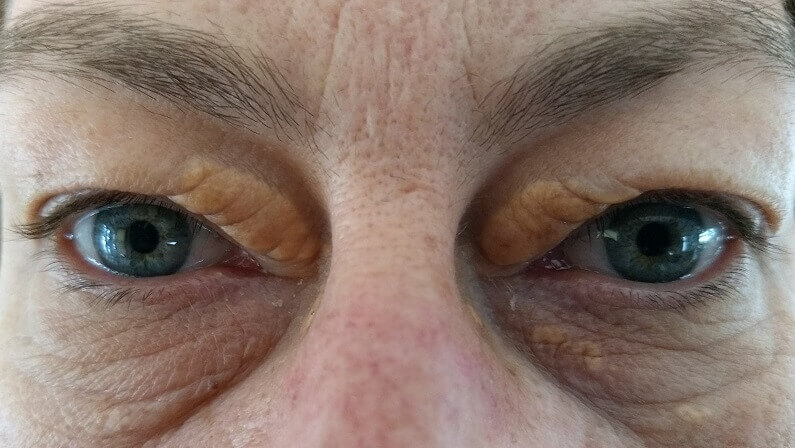
Which Xanthelasma Plaques Suit At-Home Removal?
Soft, flat or slightly raised plaques on the eyelids are generally the best fit for at-home removal. Very large, hard, deep or long-standing plaques, and any that are close to the lash line, are better discussed with a doctor first.
Clinicians judge plaques by depth, height, firmness and age: soft, superficial plaques under 5 mm high that have been there under a year suit the gentler methods, while deep, hard plaques of 5 mm or more, or those reaching the eyelid muscle, usually suit surgery.[2] It’s sensible to apply the same thinking at home.
Usually A Good Fit
- Soft, flat or slightly raised plaques
- Small to medium size
- On the upper or lower eyelid skin
- Diagnosis confirmed by a doctor
Talk To A Doctor First
- Very large, hard or thick plaques
- Plaques right at the lash line
- Plaques that bleed, crust or grow fast
- Any doubt about the diagnosis
Our guide on whether xanthelasma can be flat explains why thin, flat plaques are the simplest to deal with, and xanthelasma under the eyes covers the lower lids.
How Does The At-Home Removal Process Work, Step By Step?
You clean the area, protect the surrounding skin, apply the cream only to the plaque for the time stated in the guide, remove it, then let the area scab and heal. Always follow the product’s own instructions exactly.
Here’s how the process works with Xanthel®:
- Clean the area. Wash and dry the eyelid gently, with no makeup or creams on the skin.
- Protect the surrounding skin. Apply the supplied skin protector around the plaque so only the plaque is exposed.
- Apply to the plaque only. Put the cream on the plaque itself, keeping it well away from the eye and lash line.
- Wait the stated time. Follow the timing in the guide. A mild sensation while it works is normal.
- Remove it as directed. Take the product off at the recommended time.
- Let it heal. Over the next days the area scabs and then settles, over about one to two weeks.
It’s one application per plaque, with enough for a second on larger ones. Our guides on how to remove xanthelasma at home and xanthelasma removal at home go into more detail.
If your doctor has checked the cause and your plaques suit at-home removal, this is the cream we make for doing it yourself.

What Happens As The Area Heals?

The plaque forms a scab over the first few days, which then loosens and falls away by itself. Healing takes about one to two weeks, and the new skin may look pinker than the surrounding skin for a while before it settles.
Every person heals at their own pace, but this is the general pattern:
- The first day or two. The area may feel tender and look red or slightly swollen.
- The first week. A scab forms over the plaque. Leave it alone; it’s protecting the new skin underneath.
- Around the second week. The scab loosens and comes away naturally.
- The weeks after. The new skin can look pink or slightly different in tone at first, and gradually blends in.
Patience is the most important part of this stage. Picking a scab early is the most common reason for a less tidy result. If a larger plaque needs a second application, follow the guide on when to apply it.

How Should You Look After The Area Afterward?
Keep it clean, apply an antibacterial cream, protect it from the sun, and don’t pick, rub or cover it with makeup until it has fully healed.
- Keep it clean. Wash gently and pat dry; don’t scrub.
- Use an antibacterial cream. A thin layer helps keep the area clean while it heals.
- Protect it from the sun. New skin is sensitive to sunlight, so shade it with sunglasses and a hat, and use sun protection once healed.
- Hands off. Don’t pick the scab or rub your eyes.
- Skip makeup on the area. Wait until it has healed fully before applying anything.
Good aftercare is what turns a removal into a clean result, whatever method you use. Clinic methods carry their own risk of scarring and skin color change too,[1][3] and careful aftercare helps there as well.

What Mistakes Should You Avoid When Removing Xanthelasma At Home?
The big ones are skipping the skin protector, applying beyond the plaque, getting product near the eye, leaving it on longer than directed, and picking the scab.
- Rushing. Read the whole guide before you start, not during.
- Skipping the protector. The skin around the plaque should always be shielded.
- Going over the edges. Apply to the plaque only, not the healthy skin around it.
- Getting close to the eye. Keep well away from the lash line and the eye itself.
- Leaving it on too long. More time doesn’t mean a better result.
- Picking. Let the scab come away on its own.
- Mixing methods. Don’t add garlic, acids or other remedies before or after.

Why Don’t Natural Home Remedies Work On Xanthelasma?
Because none of them can reach the fat-filled cells deep in the eyelid skin, and some of the popular ones burn. Garlic and apple cider vinegar have both caused chemical burns and scarring on skin.
- Garlic. A systematic review of 39 reported garlic burn cases found mostly second-degree burns, with some scarring, especially on the face.[4]
- Apple cider vinegar. Used to remove skin spots at home, it has caused chemical burns with a risk of scarring and darkening.[5]
- Castor oil. We haven’t found any published evidence that it removes xanthelasma.
- Squeezing, cutting or burning. The fat is locked inside cells, so nothing comes out, and you risk infection and scarring beside your eye.
The eyelid has the thinnest skin on the body, so a burn there can leave a mark more noticeable than the plaque. Our guides on whether you can squeeze out xanthelasma and whether you can pop xanthelasma explain why those don’t work either.

Getting Rid Of Xanthelasma At Home Vs At A Clinic
| Option | Where | What The Evidence Shows | Main Downsides |
|---|---|---|---|
| Xanthel® removal cream | At home | Cosmetic cream applied only to the plaque; results vary | About one to two weeks of healing; cause needs a doctor’s check |
| CO2 laser | Clinic | Over 75% improvement in over 90% of patients | Skin color change; appointments and cost |
| Surgery | Clinic | Preferred for large, deep plaques | Stitches, scarring, eyelid position changes |
| Freezing | Clinic | Cleared nearly all of 100 cases | 26 of 100 came back; pale patches |
| Garlic, vinegar, oils | At home | No evidence of removal; burns reported | Burns, scarring, darkening |
Does Getting Rid Of Xanthelasma At Home Fix The Cause?
No. Removing the plaques is cosmetic. Any cholesterol, thyroid, liver or blood sugar problem behind them needs managing with your doctor, which also gives you the best chance of fewer new plaques.
About half of people with xanthelasma have a blood fat disorder, and diabetes, an underactive thyroid and some liver conditions can play a part too.[1] Managing those protects your heart and long-term health. It rarely makes existing plaques disappear, which is why removal is a separate step. Our guides to the causes of xanthelasma and whether xanthelasma indicates raised cholesterol explain more.

When Should You Stop And See A Doctor?
Stop and get medical advice if the area becomes increasingly painful, swollen, hot or oozing, if anything gets into your eye, if healing is clearly delayed, or if a plaque turns out to be hard, bleeding or fast-growing.
Normal While Healing
- Mild redness and tenderness at first
- A dry scab over the plaque
- Pinker new skin for a while
- Gradual improvement day by day
Get Medical Advice
- Spreading redness, heat or pus
- Product in the eye, or eye pain
- Pain that gets worse, not better
- A wound that isn’t healing
If product gets near your eye, rinse with plenty of clean water and seek medical help. For clinic options instead, see our guide on which doctor to see about xanthelasma.
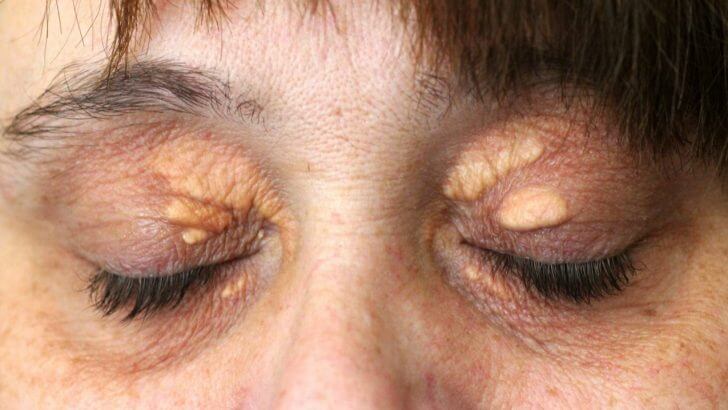
Will Xanthelasma Come Back After Removing It At Home?
It can, as with any removal method. Recurrence after removal is generally under 50%, and deeper plaques come back more often. Managing the underlying cause gives you the best chance of fewer new plaques.
Recurrence is generally reported at under 50%, higher after repeated procedures, and more common with deeper plaques.[1] New plaques can also appear in new spots if the cause continues. If one does, it can be dealt with in the same way. Our guide on whether xanthelasma comes back covers this in full.

Can You Cover Xanthelasma While You Decide?
Yes. A lavender or peach color corrector under a creamy concealer helps hide the yellow day to day, though it doesn’t remove anything, and it shouldn’t go on a healing area.
Pat a little corrector onto the plaque, let it set, then press a matching concealer over the top. It works best on flat plaques. Stop using makeup on the area once you start removal, until it has fully healed. Our guide on hiding xanthelasma with makeup goes step by step.
How Do You Get Rid Of Xanthelasma At Home? The Bottom Line

Use a removal cream made for xanthelasma, applied only to the plaque with the surrounding skin protected, then give it about one to two weeks to heal with good aftercare. Skip garlic, vinegar and picking, and have a cholesterol check first.
Done carefully, at-home removal saves clinic visits and procedures near your eye. Xanthel® is a cosmetic cream made for xanthelasma removal at home, sold by Xanthelasma.com. You’ll find it at the foot of this page, or read more about Xanthel® xanthelasma removal cream, our guide to xanthelasma cream, the full removal of xanthelasma comparison and all our xanthelasma guides.
Common Questions About Getting Rid Of Xanthelasma At Home
Can You Really Get Rid Of Xanthelasma At Home?
Yes, with a removal cream made specifically for xanthelasma. Ordinary skincare, oils and kitchen remedies can’t reach the fat-filled cells deep in the eyelid skin.
Does Garlic Get Rid Of Xanthelasma?
No. There’s no good evidence it removes xanthelasma, and garlic has caused second-degree burns and scarring on skin, which is a real risk on the thin eyelid.
Do Castor Oil Or Apple Cider Vinegar Work?
No. We haven’t found any evidence that castor oil removes xanthelasma, and apple cider vinegar has caused chemical burns on skin.
How Long Does It Take To Heal After At-Home Removal?
About one to two weeks. A scab forms over the first days and falls away by itself, and the new skin may look pinker for a while before it blends in.
How Many Applications Will I Need?
With Xanthel®, it’s one application per plaque, with enough for a second on larger ones. The guide explains when a second is needed.
Is It Safe To Remove Xanthelasma Myself?
With a purpose-made product, used exactly as directed with the surrounding skin protected, yes. Cutting, squeezing or using acids yourself risks infection, scarring and eye injury.
Will Xanthelasma Come Back After At-Home Removal?
It can, as with any method. Recurrence is generally under 50%, and managing any cholesterol or other underlying problem gives you the best chance of fewer new plaques.
Should I See A Doctor Before Removing Xanthelasma At Home?
Yes, once. A doctor can confirm it’s xanthelasma and check your cholesterol, thyroid, liver and blood sugar before you start.
Sources
- Blair K. Xanthelasma Palpebrarum. StatPearls, National Library of Medicine (NCBI Bookshelf), updated 2026.
- Nair PA, Singhal R. Xanthelasma palpebrarum: a brief review. Clinical, Cosmetic and Investigational Dermatology, 2017;11:1-5.
- Malekzadeh H, Ormseth B, Janis JE. A Practical Review of the Management of Xanthelasma Palpebrarum. Plastic and Reconstructive Surgery Global Open, 2023;11(5):e4982.
- Hitl M, Kladar N, Gavaric N, Srdenovic Conic B, Bozin B. Garlic burn injuries: a systematic review of reported cases. American Journal of Emergency Medicine, 2021.
- Feldstein S, Afshar M, Krakowski AC. Chemical Burn from Vinegar Following an Internet-based Protocol for Self-removal of Nevi. Journal of Clinical and Aesthetic Dermatology, 2015;8(6).