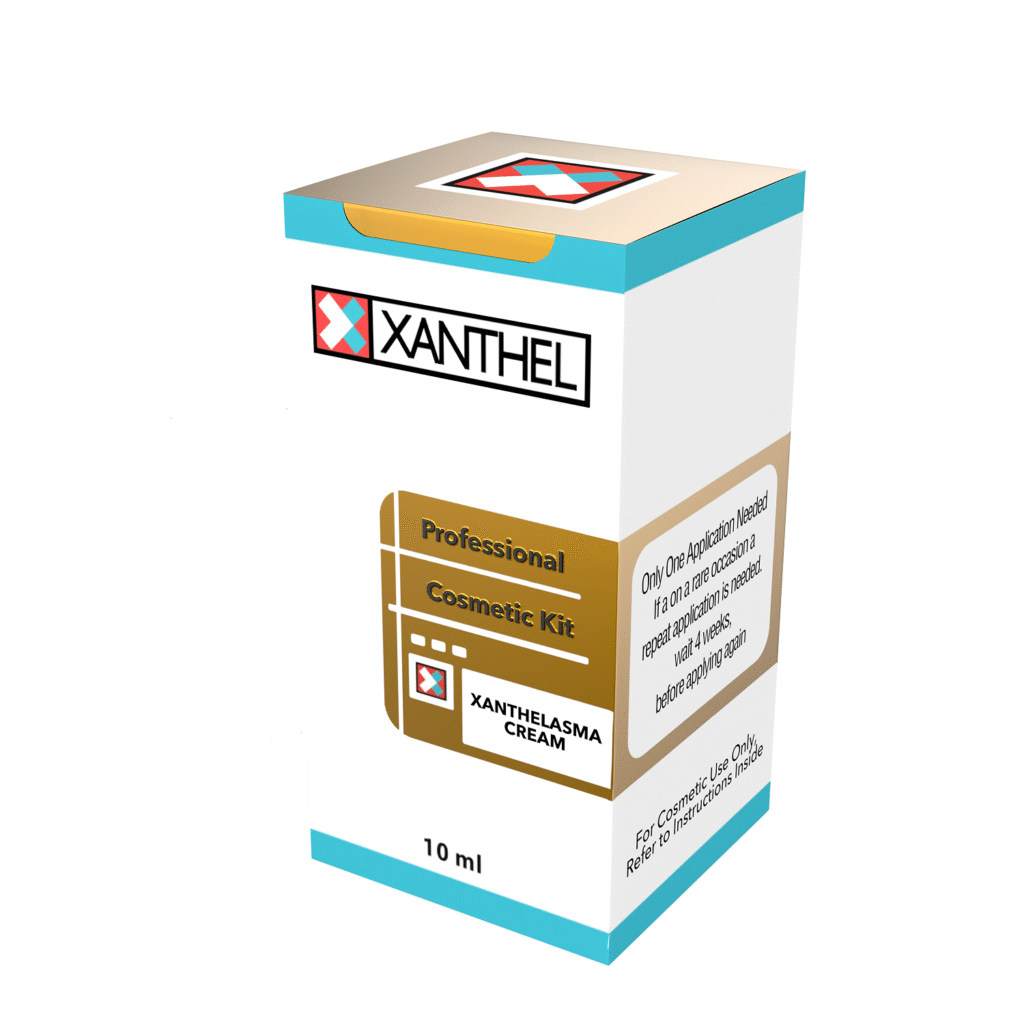
Yes. Xanthelasma does not usually fade on its own, but it can be removed. Clinic options such as surgery, laser, cryotherapy, radiofrequency, and electrosurgery all clear the visible plaque, and the least invasive route is at home with Xanthel ®, a cosmetic cream made for xanthelasma removal at home. No method changes the underlying cause, so pairing removal with a cholesterol check helps results last.
Removal is generally effective at clearing the visible marks, though results vary with the size and thickness of the plaque and the method used. For most people the at-home route with Xanthel ® is an effective first step that avoids the cost and downtime of a clinic. Larger or stubborn plaques may suit a clinic procedure. You can compare routes on our xanthelasma removal page.
It depends on the method. At home, you apply Xanthel ® to clean skin following the supplied guide, then follow the aftercare while the skin heals over one to two weeks. In a clinic, the plaque is cut, frozen, lasered, or treated with heat under local anaesthetic, with a recovery period afterwards. Our how xanthelasma is removed guide covers each.
A doctor or dermatologist can usually identify xanthelasma on sight from its soft, flat, yellow appearance near the inner eyelid, occasionally confirming with a small biopsy. A simple lipid blood test is often suggested to check for any underlying cause, since xanthelasma is made of cholesterol, though around half of people with it have normal cholesterol.
The choice depends on the size, thickness, number, and location of the plaques, your skin type, and your preference on cost, downtime, and scarring risk. Smaller, straightforward marks suit less invasive options; larger or thicker ones may need surgery. Many people start with the least invasive at-home route and keep a clinic option for stubborn marks.
There is no single best method, it depends on your marks, budget, and how much downtime you can accept. For most people the at-home route with Xanthel ® is the natural starting point, since it avoids the clinic, anaesthetic, cutting, and recovery of procedures. Larger or stubborn plaques may suit laser or surgery. See our treating xanthelasma comparison.
Weigh four things: the size of your marks, your budget, how much downtime you can accept, and how you feel about a scarring risk near the eye. Small marks and a preference for no clinic point to the at-home route; very large or thick marks may be better handled by a clinic. A doctor can confirm the marks are xanthelasma before you decide.
All methods aim to clear the plaque while sparing the surrounding skin. Cosmetic outcome depends more on plaque size, your skin, and aftercare than on the method name. The at-home route with Xanthel ® avoids cutting and freezing the delicate eyelid skin; with clinic methods, an experienced practitioner matters. Following aftercare closely supports the result whichever route you choose.
Whatever the method, the result is helped by following the instructions and aftercare closely, keeping the area clean, protecting it from the sun during healing, and not picking at any scab. Choosing a method suited to the size of your marks, and an experienced practitioner for clinic procedures, also helps. Patience through the one to two week healing period matters.
Because xanthelasma itself is harmless and does not threaten health or vision, removing it is usually about appearance rather than medical necessity. That is also why most insurers class removal as cosmetic and do not cover it. Wanting the marks gone for confidence reasons is a perfectly valid choice; it simply is not medically required.
There is no medical urgency, since the marks are harmless, so the best time is when it suits you, allowing for the one to two week healing period away from major events or strong sun exposure. Smaller, newer marks are often more straightforward to clear, so many people choose to deal with them early with xanthelasma removal at home rather than wait.
Most adults with confirmed xanthelasma who want the marks cleared are candidates for removal. Suitability depends on the method and your skin and health; certain conditions (for example pregnancy, keloid tendency, or recent use of particular skin treatments) mean some options are not advised. Always check the product guidance and, if unsure, your doctor.
Confirm the marks are xanthelasma first, have a simple cholesterol check, choose a method suited to their size, follow the instructions and aftercare carefully, protect the healing skin from the sun, and manage any underlying cause to reduce the chance of new marks. These steps give the best chance of a clean, lasting result.
Clearing the yellow plaques restores a more even appearance to the eyelid skin, which many people find improves their confidence. The marks do not affect vision, so this is a cosmetic improvement. Results are best judged after the skin has fully healed over the weeks following removal.
Yes. Xanthel ® is a cosmetic skincare cream made for xanthelasma removal at home: you apply it to the mark on clean skin following the supplied guide, including a patch test, then follow the aftercare while the skin heals over one to two weeks. It is the at-home route and avoids the clinic, anaesthetic, cutting, and downtime that procedures involve.
Laser removal uses a focused beam (commonly CO2 or erbium YAG) to vaporise the cholesterol deposit layer by layer while largely sparing the surrounding skin. It is done in a clinic, often over more than one session, with a healing period afterwards. The at-home alternative is Xanthel ®, which avoids the clinic and laser entirely.
In trained hands, laser removal of eyelid xanthelasma is widely used, with eye protection a standard part of the procedure. As with any method near the eye it carries some risk of redness, pigment change, or scarring, which is why an experienced practitioner matters. Discuss the risks with the clinic before going ahead.
Laser is applied to remove the visible deposit while limiting damage to the surrounding and underlying skin; the practitioner controls the depth to clear the plaque without going unnecessarily deep, which helps reduce scarring risk. Deeper or thicker plaques may need more than one session.
It varies with the size and thickness of the marks. Smaller plaques may clear in one session, while larger or deeper ones often need several. The clinic can give you an estimate after assessing your marks. By contrast, at-home removal with a purpose-made cream is usually a single application, with a second occasionally needed for larger marks.
Laser tends to suit people with well-defined eyelid xanthelasma who prefer a clinic procedure and can accept the cost, the possible need for repeat sessions, and a scarring or pigment-change risk. A practitioner assesses your skin and marks to confirm suitability. Those who prefer to avoid a clinic often choose the at-home route instead.
Redness and mild swelling are common immediately after laser treatment and usually settle over one to two weeks as the skin heals, though this varies between people and with the size of the area treated. Protecting the area from the sun and following aftercare supports healing. Your clinic can advise on your specific case.
Laser removal near the eye should be carried out by a suitably trained and experienced practitioner, such as a dermatologist or an appropriately qualified cosmetic doctor or oculoplastic specialist, working in a proper clinical setting with eye protection. Experience with the delicate eyelid area matters for both safety and cosmetic result.
Surgery cuts the plaque out and can be definitive for large marks but is the most invasive, with stitches and a scarring risk. Laser vaporises the deposit with precision and heals relatively quickly but often needs several sessions. Both involve cost, downtime, and a scarring risk near the eye. The least invasive alternative to either is Xanthel ® at home.
Surgical excision is usually a short procedure under local anaesthetic, often taking from a few minutes to around an hour depending on the number and size of the marks. The healing and recovery period afterwards is longer, and stitches may need to be removed. Your surgeon can give a timeline for your specific case.
Yes. Surgery is only one option. You can remove xanthelasma at home with Xanthel ®, or through non-surgical clinic procedures such as laser, cryotherapy, radiofrequency, or electrosurgery. The at-home route is the least invasive and avoids the cost and recovery of surgery, which is why many people choose it first. See getting rid of xanthelasma without surgery.
Non-surgical removal covers any method that clears the plaque without cutting it out: laser, cryotherapy, radiofrequency, and electrosurgery in a clinic, and at home with Xanthel ®, a cosmetic cream made for xanthelasma removal at home. The at-home route is the least invasive and most affordable, avoiding anaesthetic and stitches.
A TCA chemical peel applies a controlled acid in a clinic to remove the plaque, with less cutting than surgery but a risk of pigment change and the need for careful application near the eye. Surgery cuts the plaque out and is more definitive for large marks but more invasive. Both are clinic procedures; the at-home alternative is Xanthel ®.
Surgery is not the only option, which is good news if needles or operations worry you. Non-surgical clinic methods avoid cutting, and the at-home route with Xanthel ® avoids the clinic, the anaesthetic, and the needle entirely. For many people that makes the at-home cream the most comfortable starting point.
Cryotherapy, freezing the plaque with liquid nitrogen, is an established clinic method, but near the eye it carries a real risk of pigment change (lighter or darker patches), which can be more noticeable on some skin tones, and may need more than one session. It should be done by an experienced practitioner. Discuss the risks with the clinic first.
Cryotherapy near the eye should be carried out by a trained practitioner in a proper clinical setting, with care to protect the eye and the surrounding skin and to control how the freezing is applied. Aftercare, keeping the area clean and protected while it heals, is part of a safe result. Ask the clinic about their procedure and the risks.
In a clinic, a controlled amount of trichloroacetic acid is carefully applied to the plaque, where it removes the cholesterol-laden tissue so the skin can heal over. It must be applied precisely by a trained practitioner because of how close it is to the eye. This is a clinic procedure, not a DIY one. The at-home alternative is Xanthel ®.
A TCA peel can be effective when applied by a trained practitioner in a clinic, but the acid is potent and applied very close to the eye, so it carries a risk of irritation, pigment change, and scarring if not done correctly. It should never be attempted at home with an improvised acid. If you want an at-home route, use a product made for the purpose.
Any skin preparation for a clinic TCA peel should be guided entirely by the practitioner carrying it out, do not attempt to prepare or apply acid near your eye yourself, as the risk of burns and scarring is real. If you prefer an at-home option, the safe route is Xanthel ®, a cosmetic cream made for xanthelasma removal at home, used as directed.
There is no good evidence that natural or kitchen remedies clear xanthelasma, and several, applied so close to the eye, risk irritation, burns, and scarring. Managing cholesterol through diet and lifestyle is good for your health and may reduce new marks, but it rarely clears existing ones. For an at-home route that is made for the purpose, use Xanthel ® rather than an improvised remedy.
No. Garlic is often suggested online, but there is no good evidence it removes xanthelasma, and applying it to the thin skin near the eye can cause chemical burns, irritation, and scarring. It is a remedy to avoid. The safe at-home approach is Xanthel ®, a cosmetic cream made specifically for xanthelasma removal at home.
Genuine clearance of the plaque needs either a clinic procedure or a product made for the purpose; “natural” remedies such as garlic, castor oil, or apple cider vinegar lack evidence and are risky near the eye. The most accessible safe route is xanthelasma removal at home with Xanthel ®, used as directed, rather than an improvised remedy.
Removal is generally considered safe when done appropriately, but every method near the eye carries some risk. Clinic procedures can cause redness, pigment change, or scarring; the at-home route with Xanthel ® avoids cutting and freezing but still requires following the instructions, including a patch test, to use it safely. Check the contraindications before use.
Discomfort is usually limited. Clinic procedures are typically done under local anaesthetic, so pain during treatment is minimal, with some soreness, redness, or a short stinging sensation afterwards. The at-home route may involve a mild tingling on application, then healing over one to two weeks. Following aftercare keeps discomfort to a minimum.
The main risks, common to methods near the eye, are temporary redness and swelling, changes in skin pigment (lighter or darker patches), and a chance of scarring, particularly if instructions or aftercare are not followed. Recurrence is also possible if the underlying cause is unmanaged. Choosing a suitable method and following guidance reduces these risks.
Common short-term side effects include redness, mild swelling, tenderness, and scabbing as the skin heals, usually settling over one to two weeks. Less commonly, pigment changes or scarring can occur. Protecting the area from the sun, keeping it clean, and not picking at scabs all support healing. Report anything unusual to your provider.
So-called plasma or fibroblast “removal pens” used near the eye carry a real risk of burns, pigment change, and scarring, especially in untrained hands, and are not advisable for the delicate eyelid area. For an at-home route, a cosmetic product made specifically for xanthelasma, used as directed, is the safer choice: Xanthel ®.
No method near the eye is risk-free, but the least invasive options avoid cutting, freezing, and burning the delicate skin. The at-home route with Xanthel ®, used exactly as directed with a patch test, is many people’s choice for that reason. For clinic methods, safety depends heavily on an experienced practitioner.
Recovery varies by method. After at-home or less invasive clinic treatment, the skin typically heals over one to two weeks, passing through redness and scabbing before settling. Surgery may involve stitches and a longer recovery. Keeping the area clean, protected from the sun, and undisturbed supports healing whichever route you take.
For most less invasive methods, including the at-home route, the skin generally heals over one to two weeks, though full settling of redness or pigment can take longer. Surgical excision may take longer with stitches. Healing time depends on the size of the area treated and how closely aftercare is followed.
No method near the eye can promise scar-free results, but the risk is reduced by choosing a method suited to the size of the marks, using an experienced practitioner for clinic procedures, and following aftercare carefully. The at-home route avoids cutting and freezing, though following the guidance closely is still important to reduce the chance of marking.
Scarring risk rises with more invasive methods, larger or deeper plaques, and poor aftercare such as picking scabs or sun exposure during healing. It is minimised by choosing an appropriate method, following instructions and aftercare closely, keeping the area clean and sun-protected, and not disturbing the healing skin.
Follow the supplied instructions and aftercare exactly, keep the area clean, protect it from the sun, avoid picking any scab, and let it heal fully before judging the result. For clinic procedures, an experienced practitioner and a method suited to your marks help. Good aftercare is the single biggest factor you control.
People prone to keloid scarring are at higher risk of raised scars from any procedure that breaks the skin, which is why a keloid tendency is a reason to be cautious and to take medical advice before clinic removal. If you are keloid-prone, tell your practitioner, and note that products with a keloid contraindication should not be used.
Temporary pigment change, lighter or darker than surrounding skin, is a recognised effect of healing after removal near the eye, and is more likely on some skin tones or after sun exposure during healing. It often fades over weeks to months. If it persists or concerns you, see the practitioner who carried out the removal, or your doctor.
During healing, a gentle, fragrance-free moisturiser and a broad-spectrum sunscreen on the area (once any open skin has closed) support recovery and reduce the chance of pigment change, follow the specific aftercare you were given. Avoid harsh actives like acids or retinoids on the area while it heals. Ask your provider before applying anything if unsure.
It is best to avoid makeup directly over the area until the skin has closed and the scab, if any, has resolved, to reduce the risk of irritation or infection. Once healed, makeup can usually be worn again. Follow the aftercare timeline you were given, and reintroduce products gently.
No food removes or prevents xanthelasma, but a generally healthy, balanced diet supports skin healing as it would for any minor wound, alongside staying hydrated and not smoking. Because xanthelasma relates to cholesterol, a heart-healthy diet is worthwhile for your wider health and may help reduce new marks over time.
New xanthelasma tends to reappear as the familiar soft yellow plaque, while scar tissue is usually paler, firmer, or textured rather than yellow. It can be hard to tell them apart yourself, so if you are unsure whether a change at the site is a returning mark or healing scar tissue, a doctor or dermatologist can confirm on sight.
Many marks settle on their own over months with sun protection and gentle skincare. Persistent scars or pigment changes can be assessed by a dermatologist, who may suggest options to improve their appearance. Avoid self-treating the area with harsh products. If a scar concerns you, seek professional advice rather than experimenting.
In broad terms, more invasive methods that cut, freeze, or burn the skin carry a higher scarring or pigment-change risk, and risk also rises with larger or deeper plaques and with poor aftercare. The at-home route with Xanthel ® avoids cutting and freezing; with any method, an experienced hand and good aftercare reduce the risk.
Because removal clears the visible plaque but does not change the underlying tendency that formed it, raised lipids, a genetic predisposition, or factors like thyroid problems. Where that continues, new marks can form. This is true of every method. Pairing removal with a cholesterol check and healthy habits reduces the chance; any new marks can be treated again, including with Xanthel ®.
Cost varies widely by method and country. Clinic procedures such as laser, surgery, and cryotherapy can be expensive, often need more than one session, and are usually not covered by insurance because removal is cosmetic. The at-home route with Xanthel ® is generally the more affordable option, with free worldwide delivery. See our cost of removal guide.
It can be, if you choose a clinic procedure: laser, surgery, and similar methods carry clinic fees, often across several sessions, and are rarely covered by insurance. The at-home route with Xanthel ® is the more affordable alternative, which is part of why many people start there.
Laser removal is typically priced per session, and because more than one session is often needed, the total can be substantial; exact prices vary by clinic and country. As it is cosmetic, insurance usually does not cover it. It is worth asking the clinic for the full cost including likely repeat sessions before committing.
Surgical excision is usually priced as a procedure and can be one of the more expensive options, particularly with an experienced surgeon for the eyelid area, and it is rarely covered by insurance since it is cosmetic. Ask for a full quote including any follow-up. The at-home route is the more affordable alternative for suitable marks.
A clinic TCA peel is generally less costly than surgery or laser per session but may still need repeating, and prices vary by clinic and country; as a cosmetic procedure it is usually not covered by insurance. For an at-home option without clinic fees, Xanthel ® offers xanthelasma removal at home with free worldwide delivery.
Usually not. Because xanthelasma is harmless and removal is considered cosmetic, most insurers do not cover it. There can be exceptions if a plaque is large enough to affect eyelid function, but this is uncommon. It is worth checking your policy and asking your insurer directly before assuming either way.
Most people pay out of pocket, since removal is cosmetic. Clinic procedures can be costly when paid privately, especially across repeat sessions. The most affordable route for suitable marks is usually xanthelasma removal at home with Xanthel ®, which avoids clinic and anaesthetic fees and includes free worldwide delivery.
In broad terms, surgery and laser tend to be the most expensive (clinic fees plus possible repeat sessions), cryotherapy and TCA peels vary, and the at-home route with Xanthel ® is generally the most affordable, with no clinic fees and free worldwide delivery. Exact figures depend on the clinic and country.
Kitchen remedies look cheap but do not reliably work and risk irritation or scarring near the eye, so any apparent saving is false economy. The genuinely affordable safe route is a product made for the purpose: Xanthel ®, a cosmetic cream for xanthelasma removal at home, which costs far less than clinic procedures.
Clinic removal offers in-person assessment and is suited to large or complex marks, at a higher cost and with downtime. At-home removal with Xanthel ® offers convenience, no clinic visit, and lower cost for suitable marks. The right value choice depends on the size of your marks, your budget, and your preference on downtime and clinic involvement.
Weigh the cost of each route against how much the marks bother you, the downtime you can accept, and the scarring risk. For many people the at-home route with Xanthel ® offers the best balance of low cost, no downtime, and least invasiveness for suitable marks, with clinic procedures reserved for large or stubborn cases.
If clinic costs are a barrier, the at-home route is the most budget-friendly way to remove suitable xanthelasma: Xanthel ® is a cosmetic cream for xanthelasma removal at home with free worldwide delivery, avoiding clinic, anaesthetic, and repeat-session fees. For large or complex marks that need a clinic, ask about pricing and any payment options.